Yanchun Zhao , Chunxiao Luo , Jiaying Zhang , Xingkai Zhang , Fuguo Wang , Changning Bai
{"title":"A strategy of hexagonal boron nitride endowing lubricant oil with steady superlubricity","authors":"Yanchun Zhao , Chunxiao Luo , Jiaying Zhang , Xingkai Zhang , Fuguo Wang , Changning Bai","doi":"10.1016/j.apsusc.2025.163060","DOIUrl":null,"url":null,"abstract":"<div><div>Friction remains the main focus in moving mechanical assemblies as it is directly related to energy consumption, component failures, and operational stability. The use of lubricant oil is a long-term mitigation strategy, but achieving superlubricity still poses challenges. In this study, hexagonal boron nitride nanosheets (<em>h</em>-BNNS)/ chitosan (CS) composite films are successively prepared by ball milling and solution casting methods, then paired with oil medium to achieve superlubricity. The approach enables thin-film uniformity, steady superlubricity, eliminating the difficulty of uniform and stable dispersion of additives. The insertion of long chain CS polymers into the interlayers of hexagonal boron nitride (<em>h</em>-BN) can effectively promote the thinning of bulk <em>h</em>-BN during ball milling process, undoubtedly enhancing the quality of the film. The <em>h</em>-BNNS@CS composite film can act as a physical barrier layer for corrosive media, showing excellent protective capabilities. For <em>h</em>-BNNS@CS composite film paired with glycerol, macroscale superlubricity with the friction coefficient of 0.004 is observed, and a long sliding distance without performance deterioration is maintained. Comparative analyses corroborated that CS could induce glycerol to accumulate near the friction surfaces to form easy-to-shear layers, and <em>h</em>-BNNSs play a role in improving the load-bearing capacity of the nanofluids.</div></div>","PeriodicalId":247,"journal":{"name":"Applied Surface Science","volume":"697 ","pages":"Article 163060"},"PeriodicalIF":6.9000,"publicationDate":"2025-03-22","publicationTypes":"Journal Article","fieldsOfStudy":null,"isOpenAccess":false,"openAccessPdf":"","citationCount":"0","resultStr":null,"platform":"Semanticscholar","paperid":null,"PeriodicalName":"Applied Surface Science","FirstCategoryId":"88","ListUrlMain":"https://www.sciencedirect.com/science/article/pii/S0169433225007743","RegionNum":2,"RegionCategory":"材料科学","ArticlePicture":[],"TitleCN":null,"AbstractTextCN":null,"PMCID":null,"EPubDate":"","PubModel":"","JCR":"Q2","JCRName":"CHEMISTRY, PHYSICAL","Score":null,"Total":0}
引用次数: 0
Abstract
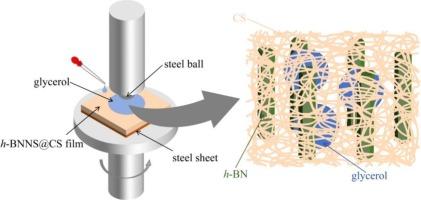
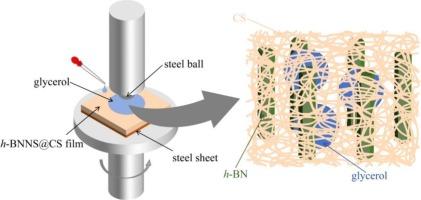
Friction remains the main focus in moving mechanical assemblies as it is directly related to energy consumption, component failures, and operational stability. The use of lubricant oil is a long-term mitigation strategy, but achieving superlubricity still poses challenges. In this study, hexagonal boron nitride nanosheets (h-BNNS)/ chitosan (CS) composite films are successively prepared by ball milling and solution casting methods, then paired with oil medium to achieve superlubricity. The approach enables thin-film uniformity, steady superlubricity, eliminating the difficulty of uniform and stable dispersion of additives. The insertion of long chain CS polymers into the interlayers of hexagonal boron nitride (h-BN) can effectively promote the thinning of bulk h-BN during ball milling process, undoubtedly enhancing the quality of the film. The h-BNNS@CS composite film can act as a physical barrier layer for corrosive media, showing excellent protective capabilities. For h-BNNS@CS composite film paired with glycerol, macroscale superlubricity with the friction coefficient of 0.004 is observed, and a long sliding distance without performance deterioration is maintained. Comparative analyses corroborated that CS could induce glycerol to accumulate near the friction surfaces to form easy-to-shear layers, and h-BNNSs play a role in improving the load-bearing capacity of the nanofluids.
期刊介绍:
Applied Surface Science covers topics contributing to a better understanding of surfaces, interfaces, nanostructures and their applications. The journal is concerned with scientific research on the atomic and molecular level of material properties determined with specific surface analytical techniques and/or computational methods, as well as the processing of such structures.



 京公网安备 11010802042870号
京ICP备2023020795号-1
京公网安备 11010802042870号
京ICP备2023020795号-1

 分享
分享
 求助内容:
求助内容: 应助结果提醒方式:
 扫码关注我们
