Xiaoxing Yang , Cunlong Zhou , Tianxiang Wang , Jingwei Zhao
{"title":"Construction and electrochemical corrosion behavior of carbon-based thin films on SS316L bipolar plates by magnetron sputtering","authors":"Xiaoxing Yang , Cunlong Zhou , Tianxiang Wang , Jingwei Zhao","doi":"10.1016/j.apsusc.2025.163055","DOIUrl":null,"url":null,"abstract":"<div><div>The gradually increasing performance requirements of hydrogen fuel cells have posed a great challenge to the conductivity performance of bipolar plates (BPs). In this paper, the SS316L BP with a thickness of 100 μm is taken as the research object, a carbon-based thin film is plated on both surfaces by a magnetron sputtering ion plating system. The electrochemical corrosion behavior and microscopic characterization show that Cr-adopted carbon-based thin film is chemically bonded with the critical surface of the substrate, which can enhance the interfacial bonding force between the thin film and the substrate and form a more stable interfacial structure. The C element in the film structure inhibits the columnar structure of Cr atoms and their nitrides in the high-energy bonding layer, delays the pitting rate of corrosive media, and makes the initial corrosion current density of the surface-modified SS316L BP less than 10<sup>−5</sup>A/cm<sup>2</sup> (meet DoE(Department of Energy) 2025 requirement). This study clarifies the corrosion mechanism of stainless steel bipolar plate coatings under high-temperature and strong acidic conditions and provides a theoretical basis for the preparation of a novel type of highly corrosion-resistant multilayer carbon-based film.</div></div>","PeriodicalId":247,"journal":{"name":"Applied Surface Science","volume":"698 ","pages":"Article 163055"},"PeriodicalIF":6.9000,"publicationDate":"2025-03-22","publicationTypes":"Journal Article","fieldsOfStudy":null,"isOpenAccess":false,"openAccessPdf":"","citationCount":"0","resultStr":null,"platform":"Semanticscholar","paperid":null,"PeriodicalName":"Applied Surface Science","FirstCategoryId":"88","ListUrlMain":"https://www.sciencedirect.com/science/article/pii/S016943322500769X","RegionNum":2,"RegionCategory":"材料科学","ArticlePicture":[],"TitleCN":null,"AbstractTextCN":null,"PMCID":null,"EPubDate":"","PubModel":"","JCR":"Q2","JCRName":"CHEMISTRY, PHYSICAL","Score":null,"Total":0}
引用次数: 0
Abstract
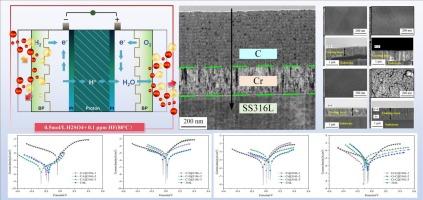
The gradually increasing performance requirements of hydrogen fuel cells have posed a great challenge to the conductivity performance of bipolar plates (BPs). In this paper, the SS316L BP with a thickness of 100 μm is taken as the research object, a carbon-based thin film is plated on both surfaces by a magnetron sputtering ion plating system. The electrochemical corrosion behavior and microscopic characterization show that Cr-adopted carbon-based thin film is chemically bonded with the critical surface of the substrate, which can enhance the interfacial bonding force between the thin film and the substrate and form a more stable interfacial structure. The C element in the film structure inhibits the columnar structure of Cr atoms and their nitrides in the high-energy bonding layer, delays the pitting rate of corrosive media, and makes the initial corrosion current density of the surface-modified SS316L BP less than 10−5A/cm2 (meet DoE(Department of Energy) 2025 requirement). This study clarifies the corrosion mechanism of stainless steel bipolar plate coatings under high-temperature and strong acidic conditions and provides a theoretical basis for the preparation of a novel type of highly corrosion-resistant multilayer carbon-based film.
期刊介绍:
Applied Surface Science covers topics contributing to a better understanding of surfaces, interfaces, nanostructures and their applications. The journal is concerned with scientific research on the atomic and molecular level of material properties determined with specific surface analytical techniques and/or computational methods, as well as the processing of such structures.




 京公网安备 11010802042870号
京ICP备2023020795号-1
京公网安备 11010802042870号
京ICP备2023020795号-1

 分享
分享
 求助内容:
求助内容: 应助结果提醒方式:
 扫码关注我们
