Xiaoling Men, Fei Qin, Bo Zhang, Kangkang Yao, Yin Zhang, Yangtao Zhou, Qifeng Kuang, Xiaolei Shang, Ruiqi Huang, Zhiwei Li, Sen Yang, Gang Liu, Teng Yang, Da Li, Zhidong Zhang
{"title":"Two-dimensional hybrid nanosheets towards room-temperature organic ferrimagnetic semiconductor","authors":"Xiaoling Men, Fei Qin, Bo Zhang, Kangkang Yao, Yin Zhang, Yangtao Zhou, Qifeng Kuang, Xiaolei Shang, Ruiqi Huang, Zhiwei Li, Sen Yang, Gang Liu, Teng Yang, Da Li, Zhidong Zhang","doi":"10.1016/j.jmst.2025.02.031","DOIUrl":null,"url":null,"abstract":"Organic magnetic semiconductors have aroused much attention for spintronic applications. However, it remains challenging to achieve organic semiconductors with strong room-temperature ferromagnetism. Here, we report a two-dimensional (2D) tetragonal organic-inorganic ferrimagnetic (FIM) semiconductor of Fe<sub>14</sub>Se<sub>16</sub>(peha)<sub>0.7</sub> (peha = pentaethylenehexamine) with excellent thermal stability and a Curie temperature (<em>T</em><sub>C</sub>) higher than 519 K. Magnetic and Mössbauer measurements reveal a long-range magnetic ordering in single crystalline Fe<sub>14</sub>Se<sub>16</sub>(peha)<sub>0.7</sub> nanosheets. The saturation magnetization and coercivity are 5.9 emu g<sup>−1</sup> and 0.42 kOe at 5 K, which slightly reduces to 4.6 emu g<sup>−1</sup> and ∼0 Oe at 300 K. A direct optical bandgap of 2.22 eV is obtained by tuning electronic structure of <em>β</em>-Fe<sub>3</sub>Se<sub>4</sub> host layers through spacer layers consisting of Fe<sup>3+</sup> and peha. Electrical and Seebeck coefficient data indicate that the n-type semiconductor follows the thermally-activated conduction mechanism (ln<em>ρ</em> <span><span style=\"\"><math><mo is=\"true\">∝</mo></math></span><span style=\"font-size: 90%; display: inline-block;\" tabindex=\"0\"></span><script type=\"math/mml\"><math><mo is=\"true\">∝</mo></math></script></span> <em>T</em><sup>−1</sup>) in a range of 130–300 K with an activation energy (<em>E</em><sub>a</sub>) of 62.69 meV. Thermal conductivity is 2.5 W m<sup>−1</sup> K<sup>−1</sup> at 300 K, while the Wiedemann-Franz law is strongly violated according to electrical-thermal transport data due to weak incorporation of organic spacer layers and host layers. This study sets the stage for exploiting new room-temperature organic magnetic semiconductor systems for spintronic materials.","PeriodicalId":16154,"journal":{"name":"Journal of Materials Science & Technology","volume":"183 1","pages":""},"PeriodicalIF":14.3000,"publicationDate":"2025-03-22","publicationTypes":"Journal Article","fieldsOfStudy":null,"isOpenAccess":false,"openAccessPdf":"","citationCount":"0","resultStr":null,"platform":"Semanticscholar","paperid":null,"PeriodicalName":"Journal of Materials Science & Technology","FirstCategoryId":"88","ListUrlMain":"https://doi.org/10.1016/j.jmst.2025.02.031","RegionNum":1,"RegionCategory":"材料科学","ArticlePicture":[],"TitleCN":null,"AbstractTextCN":null,"PMCID":null,"EPubDate":"","PubModel":"","JCR":"Q1","JCRName":"MATERIALS SCIENCE, MULTIDISCIPLINARY","Score":null,"Total":0}
引用次数: 0
Abstract
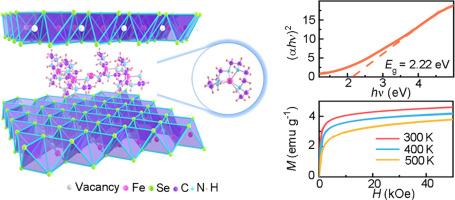
Organic magnetic semiconductors have aroused much attention for spintronic applications. However, it remains challenging to achieve organic semiconductors with strong room-temperature ferromagnetism. Here, we report a two-dimensional (2D) tetragonal organic-inorganic ferrimagnetic (FIM) semiconductor of Fe14Se16(peha)0.7 (peha = pentaethylenehexamine) with excellent thermal stability and a Curie temperature (TC) higher than 519 K. Magnetic and Mössbauer measurements reveal a long-range magnetic ordering in single crystalline Fe14Se16(peha)0.7 nanosheets. The saturation magnetization and coercivity are 5.9 emu g−1 and 0.42 kOe at 5 K, which slightly reduces to 4.6 emu g−1 and ∼0 Oe at 300 K. A direct optical bandgap of 2.22 eV is obtained by tuning electronic structure of β-Fe3Se4 host layers through spacer layers consisting of Fe3+ and peha. Electrical and Seebeck coefficient data indicate that the n-type semiconductor follows the thermally-activated conduction mechanism (lnρT−1) in a range of 130–300 K with an activation energy (Ea) of 62.69 meV. Thermal conductivity is 2.5 W m−1 K−1 at 300 K, while the Wiedemann-Franz law is strongly violated according to electrical-thermal transport data due to weak incorporation of organic spacer layers and host layers. This study sets the stage for exploiting new room-temperature organic magnetic semiconductor systems for spintronic materials.
期刊介绍:
Journal of Materials Science & Technology strives to promote global collaboration in the field of materials science and technology. It primarily publishes original research papers, invited review articles, letters, research notes, and summaries of scientific achievements. The journal covers a wide range of materials science and technology topics, including metallic materials, inorganic nonmetallic materials, and composite materials.



 京公网安备 11010802042870号
京ICP备2023020795号-1
京公网安备 11010802042870号
京ICP备2023020795号-1

 分享
分享
 求助内容:
求助内容: 应助结果提醒方式:
 扫码关注我们
