{"title":"CuO doping SiO2 for enhancing electron transfer to product C2H4 in electrocatalytic CO2 reduction","authors":"Xu Ji , Weicong Xu , Chao Liu , Xing Wang","doi":"10.1016/j.electacta.2025.146090","DOIUrl":null,"url":null,"abstract":"<div><div>The electrocatalytic CO₂ reduction reaction (CO₂RR) offers a promising pathway for carbon cycling and high-value fuel synthesis. However, the efficient production of ethylene (C₂H₄), a critical multicarbon product, remains constrained by insufficient catalyst activity and selectivity. Although copper-based materials enable C–C coupling, conventional CuO catalysts suffer from imbalanced *CO intermediate adsorption strength and sluggish charge transfer kinetics.In this study, a silica (SiO₂) doping strategy was employed to synergistically modulate the electronic structure and surface active site distribution of CuO, significantly enhancing CO₂-to-C₂H₄ conversion efficiency. Experimental results demonstrate that SiO₂ incorporation induces local electronic density rearrangement around Cu²⁺, stabilizing *CO adsorption, while the constructed Cu-O-Si interfaces accelerate charge transfer, enhances electron transfer and reduce the energy barrier for *COCHO formation. The optimized SiO₂-10 %/CuO catalyst achieves a C₂H₄ Faraday efficiency of 42 % and a partial current density of 6.3 mA/cm² at −1.4 V (vs. RHE), representing a threefold improvement over pristine CuO. Notably, the catalyst exhibits exceptional stability over 4 hours.Structural characterization and theoretical calculations reveal that SiO₂ doping promotes the self-assembly of CuO nanosheets into flower-like architectures with a high specific surface area and exposes synergistic (111)/(002) facets, which collectively enhance *CO intermediate enrichment and directional coupling. This work provides novel insights into designing high-performance CO₂RR catalysts through multidimensional modulation strategies.</div></div>","PeriodicalId":305,"journal":{"name":"Electrochimica Acta","volume":"525 ","pages":"Article 146090"},"PeriodicalIF":5.6000,"publicationDate":"2025-06-10","publicationTypes":"Journal Article","fieldsOfStudy":null,"isOpenAccess":false,"openAccessPdf":"","citationCount":"0","resultStr":null,"platform":"Semanticscholar","paperid":null,"PeriodicalName":"Electrochimica Acta","FirstCategoryId":"88","ListUrlMain":"https://www.sciencedirect.com/science/article/pii/S0013468625004529","RegionNum":3,"RegionCategory":"材料科学","ArticlePicture":[],"TitleCN":null,"AbstractTextCN":null,"PMCID":null,"EPubDate":"2025/3/22 0:00:00","PubModel":"Epub","JCR":"Q1","JCRName":"ELECTROCHEMISTRY","Score":null,"Total":0}
引用次数: 0
Abstract
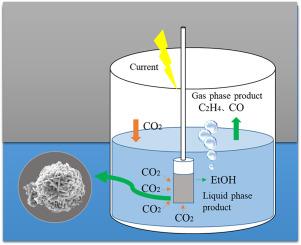
The electrocatalytic CO₂ reduction reaction (CO₂RR) offers a promising pathway for carbon cycling and high-value fuel synthesis. However, the efficient production of ethylene (C₂H₄), a critical multicarbon product, remains constrained by insufficient catalyst activity and selectivity. Although copper-based materials enable C–C coupling, conventional CuO catalysts suffer from imbalanced *CO intermediate adsorption strength and sluggish charge transfer kinetics.In this study, a silica (SiO₂) doping strategy was employed to synergistically modulate the electronic structure and surface active site distribution of CuO, significantly enhancing CO₂-to-C₂H₄ conversion efficiency. Experimental results demonstrate that SiO₂ incorporation induces local electronic density rearrangement around Cu²⁺, stabilizing *CO adsorption, while the constructed Cu-O-Si interfaces accelerate charge transfer, enhances electron transfer and reduce the energy barrier for *COCHO formation. The optimized SiO₂-10 %/CuO catalyst achieves a C₂H₄ Faraday efficiency of 42 % and a partial current density of 6.3 mA/cm² at −1.4 V (vs. RHE), representing a threefold improvement over pristine CuO. Notably, the catalyst exhibits exceptional stability over 4 hours.Structural characterization and theoretical calculations reveal that SiO₂ doping promotes the self-assembly of CuO nanosheets into flower-like architectures with a high specific surface area and exposes synergistic (111)/(002) facets, which collectively enhance *CO intermediate enrichment and directional coupling. This work provides novel insights into designing high-performance CO₂RR catalysts through multidimensional modulation strategies.
期刊介绍:
Electrochimica Acta is an international journal. It is intended for the publication of both original work and reviews in the field of electrochemistry. Electrochemistry should be interpreted to mean any of the research fields covered by the Divisions of the International Society of Electrochemistry listed below, as well as emerging scientific domains covered by ISE New Topics Committee.




 京公网安备 11010802042870号
京ICP备2023020795号-1
京公网安备 11010802042870号
京ICP备2023020795号-1

 分享
分享
 求助内容:
求助内容: 应助结果提醒方式:
 扫码关注我们
