{"title":"A multi-method framework integrating ANP-ANN and PROMETHEE-GAIA for Circular Economy performance assessment: A case study of China","authors":"Cheng Longsheng , Syed Ahsan Ali Shah","doi":"10.1016/j.jclepro.2025.145311","DOIUrl":null,"url":null,"abstract":"<div><div>This study evaluates the performance of Circular Economy (CE) initiatives across Chinese provinces using a hybrid multi-criteria decision analysis framework that integrates Analytic Network Process (ANP), Artificial Neural Networks (ANN), and Preference Ranking Organization Method for Enrichment of Evaluations-Geometrical Analysis for Interactive Assistance (PROMETHEE-GAIA), alongside Geographic Information Systems (GIS) for spatial analysis. Key dimensions—environmental, economic, regulatory, and social—are analyzed, revealing significant provincial variations. Specifically, provinces such as Guangdong and Fujian lead in CE implementation due to strong policy enforcement, substantial infrastructure investments, and high public awareness, while inland regions, including Henan and Hunan, fall behind due to weaker regulatory frameworks and lower investment levels. Analysis shows that environmental performance and economic impact are the most critical factors driving success. These results offer novel insights for policymakers and businesses, emphasizing the necessity for targeted interventions, such as enhanced regulatory frameworks and increased infrastructure funding, to promote balanced CE development across regions. Furthermore, the spatial analysis using GIS provides a critical tool for identifying the specific areas where policy and investment efforts should be concentrated, thus driving more equitable and efficient CE implementation nationwide.</div></div>","PeriodicalId":349,"journal":{"name":"Journal of Cleaner Production","volume":"501 ","pages":"Article 145311"},"PeriodicalIF":10.0000,"publicationDate":"2025-03-22","publicationTypes":"Journal Article","fieldsOfStudy":null,"isOpenAccess":false,"openAccessPdf":"","citationCount":"0","resultStr":null,"platform":"Semanticscholar","paperid":null,"PeriodicalName":"Journal of Cleaner Production","FirstCategoryId":"93","ListUrlMain":"https://www.sciencedirect.com/science/article/pii/S0959652625006614","RegionNum":1,"RegionCategory":"环境科学与生态学","ArticlePicture":[],"TitleCN":null,"AbstractTextCN":null,"PMCID":null,"EPubDate":"","PubModel":"","JCR":"Q1","JCRName":"ENGINEERING, ENVIRONMENTAL","Score":null,"Total":0}
引用次数: 0
Abstract
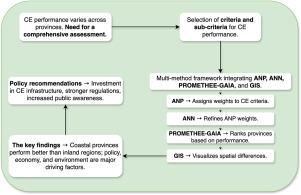
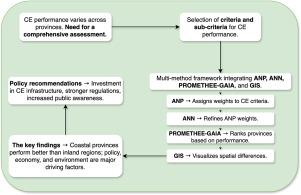
This study evaluates the performance of Circular Economy (CE) initiatives across Chinese provinces using a hybrid multi-criteria decision analysis framework that integrates Analytic Network Process (ANP), Artificial Neural Networks (ANN), and Preference Ranking Organization Method for Enrichment of Evaluations-Geometrical Analysis for Interactive Assistance (PROMETHEE-GAIA), alongside Geographic Information Systems (GIS) for spatial analysis. Key dimensions—environmental, economic, regulatory, and social—are analyzed, revealing significant provincial variations. Specifically, provinces such as Guangdong and Fujian lead in CE implementation due to strong policy enforcement, substantial infrastructure investments, and high public awareness, while inland regions, including Henan and Hunan, fall behind due to weaker regulatory frameworks and lower investment levels. Analysis shows that environmental performance and economic impact are the most critical factors driving success. These results offer novel insights for policymakers and businesses, emphasizing the necessity for targeted interventions, such as enhanced regulatory frameworks and increased infrastructure funding, to promote balanced CE development across regions. Furthermore, the spatial analysis using GIS provides a critical tool for identifying the specific areas where policy and investment efforts should be concentrated, thus driving more equitable and efficient CE implementation nationwide.
期刊介绍:
The Journal of Cleaner Production is an international, transdisciplinary journal that addresses and discusses theoretical and practical Cleaner Production, Environmental, and Sustainability issues. It aims to help societies become more sustainable by focusing on the concept of 'Cleaner Production', which aims at preventing waste production and increasing efficiencies in energy, water, resources, and human capital use. The journal serves as a platform for corporations, governments, education institutions, regions, and societies to engage in discussions and research related to Cleaner Production, environmental, and sustainability practices.



 京公网安备 11010802042870号
京ICP备2023020795号-1
京公网安备 11010802042870号
京ICP备2023020795号-1

 分享
分享
 求助内容:
求助内容: 应助结果提醒方式:
 扫码关注我们
