Intensified plant-scale post-combustion CO2 capture based on piperazine-activated methyldiethanolamine solution via cascaded stationary and rotating packed beds
Fanxiang Gao , Yang Liu , Binjiang Zhai , Jinwen Shi , Jianhong Wu , Lei Li , Shijian Lu , Yunsong Yu , Maochang Liu , Dengwei Jing
{"title":"Intensified plant-scale post-combustion CO2 capture based on piperazine-activated methyldiethanolamine solution via cascaded stationary and rotating packed beds","authors":"Fanxiang Gao , Yang Liu , Binjiang Zhai , Jinwen Shi , Jianhong Wu , Lei Li , Shijian Lu , Yunsong Yu , Maochang Liu , Dengwei Jing","doi":"10.1016/j.jclepro.2025.145359","DOIUrl":null,"url":null,"abstract":"<div><div>Solvent-based post-combustion carbon capture (PCC) with packed beds (PBs) suffers from high energy consumption and large space occupation in the commercialization process. Benefiting from the strong separation efficiency, compact design and wide solvent adaptability of rotating packed beds (RPBs), replacing PBs with RPBs and integrating them with energy-saving solvents is a potential solution to enable complete commercialization of PCC. Nonetheless, the size constraints and economic uncertainties associated with RPBs remain key challenges hindering their large-scale implementation. Using RPBs in series/parallel or with PBs promises a balance between space savings and cost reduction, but this trade-off advantage has not yet been quantified. Therefore, this work provides a detailed energetic and economic analysis of a cascade combination of PB and RPB for industrial-scale PCC using methyldiethanolamine + piperazine (MDEA + PZ) aqueous solution. Rate-based models for PB and RPB were first developed and validated in Aspen Plus®, where the new correlations required for high gravity characteristics in RPB were written into Visual Fortran sub-routines and linked to Aspen Plus®. Three different absorption configurations (single PB, single RPB, or cascade of the two) were then proposed and implemented in Aspen Plus® for the PCC process with a practical-scale application targeting 10000 m<sup>3</sup>/h flue gas. The results show that using a cascade combination of PB and RPB to replace a single RPB can reduce the total specific capture energy from 5.19 GJ/tCO<sub>2</sub> to 4.30 GJ/tCO<sub>2</sub>, and save up to 44.58 % of the capture cost over an electricity price range of $0.1–0.5/kWh.</div></div>","PeriodicalId":349,"journal":{"name":"Journal of Cleaner Production","volume":"504 ","pages":"Article 145359"},"PeriodicalIF":10.0000,"publicationDate":"2025-05-01","publicationTypes":"Journal Article","fieldsOfStudy":null,"isOpenAccess":false,"openAccessPdf":"","citationCount":"0","resultStr":null,"platform":"Semanticscholar","paperid":null,"PeriodicalName":"Journal of Cleaner Production","FirstCategoryId":"93","ListUrlMain":"https://www.sciencedirect.com/science/article/pii/S0959652625007097","RegionNum":1,"RegionCategory":"环境科学与生态学","ArticlePicture":[],"TitleCN":null,"AbstractTextCN":null,"PMCID":null,"EPubDate":"2025/3/22 0:00:00","PubModel":"Epub","JCR":"Q1","JCRName":"ENGINEERING, ENVIRONMENTAL","Score":null,"Total":0}
引用次数: 0
Abstract
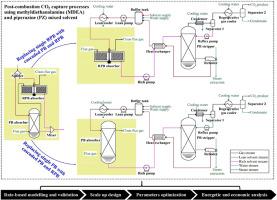
Solvent-based post-combustion carbon capture (PCC) with packed beds (PBs) suffers from high energy consumption and large space occupation in the commercialization process. Benefiting from the strong separation efficiency, compact design and wide solvent adaptability of rotating packed beds (RPBs), replacing PBs with RPBs and integrating them with energy-saving solvents is a potential solution to enable complete commercialization of PCC. Nonetheless, the size constraints and economic uncertainties associated with RPBs remain key challenges hindering their large-scale implementation. Using RPBs in series/parallel or with PBs promises a balance between space savings and cost reduction, but this trade-off advantage has not yet been quantified. Therefore, this work provides a detailed energetic and economic analysis of a cascade combination of PB and RPB for industrial-scale PCC using methyldiethanolamine + piperazine (MDEA + PZ) aqueous solution. Rate-based models for PB and RPB were first developed and validated in Aspen Plus®, where the new correlations required for high gravity characteristics in RPB were written into Visual Fortran sub-routines and linked to Aspen Plus®. Three different absorption configurations (single PB, single RPB, or cascade of the two) were then proposed and implemented in Aspen Plus® for the PCC process with a practical-scale application targeting 10000 m3/h flue gas. The results show that using a cascade combination of PB and RPB to replace a single RPB can reduce the total specific capture energy from 5.19 GJ/tCO2 to 4.30 GJ/tCO2, and save up to 44.58 % of the capture cost over an electricity price range of $0.1–0.5/kWh.
期刊介绍:
The Journal of Cleaner Production is an international, transdisciplinary journal that addresses and discusses theoretical and practical Cleaner Production, Environmental, and Sustainability issues. It aims to help societies become more sustainable by focusing on the concept of 'Cleaner Production', which aims at preventing waste production and increasing efficiencies in energy, water, resources, and human capital use. The journal serves as a platform for corporations, governments, education institutions, regions, and societies to engage in discussions and research related to Cleaner Production, environmental, and sustainability practices.





 京公网安备 11010802042870号
京ICP备2023020795号-1
京公网安备 11010802042870号
京ICP备2023020795号-1

 分享
分享
 求助内容:
求助内容: 应助结果提醒方式:
 扫码关注我们
