{"title":"The controversial role of CD151 in different solid tumors: promoter or suppressor?","authors":"Xue Gao, Sa Liu, Yubo Cao, Lei Shi, Yuanqin Yin","doi":"10.1186/s12935-025-03751-9","DOIUrl":null,"url":null,"abstract":"<p><p>As a member of the tetraspanin superfamily, CD151 plays a pivotal role in tumorigenesis, progression, and metastasis. CD151 is involved in various cellular processes, including cell-cell junction, signal transduction, epithelial-mesenchymal transition (EMT), cancer stem cell maintenance (CSCs), angiogenesis, and exosome regulation. Therefore, CD151 is a potential target for tumor therapy and may be valuable in tumor diagnosis and prognosis. Notably, while CD151 predominantly functions as an oncogene in most cancers, it can also exhibit tumor-suppressive roles in specific contexts, indicating that its function is context-dependent. Additionally, CD151 plays a significant role in modulating the immune microenvironment. For instance, CD151 supports the proliferation, activation, and migration of T cells. The CD151 peptide may function as a tumor vaccination by stimulating CD8 + IFNγ + lymphocytes and inducing cytotoxic effects. Thus, the function of CD151 in tumors is intricate and warrants further investigation. In this review, we discuss the diagnostic and prognostic potential of CD151, as well as its regulatory roles in solid cancers, including those of the digestive system, lung, breast, prostate, and gynecological tissues. Basic experiments and clinical data demonstrate the beneficial and detrimental effects of CD151 in malignancies and offer a path forward for future investigation.</p>","PeriodicalId":9385,"journal":{"name":"Cancer Cell International","volume":"25 1","pages":"110"},"PeriodicalIF":6.0000,"publicationDate":"2025-03-21","publicationTypes":"Journal Article","fieldsOfStudy":null,"isOpenAccess":false,"openAccessPdf":"https://www.ncbi.nlm.nih.gov/pmc/articles/PMC11927130/pdf/","citationCount":"0","resultStr":null,"platform":"Semanticscholar","paperid":null,"PeriodicalName":"Cancer Cell International","FirstCategoryId":"3","ListUrlMain":"https://doi.org/10.1186/s12935-025-03751-9","RegionNum":2,"RegionCategory":"医学","ArticlePicture":[],"TitleCN":null,"AbstractTextCN":null,"PMCID":null,"EPubDate":"","PubModel":"","JCR":"Q1","JCRName":"ONCOLOGY","Score":null,"Total":0}
引用次数: 0
Abstract
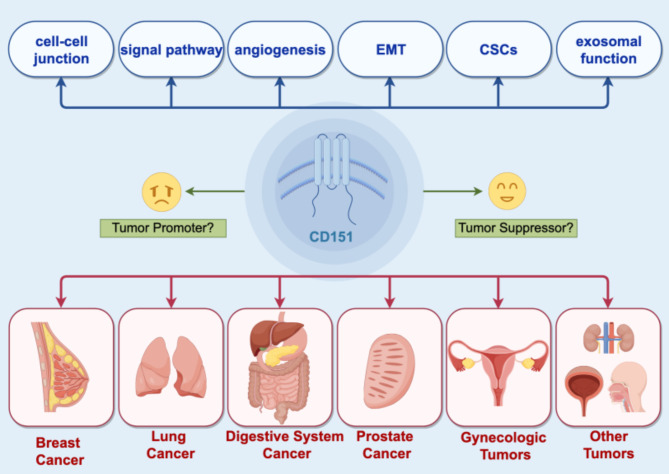
As a member of the tetraspanin superfamily, CD151 plays a pivotal role in tumorigenesis, progression, and metastasis. CD151 is involved in various cellular processes, including cell-cell junction, signal transduction, epithelial-mesenchymal transition (EMT), cancer stem cell maintenance (CSCs), angiogenesis, and exosome regulation. Therefore, CD151 is a potential target for tumor therapy and may be valuable in tumor diagnosis and prognosis. Notably, while CD151 predominantly functions as an oncogene in most cancers, it can also exhibit tumor-suppressive roles in specific contexts, indicating that its function is context-dependent. Additionally, CD151 plays a significant role in modulating the immune microenvironment. For instance, CD151 supports the proliferation, activation, and migration of T cells. The CD151 peptide may function as a tumor vaccination by stimulating CD8 + IFNγ + lymphocytes and inducing cytotoxic effects. Thus, the function of CD151 in tumors is intricate and warrants further investigation. In this review, we discuss the diagnostic and prognostic potential of CD151, as well as its regulatory roles in solid cancers, including those of the digestive system, lung, breast, prostate, and gynecological tissues. Basic experiments and clinical data demonstrate the beneficial and detrimental effects of CD151 in malignancies and offer a path forward for future investigation.
期刊介绍:
Cancer Cell International publishes articles on all aspects of cancer cell biology, originating largely from, but not limited to, work using cell culture techniques.
The journal focuses on novel cancer studies reporting data from biological experiments performed on cells grown in vitro, in two- or three-dimensional systems, and/or in vivo (animal experiments). These types of experiments have provided crucial data in many fields, from cell proliferation and transformation, to epithelial-mesenchymal interaction, to apoptosis, and host immune response to tumors.
Cancer Cell International also considers articles that focus on novel technologies or novel pathways in molecular analysis and on epidemiological studies that may affect patient care, as well as articles reporting translational cancer research studies where in vitro discoveries are bridged to the clinic. As such, the journal is interested in laboratory and animal studies reporting on novel biomarkers of tumor progression and response to therapy and on their applicability to human cancers.



 京公网安备 11010802042870号
京ICP备2023020795号-1
京公网安备 11010802042870号
京ICP备2023020795号-1

 分享
分享
 求助内容:
求助内容: 应助结果提醒方式:
 扫码关注我们
