{"title":"How does physical exercise influence self-efficacy in adolescents? A study based on the mediating role of psychological resilience.","authors":"Bo Peng, Weisong Chen, Hongshen Wang, Ting Yu","doi":"10.1186/s40359-025-02529-y","DOIUrl":null,"url":null,"abstract":"<p><strong>Objective: </strong>This study explores the influence of physical exercise on self-efficacy in adolescents, focusing on the mediating role of psychological resilience. By analyzing direct and indirect pathways, the study provides insights into the psychological mechanisms linking physical activity and self-efficacy.</p><p><strong>Method: </strong>Data were collected from 1,613 adolescent participants across 15 provinces in China using validated questionnaires to measure physical exercise, psychological resilience, and self-efficacy. Structural equation modeling (SEM) was used to test direct and mediated effects, while multi-group invariance testing examined gender differences.</p><p><strong>Results: </strong>Physical exercise significantly predicts both psychological resilience (β = 0.410, p < 0.001) and self-efficacy (β = 0.220, p < 0.001). Psychological resilience positively predicts self-efficacy (β = 0.417, p < 0.001). Mediation analysis revealed that psychological resilience partially mediates the relationship between physical exercise and self-efficacy, contributing 43.85% to the total effect. Multi-group analysis confirmed structural invariance across genders.</p><p><strong>Conclusion: </strong>Physical exercise enhances adolescents' self-efficacy both directly and indirectly through psychological resilience. It strengthens psychological resilience, which in turn boosts self-efficacy. These findings highlight the key role of physical activity in promoting resilience and building adolescents' confidence in their abilities.</p>","PeriodicalId":37867,"journal":{"name":"BMC Psychology","volume":"13 1","pages":"285"},"PeriodicalIF":3.0000,"publicationDate":"2025-03-21","publicationTypes":"Journal Article","fieldsOfStudy":null,"isOpenAccess":false,"openAccessPdf":"https://www.ncbi.nlm.nih.gov/pmc/articles/PMC11927186/pdf/","citationCount":"0","resultStr":null,"platform":"Semanticscholar","paperid":null,"PeriodicalName":"BMC Psychology","FirstCategoryId":"102","ListUrlMain":"https://doi.org/10.1186/s40359-025-02529-y","RegionNum":3,"RegionCategory":"心理学","ArticlePicture":[],"TitleCN":null,"AbstractTextCN":null,"PMCID":null,"EPubDate":"","PubModel":"","JCR":"Q1","JCRName":"PSYCHOLOGY, MULTIDISCIPLINARY","Score":null,"Total":0}
引用次数: 0
Abstract
Objective: This study explores the influence of physical exercise on self-efficacy in adolescents, focusing on the mediating role of psychological resilience. By analyzing direct and indirect pathways, the study provides insights into the psychological mechanisms linking physical activity and self-efficacy.
Method: Data were collected from 1,613 adolescent participants across 15 provinces in China using validated questionnaires to measure physical exercise, psychological resilience, and self-efficacy. Structural equation modeling (SEM) was used to test direct and mediated effects, while multi-group invariance testing examined gender differences.
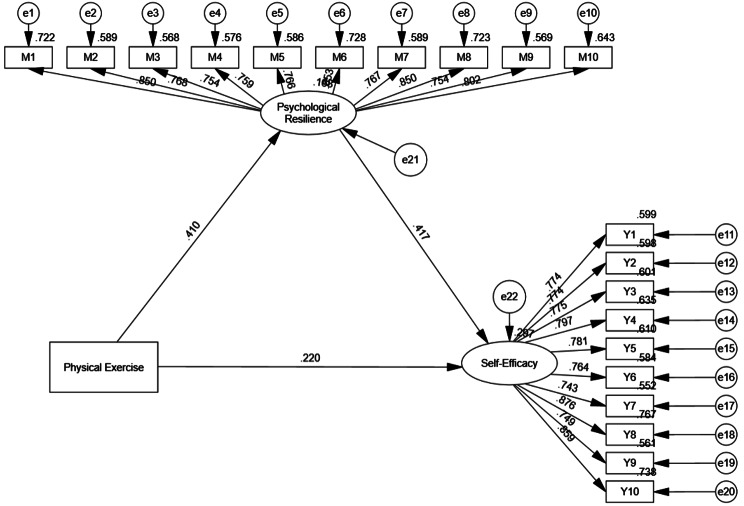
Results: Physical exercise significantly predicts both psychological resilience (β = 0.410, p < 0.001) and self-efficacy (β = 0.220, p < 0.001). Psychological resilience positively predicts self-efficacy (β = 0.417, p < 0.001). Mediation analysis revealed that psychological resilience partially mediates the relationship between physical exercise and self-efficacy, contributing 43.85% to the total effect. Multi-group analysis confirmed structural invariance across genders.
Conclusion: Physical exercise enhances adolescents' self-efficacy both directly and indirectly through psychological resilience. It strengthens psychological resilience, which in turn boosts self-efficacy. These findings highlight the key role of physical activity in promoting resilience and building adolescents' confidence in their abilities.
期刊介绍:
BMC Psychology is an open access, peer-reviewed journal that considers manuscripts on all aspects of psychology, human behavior and the mind, including developmental, clinical, cognitive, experimental, health and social psychology, as well as personality and individual differences. The journal welcomes quantitative and qualitative research methods, including animal studies.





 京公网安备 11010802042870号
京ICP备2023020795号-1
京公网安备 11010802042870号
京ICP备2023020795号-1

 分享
分享
 求助内容:
求助内容: 应助结果提醒方式:
 扫码关注我们
