Ieva Vaicekauskaitė, Algirdas Žalimas, Rasa Sabaliauskaitė, Kristina Žukauskaitė, Mantas Trakymas, Jurgita Ušinskienė, Albertas Ulys, Sonata Jarmalaitė
{"title":"Genomic analysis of small renal masses reveals mutations linked with renal cell carcinoma and fast-growing tumors.","authors":"Ieva Vaicekauskaitė, Algirdas Žalimas, Rasa Sabaliauskaitė, Kristina Žukauskaitė, Mantas Trakymas, Jurgita Ušinskienė, Albertas Ulys, Sonata Jarmalaitė","doi":"10.1007/s00432-025-06162-5","DOIUrl":null,"url":null,"abstract":"<p><strong>Purpose: </strong>Small renal masses (SRMs) SRMs are a heterogeneous group of small kidney lesions. Currently, the genomic landscape of SRMs is understudied, and clinically relevant tools for malignancy detection and fast tumor growth prediction are lacking. The aim of the study was to evaluate whether mutations in SRMs are associated with increased risk of renal cell carcinoma (RCC) or aggressive tumors.</p><p><strong>Methods: </strong>In this pilot study, 52 patients with SRMs were divided based on tumor histology into RCC and benign tumors, while RCC cases were divided into fast-growing and slow-growing tumor groups. Tissue biopsy samples evaluated for mutations in 51 cancer hotspot genes using next generation sequencing and qPCR. Non-benign mutations were tested for associations with RCC and clinical features. Receiver operating curve analysis used for evaluation of mutation biomarker models prediction of RCC and fast-growing tumors.</p><p><strong>Results: </strong>75% of SRMs harbored non-synonymous alterations in 16/51 genes. 38.5% of detected mutations were listed in ClinVar and correlated with smaller SRM volume (p = 0.023). KRAS, VHL, HNF1A, TP53, and ATM mutations were predominantly detected in RCC rather than benign SRMs (p = 0.046). SRMs with pathogenic mutations were at three times higher risk of being RCC and four times higher risk of fast growth.</p><p><strong>Conclusion: </strong>Genomic biomarkers may improve risk stratification and management of patients with SRMs, however a more extensive genomic analysis of SRMs is still needed.</p>","PeriodicalId":15118,"journal":{"name":"Journal of Cancer Research and Clinical Oncology","volume":"151 3","pages":"118"},"PeriodicalIF":2.8000,"publicationDate":"2025-03-22","publicationTypes":"Journal Article","fieldsOfStudy":null,"isOpenAccess":false,"openAccessPdf":"https://www.ncbi.nlm.nih.gov/pmc/articles/PMC11928375/pdf/","citationCount":"0","resultStr":null,"platform":"Semanticscholar","paperid":null,"PeriodicalName":"Journal of Cancer Research and Clinical Oncology","FirstCategoryId":"3","ListUrlMain":"https://doi.org/10.1007/s00432-025-06162-5","RegionNum":3,"RegionCategory":"医学","ArticlePicture":[],"TitleCN":null,"AbstractTextCN":null,"PMCID":null,"EPubDate":"","PubModel":"","JCR":"Q3","JCRName":"ONCOLOGY","Score":null,"Total":0}
引用次数: 0
Abstract
Purpose: Small renal masses (SRMs) SRMs are a heterogeneous group of small kidney lesions. Currently, the genomic landscape of SRMs is understudied, and clinically relevant tools for malignancy detection and fast tumor growth prediction are lacking. The aim of the study was to evaluate whether mutations in SRMs are associated with increased risk of renal cell carcinoma (RCC) or aggressive tumors.
Methods: In this pilot study, 52 patients with SRMs were divided based on tumor histology into RCC and benign tumors, while RCC cases were divided into fast-growing and slow-growing tumor groups. Tissue biopsy samples evaluated for mutations in 51 cancer hotspot genes using next generation sequencing and qPCR. Non-benign mutations were tested for associations with RCC and clinical features. Receiver operating curve analysis used for evaluation of mutation biomarker models prediction of RCC and fast-growing tumors.
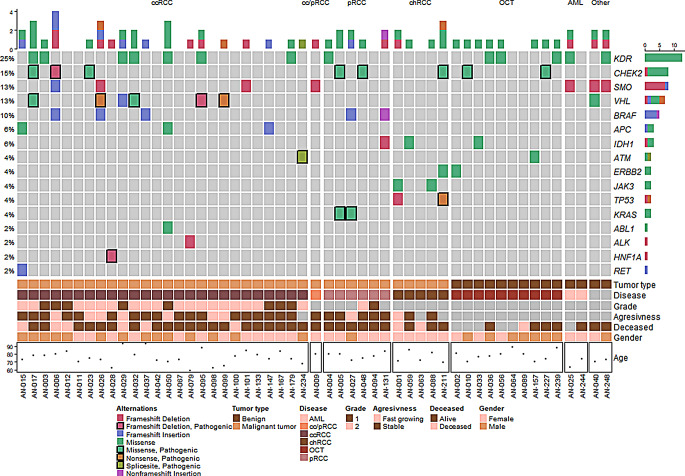
Results: 75% of SRMs harbored non-synonymous alterations in 16/51 genes. 38.5% of detected mutations were listed in ClinVar and correlated with smaller SRM volume (p = 0.023). KRAS, VHL, HNF1A, TP53, and ATM mutations were predominantly detected in RCC rather than benign SRMs (p = 0.046). SRMs with pathogenic mutations were at three times higher risk of being RCC and four times higher risk of fast growth.
Conclusion: Genomic biomarkers may improve risk stratification and management of patients with SRMs, however a more extensive genomic analysis of SRMs is still needed.
期刊介绍:
The "Journal of Cancer Research and Clinical Oncology" publishes significant and up-to-date articles within the fields of experimental and clinical oncology. The journal, which is chiefly devoted to Original papers, also includes Reviews as well as Editorials and Guest editorials on current, controversial topics. The section Letters to the editors provides a forum for a rapid exchange of comments and information concerning previously published papers and topics of current interest. Meeting reports provide current information on the latest results presented at important congresses.
The following fields are covered: carcinogenesis - etiology, mechanisms; molecular biology; recent developments in tumor therapy; general diagnosis; laboratory diagnosis; diagnostic and experimental pathology; oncologic surgery; and epidemiology.





 京公网安备 11010802042870号
京ICP备2023020795号-1
京公网安备 11010802042870号
京ICP备2023020795号-1

 分享
分享
 求助内容:
求助内容: 应助结果提醒方式:
 扫码关注我们
