Lijuan Liu, Zhixi Yun, Linus Manubens-Gil, Hanbo Chen, Feng Xiong, Hongwei Dong, Hongkui Zeng, Michael Hawrylycz, Giorgio A. Ascoli, Hanchuan Peng
{"title":"Connectivity of single neurons classifies cell subtypes in mouse brains","authors":"Lijuan Liu, Zhixi Yun, Linus Manubens-Gil, Hanbo Chen, Feng Xiong, Hongwei Dong, Hongkui Zeng, Michael Hawrylycz, Giorgio A. Ascoli, Hanchuan Peng","doi":"10.1038/s41592-025-02621-6","DOIUrl":null,"url":null,"abstract":"Classification of single neurons at a brain-wide scale is a way to characterize the structural and functional organization of brains. Here we acquired and standardized a large morphology database of 20,158 mouse neurons and generated a potential connectivity map of single neurons based on their dendritic and axonal arbors. With such an anatomy–morphology–connectivity mapping, we defined neuron connectivity subtypes for neurons in 31 brain regions. We found that cell types defined by connectivity show distinct separation from each other. Within this context, we were able to characterize the diversity in secondary motor cortical neurons, and subtype connectivity patterns in thalamocortical pathways. Our findings underscore the importance of connectivity in characterizing the modularity of brain anatomy at the single-cell level. These results highlight that connectivity subtypes supplement conventionally recognized transcriptomic cell types, electrophysiological cell types and morphological cell types as factors to classify cell classes and their identities. This Resource presents a method to define connectivity types of neurons based on a spatially registered large database containing more than 20,000 neuronal reconstructions. A brain connectivity map is also generated using such connectivity features.","PeriodicalId":18981,"journal":{"name":"Nature Methods","volume":"22 4","pages":"861-873"},"PeriodicalIF":32.1000,"publicationDate":"2025-03-21","publicationTypes":"Journal Article","fieldsOfStudy":null,"isOpenAccess":false,"openAccessPdf":"https://www.ncbi.nlm.nih.gov/pmc/articles/PMC11978518/pdf/","citationCount":"0","resultStr":null,"platform":"Semanticscholar","paperid":null,"PeriodicalName":"Nature Methods","FirstCategoryId":"99","ListUrlMain":"https://www.nature.com/articles/s41592-025-02621-6","RegionNum":1,"RegionCategory":"生物学","ArticlePicture":[],"TitleCN":null,"AbstractTextCN":null,"PMCID":null,"EPubDate":"","PubModel":"","JCR":"Q1","JCRName":"BIOCHEMICAL RESEARCH METHODS","Score":null,"Total":0}
引用次数: 0
Abstract
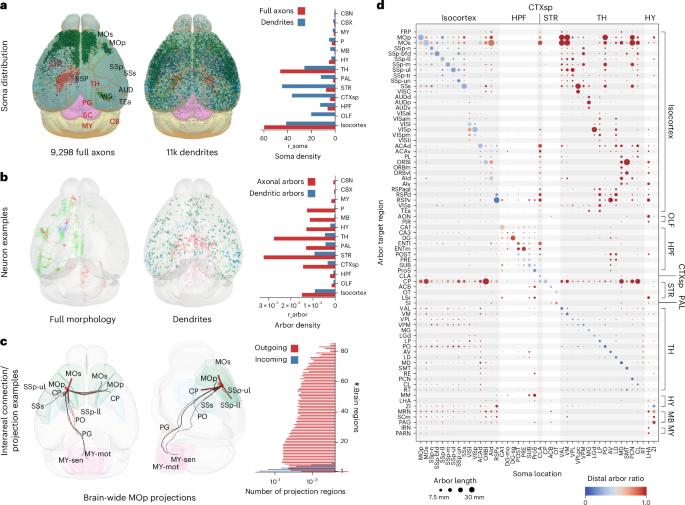
Classification of single neurons at a brain-wide scale is a way to characterize the structural and functional organization of brains. Here we acquired and standardized a large morphology database of 20,158 mouse neurons and generated a potential connectivity map of single neurons based on their dendritic and axonal arbors. With such an anatomy–morphology–connectivity mapping, we defined neuron connectivity subtypes for neurons in 31 brain regions. We found that cell types defined by connectivity show distinct separation from each other. Within this context, we were able to characterize the diversity in secondary motor cortical neurons, and subtype connectivity patterns in thalamocortical pathways. Our findings underscore the importance of connectivity in characterizing the modularity of brain anatomy at the single-cell level. These results highlight that connectivity subtypes supplement conventionally recognized transcriptomic cell types, electrophysiological cell types and morphological cell types as factors to classify cell classes and their identities. This Resource presents a method to define connectivity types of neurons based on a spatially registered large database containing more than 20,000 neuronal reconstructions. A brain connectivity map is also generated using such connectivity features.
期刊介绍:
Nature Methods is a monthly journal that focuses on publishing innovative methods and substantial enhancements to fundamental life sciences research techniques. Geared towards a diverse, interdisciplinary readership of researchers in academia and industry engaged in laboratory work, the journal offers new tools for research and emphasizes the immediate practical significance of the featured work. It publishes primary research papers and reviews recent technical and methodological advancements, with a particular interest in primary methods papers relevant to the biological and biomedical sciences. This includes methods rooted in chemistry with practical applications for studying biological problems.



 京公网安备 11010802042870号
京ICP备2023020795号-1
京公网安备 11010802042870号
京ICP备2023020795号-1

 分享
分享
 求助内容:
求助内容: 应助结果提醒方式:
 扫码关注我们
