{"title":"Interfacial Molecule Engineering Builds Tri-Functional Bilayer Silane Films with Hydrophobic Ion Channels for Highly Stable Zn Metal Anode","authors":"Chang Yan, Fangzhou He, Lukun Feng, Ling Zhu, Peng Li, Jing Tang, Huibing He, Yi Liu, Yuanqin Zhu, Guanghua Li, Dongdong Li","doi":"10.1002/adfm.202503493","DOIUrl":null,"url":null,"abstract":"<p>The vulnerable Zn electrode interface with uncontrolled Zn dendrite growth and severe parasitic side reactions constrains the practical application of aqueous zinc-ion batteries (AZIBs). General interface engineering of Zn offers a promising approach to relieve these issues but is limited by the confined functionality, low affinity, and additional weight of the protective layer. In this study, a bilayer silane film (SF) is developed with hydrophobic, ion-buffering, and strong interfacial adhesion properties through the precise assembly of silane coupling agents. The well-designed SF layer enables Zn<sup>2+</sup> to undergo continuous processes, including being captured by –CF<sub>3</sub> groups, followed in sequence by inducing desolvation, directed diffusing through silane nanochannels, and buffered diffusion. This multiple process contributed to the accelerated [Zn(H<sub>2</sub>O)<sub>6</sub>]<sup>2+</sup> desolvation, stabilized Zn<sup>2+</sup> transport, and inhibited side reactions. Consequently, dendrite-free and highly reversible SF@Zn anodes are realized, exhibiting an ultra-long lifetime (more than 4300 h), a high Coulombic efficiency (CE) (99.1% after 2600 cycles), and a superior full cell capacity retention (83.2% after 1000 cycles). This innovative strategy provides a novel method to enhance Zn anode stability via molecular-level interfacial layer design by multicomponent silane coupling reaction, offering new insights into the advanced interface design for AZIBs.</p>","PeriodicalId":112,"journal":{"name":"Advanced Functional Materials","volume":"35 35","pages":""},"PeriodicalIF":19.0000,"publicationDate":"2025-03-24","publicationTypes":"Journal Article","fieldsOfStudy":null,"isOpenAccess":false,"openAccessPdf":"","citationCount":"0","resultStr":null,"platform":"Semanticscholar","paperid":null,"PeriodicalName":"Advanced Functional Materials","FirstCategoryId":"88","ListUrlMain":"https://advanced.onlinelibrary.wiley.com/doi/10.1002/adfm.202503493","RegionNum":1,"RegionCategory":"材料科学","ArticlePicture":[],"TitleCN":null,"AbstractTextCN":null,"PMCID":null,"EPubDate":"","PubModel":"","JCR":"Q1","JCRName":"CHEMISTRY, MULTIDISCIPLINARY","Score":null,"Total":0}
引用次数: 0
Abstract
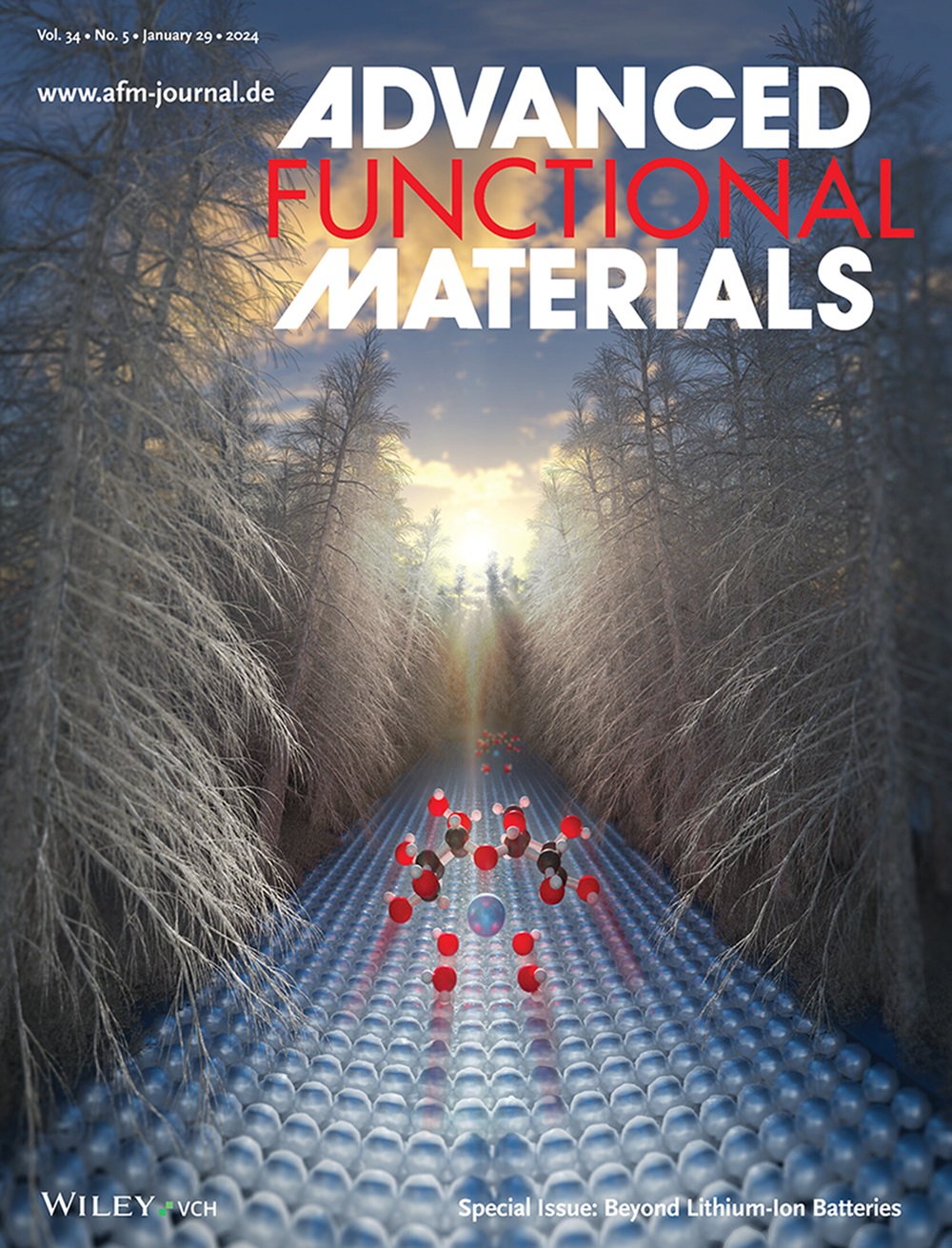
The vulnerable Zn electrode interface with uncontrolled Zn dendrite growth and severe parasitic side reactions constrains the practical application of aqueous zinc-ion batteries (AZIBs). General interface engineering of Zn offers a promising approach to relieve these issues but is limited by the confined functionality, low affinity, and additional weight of the protective layer. In this study, a bilayer silane film (SF) is developed with hydrophobic, ion-buffering, and strong interfacial adhesion properties through the precise assembly of silane coupling agents. The well-designed SF layer enables Zn2+ to undergo continuous processes, including being captured by –CF3 groups, followed in sequence by inducing desolvation, directed diffusing through silane nanochannels, and buffered diffusion. This multiple process contributed to the accelerated [Zn(H2O)6]2+ desolvation, stabilized Zn2+ transport, and inhibited side reactions. Consequently, dendrite-free and highly reversible SF@Zn anodes are realized, exhibiting an ultra-long lifetime (more than 4300 h), a high Coulombic efficiency (CE) (99.1% after 2600 cycles), and a superior full cell capacity retention (83.2% after 1000 cycles). This innovative strategy provides a novel method to enhance Zn anode stability via molecular-level interfacial layer design by multicomponent silane coupling reaction, offering new insights into the advanced interface design for AZIBs.
期刊介绍:
Firmly established as a top-tier materials science journal, Advanced Functional Materials reports breakthrough research in all aspects of materials science, including nanotechnology, chemistry, physics, and biology every week.
Advanced Functional Materials is known for its rapid and fair peer review, quality content, and high impact, making it the first choice of the international materials science community.





 京公网安备 11010802042870号
京ICP备2023020795号-1
京公网安备 11010802042870号
京ICP备2023020795号-1

 分享
分享
 求助内容:
求助内容: 应助结果提醒方式:
 扫码关注我们
