Moein Safarkhani , Fahimeh Taghavimandi , Yonghyeon Park , Amirhossein Ojaghi , Donghyeon Kim , Soobin Han , Hanseung Kim , Ali Mohammadi , Min Gyu Kim , Poojitha Yanamala , Reza Maleki , Sang Myeon Lee , Kwangsoo Shin , Yun Suk Huh
{"title":"Sprayable Off-On DCP detection: Biocompatible carboxamide-based sensor with fluorescent signaling and colorimetric coagulation trigger","authors":"Moein Safarkhani , Fahimeh Taghavimandi , Yonghyeon Park , Amirhossein Ojaghi , Donghyeon Kim , Soobin Han , Hanseung Kim , Ali Mohammadi , Min Gyu Kim , Poojitha Yanamala , Reza Maleki , Sang Myeon Lee , Kwangsoo Shin , Yun Suk Huh","doi":"10.1016/j.jhazmat.2025.138045","DOIUrl":null,"url":null,"abstract":"<div><div>Detecting hazardous nerve agents is essential due to their extreme toxicity and potential for severe harm, necessitating rapid and reliable sensing solutions. This study introduces a compact, high-performance sensor designed for diethyl chlorophosphate (DCP) detection, a commonly used nerve agent simulant, engineered for rapid response and easy field readiness. Leveraging triphenyl phosphite as an innovative synthetic modification instead of the traditional triphenyl phosphate, the sensor achieved a higher yield, an acceptable limit of detection (LOD, 4.75 µM), and enhanced sensitivity. Characterization techniques (including Density Functional Theory (DFT) analysis, HOMO-LUMO gap, and electrostatic potential mapping) align with XPS, NMR, and Raman spectroscopy results, confirming the sensor’s structural integrity and operational efficacy. The sensor’s rapid response is showcased through distinct chromogenic and fluorescence shifts, enabling naked-eye visual identification. The selectivity study reveals strong specificity for DCP, with no response to even HCl, H<sub>3</sub>PO<sub>4</sub>, NaOH, or structurally similar compounds, ensuring reliability in complex environments. Biocompatibility tests on HaCaT and CD-1064sk cell lines further support their safe use by operators. With safe near-UV-A excitation (385 nm) and an extended linear range (1–50 Equiv) at high DCP concentrations, this sensor is a valuable tool for emergency applications where immediate detection and response are crucial.</div></div>","PeriodicalId":361,"journal":{"name":"Journal of Hazardous Materials","volume":"492 ","pages":"Article 138045"},"PeriodicalIF":11.3000,"publicationDate":"2025-03-24","publicationTypes":"Journal Article","fieldsOfStudy":null,"isOpenAccess":false,"openAccessPdf":"","citationCount":"0","resultStr":null,"platform":"Semanticscholar","paperid":null,"PeriodicalName":"Journal of Hazardous Materials","FirstCategoryId":"93","ListUrlMain":"https://www.sciencedirect.com/science/article/pii/S0304389425009604","RegionNum":1,"RegionCategory":"环境科学与生态学","ArticlePicture":[],"TitleCN":null,"AbstractTextCN":null,"PMCID":null,"EPubDate":"","PubModel":"","JCR":"Q1","JCRName":"ENGINEERING, ENVIRONMENTAL","Score":null,"Total":0}
引用次数: 0
Abstract
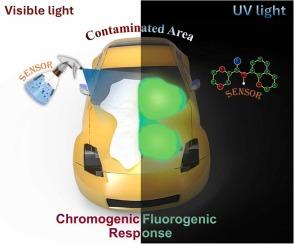
Detecting hazardous nerve agents is essential due to their extreme toxicity and potential for severe harm, necessitating rapid and reliable sensing solutions. This study introduces a compact, high-performance sensor designed for diethyl chlorophosphate (DCP) detection, a commonly used nerve agent simulant, engineered for rapid response and easy field readiness. Leveraging triphenyl phosphite as an innovative synthetic modification instead of the traditional triphenyl phosphate, the sensor achieved a higher yield, an acceptable limit of detection (LOD, 4.75 µM), and enhanced sensitivity. Characterization techniques (including Density Functional Theory (DFT) analysis, HOMO-LUMO gap, and electrostatic potential mapping) align with XPS, NMR, and Raman spectroscopy results, confirming the sensor’s structural integrity and operational efficacy. The sensor’s rapid response is showcased through distinct chromogenic and fluorescence shifts, enabling naked-eye visual identification. The selectivity study reveals strong specificity for DCP, with no response to even HCl, H3PO4, NaOH, or structurally similar compounds, ensuring reliability in complex environments. Biocompatibility tests on HaCaT and CD-1064sk cell lines further support their safe use by operators. With safe near-UV-A excitation (385 nm) and an extended linear range (1–50 Equiv) at high DCP concentrations, this sensor is a valuable tool for emergency applications where immediate detection and response are crucial.
期刊介绍:
The Journal of Hazardous Materials serves as a global platform for promoting cutting-edge research in the field of Environmental Science and Engineering. Our publication features a wide range of articles, including full-length research papers, review articles, and perspectives, with the aim of enhancing our understanding of the dangers and risks associated with various materials concerning public health and the environment. It is important to note that the term "environmental contaminants" refers specifically to substances that pose hazardous effects through contamination, while excluding those that do not have such impacts on the environment or human health. Moreover, we emphasize the distinction between wastes and hazardous materials in order to provide further clarity on the scope of the journal. We have a keen interest in exploring specific compounds and microbial agents that have adverse effects on the environment.



 京公网安备 11010802042870号
京ICP备2023020795号-1
京公网安备 11010802042870号
京ICP备2023020795号-1

 分享
分享
 求助内容:
求助内容: 应助结果提醒方式:
 扫码关注我们
