M. Kaniselvan, Y.-R. Jeon, M. Mladenović, M. Luisier, D. Akinwande
{"title":"Mechanisms of resistive switching in two-dimensional monolayer and multilayer materials","authors":"M. Kaniselvan, Y.-R. Jeon, M. Mladenović, M. Luisier, D. Akinwande","doi":"10.1038/s41563-025-02170-5","DOIUrl":null,"url":null,"abstract":"The power and energy consumption of resistive switching devices can be lowered by reducing the dimensions of their active layers. Efforts to push this low-energy switching property to its limits have led to the investigation of active regions made with two-dimensional (2D) layered materials. Despite their small dimensions, 2D layered materials exhibit a rich variety of switching mechanisms, each involving different types of atomic structure reconfiguration. In this Review, we highlight and classify the mechanisms of resistive switching in monolayer and bulk 2D layered materials, with a subsequent focus on those occurring in a monolayer and/or localized to point defects in the crystalline sheet. We discuss the complex energetics involved in these fundamentally defect-assisted processes, including the coexistence of multiple mechanisms and the effects of the contacts used. Examining the highly localized ‘atomristor’-type switching, we provide insights into atomic motions and electronic transport across the metal–2D interfaces underlying their operation. Finally, we discuss progress and our perspective on the challenges associated with the development of 2D resistive switching devices. Promising application areas and material systems are identified and suggested for further research. The authors review the mechanisms of resistive switching in monolayer and bulk forms of two-dimensional layered materials, providing insights into atomic motions and electronic transport across interfaces.","PeriodicalId":19058,"journal":{"name":"Nature Materials","volume":"24 9","pages":"1346-1358"},"PeriodicalIF":38.5000,"publicationDate":"2025-03-24","publicationTypes":"Journal Article","fieldsOfStudy":null,"isOpenAccess":false,"openAccessPdf":"","citationCount":"0","resultStr":null,"platform":"Semanticscholar","paperid":null,"PeriodicalName":"Nature Materials","FirstCategoryId":"88","ListUrlMain":"https://www.nature.com/articles/s41563-025-02170-5","RegionNum":1,"RegionCategory":"材料科学","ArticlePicture":[],"TitleCN":null,"AbstractTextCN":null,"PMCID":null,"EPubDate":"","PubModel":"","JCR":"Q1","JCRName":"CHEMISTRY, PHYSICAL","Score":null,"Total":0}
引用次数: 0
Abstract
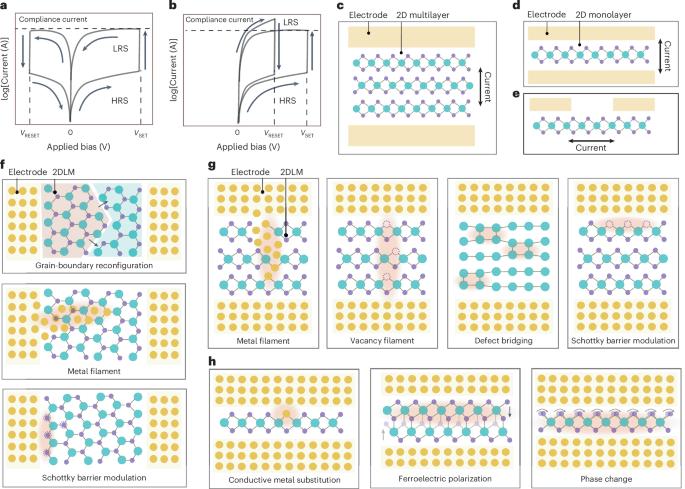
The power and energy consumption of resistive switching devices can be lowered by reducing the dimensions of their active layers. Efforts to push this low-energy switching property to its limits have led to the investigation of active regions made with two-dimensional (2D) layered materials. Despite their small dimensions, 2D layered materials exhibit a rich variety of switching mechanisms, each involving different types of atomic structure reconfiguration. In this Review, we highlight and classify the mechanisms of resistive switching in monolayer and bulk 2D layered materials, with a subsequent focus on those occurring in a monolayer and/or localized to point defects in the crystalline sheet. We discuss the complex energetics involved in these fundamentally defect-assisted processes, including the coexistence of multiple mechanisms and the effects of the contacts used. Examining the highly localized ‘atomristor’-type switching, we provide insights into atomic motions and electronic transport across the metal–2D interfaces underlying their operation. Finally, we discuss progress and our perspective on the challenges associated with the development of 2D resistive switching devices. Promising application areas and material systems are identified and suggested for further research. The authors review the mechanisms of resistive switching in monolayer and bulk forms of two-dimensional layered materials, providing insights into atomic motions and electronic transport across interfaces.
期刊介绍:
Nature Materials is a monthly multi-disciplinary journal aimed at bringing together cutting-edge research across the entire spectrum of materials science and engineering. It covers all applied and fundamental aspects of the synthesis/processing, structure/composition, properties, and performance of materials. The journal recognizes that materials research has an increasing impact on classical disciplines such as physics, chemistry, and biology.
Additionally, Nature Materials provides a forum for the development of a common identity among materials scientists and encourages interdisciplinary collaboration. It takes an integrated and balanced approach to all areas of materials research, fostering the exchange of ideas between scientists involved in different disciplines.
Nature Materials is an invaluable resource for scientists in academia and industry who are active in discovering and developing materials and materials-related concepts. It offers engaging and informative papers of exceptional significance and quality, with the aim of influencing the development of society in the future.




 京公网安备 11010802042870号
京ICP备2023020795号-1
京公网安备 11010802042870号
京ICP备2023020795号-1

 分享
分享
 求助内容:
求助内容: 应助结果提醒方式:
 扫码关注我们
