{"title":"Relativistic effect behind the molybdenum vs. tungsten selectivity in enzymes†","authors":"Udita Das, Ankita Das and Asim K. Das","doi":"10.1039/D5DT00001G","DOIUrl":null,"url":null,"abstract":"<p >Molybdenum and tungsten, being congeners of the 6<small><sup>th</sup></small> group of d-block elements, are similar in many respects in terms of their properties. In fact, both participate in similar types of oxotransferase activity in their enzymes. Molybdenum is regarded as the heaviest essential trace metal in all forms of life; however, its next heavier congener, tungsten, as the heaviest metal, is found only in some prokaryotic organisms. Tungstoenzymes are generally selected by nature for carrying out low-potential redox activities under anaerobic conditions in prokaryotic organisms. This nature's molybdenum <em>vs</em>. tungsten selectivity for their biological functions under different working conditions (surrounding temperature and aerobic/anaerobic environment) is determined mainly by the relativistic effect, which is experienced to different extents by these two congeners. Understanding the mechanistic aspects of the relativistic effect-controlled enzymatic activities of tungstoenzymes is of immense biotechnological interest to develop eco-friendly and cost-effective methods for the commercial synthesis of acetaldehyde through the hydration of acetylene and commercial production of hydrogen (H<small><sub>2</sub></small>, a green fuel) by producing tungsten-incorporated nitrogenase (W–N<small><sub>2</sub></small>-ase) in CA6 (mutant strain) and to develop a biomimetic method to replace the hazardous Birch reduction in organic synthesis.</p>","PeriodicalId":71,"journal":{"name":"Dalton Transactions","volume":" 22","pages":" 8728-8744"},"PeriodicalIF":3.3000,"publicationDate":"2025-03-24","publicationTypes":"Journal Article","fieldsOfStudy":null,"isOpenAccess":false,"openAccessPdf":"","citationCount":"0","resultStr":null,"platform":"Semanticscholar","paperid":null,"PeriodicalName":"Dalton Transactions","FirstCategoryId":"92","ListUrlMain":"https://pubs.rsc.org/en/content/articlelanding/2025/dt/d5dt00001g","RegionNum":3,"RegionCategory":"化学","ArticlePicture":[],"TitleCN":null,"AbstractTextCN":null,"PMCID":null,"EPubDate":"","PubModel":"","JCR":"Q2","JCRName":"CHEMISTRY, INORGANIC & NUCLEAR","Score":null,"Total":0}
引用次数: 0
Abstract
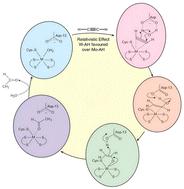
Molybdenum and tungsten, being congeners of the 6th group of d-block elements, are similar in many respects in terms of their properties. In fact, both participate in similar types of oxotransferase activity in their enzymes. Molybdenum is regarded as the heaviest essential trace metal in all forms of life; however, its next heavier congener, tungsten, as the heaviest metal, is found only in some prokaryotic organisms. Tungstoenzymes are generally selected by nature for carrying out low-potential redox activities under anaerobic conditions in prokaryotic organisms. This nature's molybdenum vs. tungsten selectivity for their biological functions under different working conditions (surrounding temperature and aerobic/anaerobic environment) is determined mainly by the relativistic effect, which is experienced to different extents by these two congeners. Understanding the mechanistic aspects of the relativistic effect-controlled enzymatic activities of tungstoenzymes is of immense biotechnological interest to develop eco-friendly and cost-effective methods for the commercial synthesis of acetaldehyde through the hydration of acetylene and commercial production of hydrogen (H2, a green fuel) by producing tungsten-incorporated nitrogenase (W–N2-ase) in CA6 (mutant strain) and to develop a biomimetic method to replace the hazardous Birch reduction in organic synthesis.
期刊介绍:
Dalton Transactions is a journal for all areas of inorganic chemistry, which encompasses the organometallic, bioinorganic and materials chemistry of the elements, with applications including synthesis, catalysis, energy conversion/storage, electrical devices and medicine. Dalton Transactions welcomes high-quality, original submissions in all of these areas and more, where the advancement of knowledge in inorganic chemistry is significant.




 京公网安备 11010802042870号
京ICP备2023020795号-1
京公网安备 11010802042870号
京ICP备2023020795号-1

 分享
分享
 求助内容:
求助内容: 应助结果提醒方式:
 扫码关注我们
