Shun Ding, Haoqi Wang, Chunhong Zhou, Yanlan Wang and Xiang Liu
{"title":"Up-cycling of waste A4 paper into a CaCO3/biochar nanocomposite for wastewater purification: efficiency, mechanism and biotoxicity evaluation†","authors":"Shun Ding, Haoqi Wang, Chunhong Zhou, Yanlan Wang and Xiang Liu","doi":"10.1039/D5EN00072F","DOIUrl":null,"url":null,"abstract":"<p >Waste A4 paper, which is mainly composed of cellulose, is a renewable, low-cost and easily accessible material. Converting waste paper into a carbon-based catalyst is a green and sustainable way to recycle waste paper. Herein, we report a strategy of treating waste with waste to synthesize a calcium carbonate/biochar nanocomposite (CCBN), based on a hydrothermal method and the calcination of waste A4 paper, as a high-efficiency nanocatalyst in activating PMS for the treatment of antibiotic wastewater. Full physical characterizations confirmed that the waste A4 paper was successfully converted into a calcium carbonate/biochar nanocomposite (CCBN) with the structure of porous biochar after calcination at 400 °C. CCBN-400 was composed of biochar and CaCO<small><sub>3</sub></small>, and was favorable for PMS activation. The quenching tests, electrochemical analysis and EPR analysis suggest that <small><sup>1</sup></small>O<small><sub>2</sub></small> and e<small><sup>−</sup></small> are the primary active species in the CCBN-400/PMS system. Moreover, a germination experiment suggested that the bio-toxicity of tetracycline to wheat seeds was significantly decreased by treatment with the CCBN-400/PMS system. Here, we successfully up-cycled waste A4 paper into a carbon-based catalyst for water decontamination.</p>","PeriodicalId":73,"journal":{"name":"Environmental Science: Nano","volume":" 5","pages":" 2647-2656"},"PeriodicalIF":5.1000,"publicationDate":"2025-03-24","publicationTypes":"Journal Article","fieldsOfStudy":null,"isOpenAccess":false,"openAccessPdf":"","citationCount":"0","resultStr":null,"platform":"Semanticscholar","paperid":null,"PeriodicalName":"Environmental Science: Nano","FirstCategoryId":"6","ListUrlMain":"https://pubs.rsc.org/en/content/articlelanding/2025/en/d5en00072f","RegionNum":2,"RegionCategory":"环境科学与生态学","ArticlePicture":[],"TitleCN":null,"AbstractTextCN":null,"PMCID":null,"EPubDate":"","PubModel":"","JCR":"Q1","JCRName":"CHEMISTRY, MULTIDISCIPLINARY","Score":null,"Total":0}
引用次数: 0
Abstract
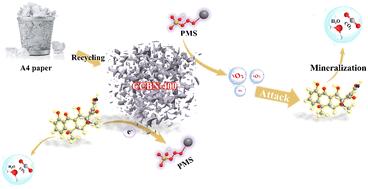
Waste A4 paper, which is mainly composed of cellulose, is a renewable, low-cost and easily accessible material. Converting waste paper into a carbon-based catalyst is a green and sustainable way to recycle waste paper. Herein, we report a strategy of treating waste with waste to synthesize a calcium carbonate/biochar nanocomposite (CCBN), based on a hydrothermal method and the calcination of waste A4 paper, as a high-efficiency nanocatalyst in activating PMS for the treatment of antibiotic wastewater. Full physical characterizations confirmed that the waste A4 paper was successfully converted into a calcium carbonate/biochar nanocomposite (CCBN) with the structure of porous biochar after calcination at 400 °C. CCBN-400 was composed of biochar and CaCO3, and was favorable for PMS activation. The quenching tests, electrochemical analysis and EPR analysis suggest that 1O2 and e− are the primary active species in the CCBN-400/PMS system. Moreover, a germination experiment suggested that the bio-toxicity of tetracycline to wheat seeds was significantly decreased by treatment with the CCBN-400/PMS system. Here, we successfully up-cycled waste A4 paper into a carbon-based catalyst for water decontamination.
期刊介绍:
Environmental Science: Nano serves as a comprehensive and high-impact peer-reviewed source of information on the design and demonstration of engineered nanomaterials for environment-based applications. It also covers the interactions between engineered, natural, and incidental nanomaterials with biological and environmental systems. This scope includes, but is not limited to, the following topic areas:
Novel nanomaterial-based applications for water, air, soil, food, and energy sustainability
Nanomaterial interactions with biological systems and nanotoxicology
Environmental fate, reactivity, and transformations of nanoscale materials
Nanoscale processes in the environment
Sustainable nanotechnology including rational nanomaterial design, life cycle assessment, risk/benefit analysis



 京公网安备 11010802042870号
京ICP备2023020795号-1
京公网安备 11010802042870号
京ICP备2023020795号-1

 分享
分享
 求助内容:
求助内容: 应助结果提醒方式:
 扫码关注我们
