{"title":"Suspension Electrolytes with Catalytically Self-Expediating Desolvation Kinetics for Low-Temperature Zinc Metal Batteries","authors":"Jing Dong, Xiaomin Cheng, Haifeng Yang, Huihua Li, Haitao Liu, Lujie Jia, Yongzheng Zhang, Qinghua Guan, Jiqiang Jia, Fanglin Wu, Jing Zhang, Meinan Liu, Hongzhen Lin, Jian Wang","doi":"10.1002/adma.202501079","DOIUrl":null,"url":null,"abstract":"<p>The conventional electrolyte for rechargeable aqueous zinc metal batteries (AZMBs) breeds many problems such as Zn dendrite growth and side reaction of hydrogen evolution reaction, which are fundamentally attributed to the uneven ion flux owing to the high barriers of desolvation and diffusion of Zn[(H<sub>2</sub>O)<sub>6</sub>]<sup>2+</sup> clusters. Herein, to modulate the [Zn(H<sub>2</sub>O)<sub>6</sub>]<sup>2+</sup> solvation structure, the suspension electrolyte engineering employed with electron-delocalized catalytic nanoparticles is initially proposed to expedite desolvation kinetics. As a proof, the electron-density-adjustable CeO<sub>2-</sub><i><sub>x</sub></i> is introduced into the commercial electrolyte and preferentially adsorbed on the Zn surface, regulating the Zn[(H<sub>2</sub>O)<sub>6</sub>]<sup>2+</sup> structure. Meanwhile, the defect-rich CeO<sub>2-</sub><i><sub>x</sub></i> redistributes the localized space electric field to uniformize ion flux kinetics and inhibits dendrite growth, as confirmed by a series of theoretical simulations, spectroscopical and experimental measurements. Encouragingly, the CeO<sub>2-</sub><i><sub>x</sub></i> decorated suspension electrolyte enables a long stability over 1200 cycles at 5 mA cm<sup>−2</sup> and an extended lifespan exceeding 6500 h with lower overpotentials of 34 mV under 0 °C. Matched with polyaniline cathodes, the full cells with suspension electrolyte exhibit a capacity-retention of 96.75% at 1 A g<sup>−1</sup> under −20 °C as well as a long lifespan of up to 400 cycles in a large-areal pouch cell, showcasing promising potentials of suspension electrolyte for practical AZMBs.</p>","PeriodicalId":114,"journal":{"name":"Advanced Materials","volume":"37 18","pages":""},"PeriodicalIF":26.8000,"publicationDate":"2025-03-23","publicationTypes":"Journal Article","fieldsOfStudy":null,"isOpenAccess":false,"openAccessPdf":"https://onlinelibrary.wiley.com/doi/epdf/10.1002/adma.202501079","citationCount":"0","resultStr":null,"platform":"Semanticscholar","paperid":null,"PeriodicalName":"Advanced Materials","FirstCategoryId":"88","ListUrlMain":"https://advanced.onlinelibrary.wiley.com/doi/10.1002/adma.202501079","RegionNum":1,"RegionCategory":"材料科学","ArticlePicture":[],"TitleCN":null,"AbstractTextCN":null,"PMCID":null,"EPubDate":"","PubModel":"","JCR":"Q1","JCRName":"CHEMISTRY, MULTIDISCIPLINARY","Score":null,"Total":0}
引用次数: 0
Abstract
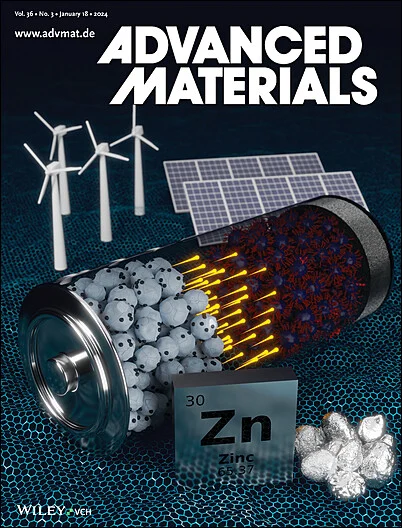
The conventional electrolyte for rechargeable aqueous zinc metal batteries (AZMBs) breeds many problems such as Zn dendrite growth and side reaction of hydrogen evolution reaction, which are fundamentally attributed to the uneven ion flux owing to the high barriers of desolvation and diffusion of Zn[(H2O)6]2+ clusters. Herein, to modulate the [Zn(H2O)6]2+ solvation structure, the suspension electrolyte engineering employed with electron-delocalized catalytic nanoparticles is initially proposed to expedite desolvation kinetics. As a proof, the electron-density-adjustable CeO2-x is introduced into the commercial electrolyte and preferentially adsorbed on the Zn surface, regulating the Zn[(H2O)6]2+ structure. Meanwhile, the defect-rich CeO2-x redistributes the localized space electric field to uniformize ion flux kinetics and inhibits dendrite growth, as confirmed by a series of theoretical simulations, spectroscopical and experimental measurements. Encouragingly, the CeO2-x decorated suspension electrolyte enables a long stability over 1200 cycles at 5 mA cm−2 and an extended lifespan exceeding 6500 h with lower overpotentials of 34 mV under 0 °C. Matched with polyaniline cathodes, the full cells with suspension electrolyte exhibit a capacity-retention of 96.75% at 1 A g−1 under −20 °C as well as a long lifespan of up to 400 cycles in a large-areal pouch cell, showcasing promising potentials of suspension electrolyte for practical AZMBs.
传统的可充电水性锌金属电池(AZMBs)电解液存在锌枝晶生长和析氢副反应等问题,其根本原因是由于Zn[(H2O)6]2+团簇的高溶解度和扩散障碍导致离子通量不均匀。为了调节[Zn(H2O)6]2+的溶剂化结构,我们首先提出了采用电子离域催化纳米颗粒的悬浮电解质工程来加速脱溶动力学。作为证明,电子密度可调节的CeO2 - x被引入到商业电解质中,并优先吸附在Zn表面,调节Zn[(H2O)6]2+结构。同时,通过一系列的理论模拟、光谱和实验测量证实,富含缺陷的CeO2‐x重新分配了局域空间电场,以均匀离子通量动力学并抑制枝晶生长。令人鼓舞的是,CeO2‐x装饰的悬浮电解质在5 mA cm - 2下可保持1200次以上的长周期稳定性,在0°C下具有34 mV的过电位,寿命超过6500 h。与聚苯胺阴极相匹配,具有悬浮电解质的全电池在- 20°C下在1 a g - 1下的容量保持率为96.75%,并且在大面积袋状电池中具有长达400次循环的长寿命,显示了悬浮电解质用于实际azmb的良好潜力。
期刊介绍:
Advanced Materials, one of the world's most prestigious journals and the foundation of the Advanced portfolio, is the home of choice for best-in-class materials science for more than 30 years. Following this fast-growing and interdisciplinary field, we are considering and publishing the most important discoveries on any and all materials from materials scientists, chemists, physicists, engineers as well as health and life scientists and bringing you the latest results and trends in modern materials-related research every week.





 京公网安备 11010802042870号
京ICP备2023020795号-1
京公网安备 11010802042870号
京ICP备2023020795号-1

 分享
分享
 求助内容:
求助内容: 应助结果提醒方式:
 扫码关注我们
