Aicun Li, Zhicheng Gong, Yuhan Long, Yuanpei Li, Chen Liu, Xiao Lu, Qing Li, Xiaoniu He, Hezhe Lu, Kaichun Wu, Yongzhan Nie, Jing Tan, Jing Ye, Han You
{"title":"Lactylation of LSD1 is an acquired epigenetic vulnerability of BRAFi/MEKi-resistant melanoma","authors":"Aicun Li, Zhicheng Gong, Yuhan Long, Yuanpei Li, Chen Liu, Xiao Lu, Qing Li, Xiaoniu He, Hezhe Lu, Kaichun Wu, Yongzhan Nie, Jing Tan, Jing Ye, Han You","doi":"10.1016/j.devcel.2025.02.016","DOIUrl":null,"url":null,"abstract":"<em>BRAF</em><sup><em>V600E</em></sup> mutant melanomas treated with BRAF inhibitor (BRAFi) and MEK inhibitor (MEKi) almost invariably develop drug resistance, accompanied by restored glucose metabolism. How resumed glycolysis controls acquired resistance remains unknown. Here, we identify that lysine-specific demethylase 1 (LSD1) lactylation, induced by re-accumulated lactate in both human and murine BRAFi/MEKi-resistant melanoma cells, selectively drives survival via epigenetic reprogramming. Mechanistically, lactylation of LSD1 promotes its interaction with Fos-related antigen 1 (FosL1), preventing its degradation by E3 ligase tripartite-motif-containing protein 21 (TRIM21) and selectively enhancing its genomic enrichment. We further demonstrate that lactylated LSD1 co-directs gene transcription with FosL1 to repress ferroptosis via interfering with transferrin receptor protein 1 (TFRC)-mediated iron uptake. LSD1 inhibition activates ferroptosis, resulting in drastic regression of drug-resistant murine melanoma when combined with immunotherapy. Our results highlight a crucial role of metabolic rewiring-induced epigenetic reprogramming as a bypass resistance mechanism in BRAFi/MEKi-resistant melanoma, providing a therapeutically actionable strategy to overcome resistance to targeted therapy and immunotherapy.","PeriodicalId":11157,"journal":{"name":"Developmental cell","volume":"183 1","pages":""},"PeriodicalIF":8.7000,"publicationDate":"2025-03-24","publicationTypes":"Journal Article","fieldsOfStudy":null,"isOpenAccess":false,"openAccessPdf":"","citationCount":"0","resultStr":null,"platform":"Semanticscholar","paperid":null,"PeriodicalName":"Developmental cell","FirstCategoryId":"99","ListUrlMain":"https://doi.org/10.1016/j.devcel.2025.02.016","RegionNum":1,"RegionCategory":"生物学","ArticlePicture":[],"TitleCN":null,"AbstractTextCN":null,"PMCID":null,"EPubDate":"","PubModel":"","JCR":"Q1","JCRName":"CELL BIOLOGY","Score":null,"Total":0}
引用次数: 0
Abstract
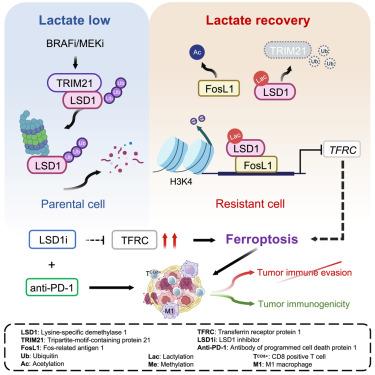
BRAFV600E mutant melanomas treated with BRAF inhibitor (BRAFi) and MEK inhibitor (MEKi) almost invariably develop drug resistance, accompanied by restored glucose metabolism. How resumed glycolysis controls acquired resistance remains unknown. Here, we identify that lysine-specific demethylase 1 (LSD1) lactylation, induced by re-accumulated lactate in both human and murine BRAFi/MEKi-resistant melanoma cells, selectively drives survival via epigenetic reprogramming. Mechanistically, lactylation of LSD1 promotes its interaction with Fos-related antigen 1 (FosL1), preventing its degradation by E3 ligase tripartite-motif-containing protein 21 (TRIM21) and selectively enhancing its genomic enrichment. We further demonstrate that lactylated LSD1 co-directs gene transcription with FosL1 to repress ferroptosis via interfering with transferrin receptor protein 1 (TFRC)-mediated iron uptake. LSD1 inhibition activates ferroptosis, resulting in drastic regression of drug-resistant murine melanoma when combined with immunotherapy. Our results highlight a crucial role of metabolic rewiring-induced epigenetic reprogramming as a bypass resistance mechanism in BRAFi/MEKi-resistant melanoma, providing a therapeutically actionable strategy to overcome resistance to targeted therapy and immunotherapy.
期刊介绍:
Developmental Cell, established in 2001, is a comprehensive journal that explores a wide range of topics in cell and developmental biology. Our publication encompasses work across various disciplines within biology, with a particular emphasis on investigating the intersections between cell biology, developmental biology, and other related fields. Our primary objective is to present research conducted through a cell biological perspective, addressing the essential mechanisms governing cell function, cellular interactions, and responses to the environment. Moreover, we focus on understanding the collective behavior of cells, culminating in the formation of tissues, organs, and whole organisms, while also investigating the consequences of any malfunctions in these intricate processes.



 京公网安备 11010802042870号
京ICP备2023020795号-1
京公网安备 11010802042870号
京ICP备2023020795号-1

 分享
分享
 求助内容:
求助内容: 应助结果提醒方式:
 扫码关注我们
