{"title":"Room-Temperature CO2 Monitoring Platform Enabled by Alkali Metal Functionalization of a Mg-MOF-74-Based QCM Sensor","authors":"Xukun Wang, Xiaoyi Xu, Tingting Zhou, Tong Zhang","doi":"10.1021/acssensors.4c02955","DOIUrl":null,"url":null,"abstract":"Carbon dioxide (CO<sub>2</sub>) detection is indispensable for monitoring climate change, ensuring air quality, managing industrial processes, and safeguarding human health. Nevertheless, the chemical inertness and stability of CO<sub>2</sub> pose significant challenges in advancing detection technologies in practical applications. In order to overcome these challenges, nanoscale MOF-74 metal–organic frameworks (MOFs) functionalized with alkali metals (Li, Na, and K) have been synthesized for the effective detection of the CO<sub>2</sub> gas. The sensing results indicate that the Li–Mg-MOF-74-based quartz crystal microbalance (QCM) CO<sub>2</sub> sensors demonstrate excellent properties, such as very high sensitivity, rapid response/recovery time (84 s/69 s), broad detection range (300–10000 ppm), and remarkable selectivity at room temperature. The enhanced performance benefits from the increased electrostatic force and Lewis’s acidity resulting from alkali metal ions (Li<sup>+</sup>) and open metal sites (Mg<sup>2+</sup>). In addition, the equilibrium constant of CO<sub>2</sub> on the sensor surface was calculated by the Langmuir adsorption isotherm model, revealing spontaneous and robust adsorption behavior. These results indicate that alkali-metal-modified Mg-MOF-74 materials have great potential for practical CO<sub>2</sub> detection and provide a feasible solution for the design of high-performance, room-temperature CO<sub>2</sub> sensing platforms.","PeriodicalId":24,"journal":{"name":"ACS Sensors","volume":"183 1","pages":""},"PeriodicalIF":9.1000,"publicationDate":"2025-03-24","publicationTypes":"Journal Article","fieldsOfStudy":null,"isOpenAccess":false,"openAccessPdf":"","citationCount":"0","resultStr":null,"platform":"Semanticscholar","paperid":null,"PeriodicalName":"ACS Sensors","FirstCategoryId":"92","ListUrlMain":"https://doi.org/10.1021/acssensors.4c02955","RegionNum":1,"RegionCategory":"化学","ArticlePicture":[],"TitleCN":null,"AbstractTextCN":null,"PMCID":null,"EPubDate":"","PubModel":"","JCR":"Q1","JCRName":"CHEMISTRY, ANALYTICAL","Score":null,"Total":0}
引用次数: 0
Abstract
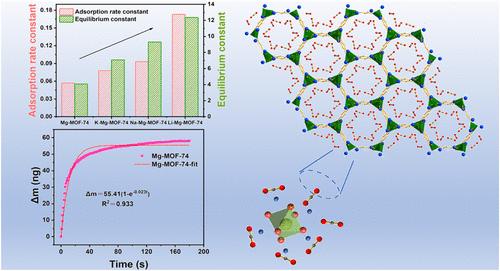
Carbon dioxide (CO2) detection is indispensable for monitoring climate change, ensuring air quality, managing industrial processes, and safeguarding human health. Nevertheless, the chemical inertness and stability of CO2 pose significant challenges in advancing detection technologies in practical applications. In order to overcome these challenges, nanoscale MOF-74 metal–organic frameworks (MOFs) functionalized with alkali metals (Li, Na, and K) have been synthesized for the effective detection of the CO2 gas. The sensing results indicate that the Li–Mg-MOF-74-based quartz crystal microbalance (QCM) CO2 sensors demonstrate excellent properties, such as very high sensitivity, rapid response/recovery time (84 s/69 s), broad detection range (300–10000 ppm), and remarkable selectivity at room temperature. The enhanced performance benefits from the increased electrostatic force and Lewis’s acidity resulting from alkali metal ions (Li+) and open metal sites (Mg2+). In addition, the equilibrium constant of CO2 on the sensor surface was calculated by the Langmuir adsorption isotherm model, revealing spontaneous and robust adsorption behavior. These results indicate that alkali-metal-modified Mg-MOF-74 materials have great potential for practical CO2 detection and provide a feasible solution for the design of high-performance, room-temperature CO2 sensing platforms.
期刊介绍:
ACS Sensors is a peer-reviewed research journal that focuses on the dissemination of new and original knowledge in the field of sensor science, particularly those that selectively sense chemical or biological species or processes. The journal covers a broad range of topics, including but not limited to biosensors, chemical sensors, gas sensors, intracellular sensors, single molecule sensors, cell chips, and microfluidic devices. It aims to publish articles that address conceptual advances in sensing technology applicable to various types of analytes or application papers that report on the use of existing sensing concepts in new ways or for new analytes.



 京公网安备 11010802042870号
京ICP备2023020795号-1
京公网安备 11010802042870号
京ICP备2023020795号-1

 分享
分享
 求助内容:
求助内容: 应助结果提醒方式:
 扫码关注我们
