Chong Hu, Xiaorui Shi, Bin Guo, Zeping Yang, Jie Zhou, Fu Wang
{"title":"Toehold-Based CRISPR-dCas9 Transcriptional Activation Platform for Spatiotemporally Controllable Gene Therapy in Tumor and Diabetic Mouse Models","authors":"Chong Hu, Xiaorui Shi, Bin Guo, Zeping Yang, Jie Zhou, Fu Wang","doi":"10.1021/acsnano.5c01078","DOIUrl":null,"url":null,"abstract":"The CRISPR-Cas system has been extensively employed as a genome editing tool with the dCas9-based transcriptional activation system emerging as a particularly promising approach for gene editing in the treatment of diseases at the gene level. Nevertheless, the challenge of achieving effective spatiotemporal control of the transcriptional activation system of dCas9 has thus far restricted its broader application. In this study, we present an miRNA-responsive CRISPR-dCas9 transcriptional activation (mCTA) system. This system is capable of responding specifically to exogenous and endogenous miRNAs in mammalian cells and enables the specific imaging of miRNAs during neural development or in the deep tissues of mice. Furthermore, the replacement of downstream functional genes with DTA has been demonstrated to result in the effective apoptosis of tumor cells and inhibition of xenografted tumor growth in mice. Finally, in a diabetic mouse model, the m<sub>122</sub>CTA system was shown to reduce the blood glucose in diabetic mice via the activation of PDX-1 gene. Our work provides an effective platform for miRNA imaging and gene therapy via spatiotemporal control of gene regulation.","PeriodicalId":21,"journal":{"name":"ACS Nano","volume":"61 1","pages":""},"PeriodicalIF":16.0000,"publicationDate":"2025-03-24","publicationTypes":"Journal Article","fieldsOfStudy":null,"isOpenAccess":false,"openAccessPdf":"","citationCount":"0","resultStr":null,"platform":"Semanticscholar","paperid":null,"PeriodicalName":"ACS Nano","FirstCategoryId":"88","ListUrlMain":"https://doi.org/10.1021/acsnano.5c01078","RegionNum":1,"RegionCategory":"材料科学","ArticlePicture":[],"TitleCN":null,"AbstractTextCN":null,"PMCID":null,"EPubDate":"","PubModel":"","JCR":"Q1","JCRName":"CHEMISTRY, MULTIDISCIPLINARY","Score":null,"Total":0}
引用次数: 0
Abstract
The CRISPR-Cas system has been extensively employed as a genome editing tool with the dCas9-based transcriptional activation system emerging as a particularly promising approach for gene editing in the treatment of diseases at the gene level. Nevertheless, the challenge of achieving effective spatiotemporal control of the transcriptional activation system of dCas9 has thus far restricted its broader application. In this study, we present an miRNA-responsive CRISPR-dCas9 transcriptional activation (mCTA) system. This system is capable of responding specifically to exogenous and endogenous miRNAs in mammalian cells and enables the specific imaging of miRNAs during neural development or in the deep tissues of mice. Furthermore, the replacement of downstream functional genes with DTA has been demonstrated to result in the effective apoptosis of tumor cells and inhibition of xenografted tumor growth in mice. Finally, in a diabetic mouse model, the m122CTA system was shown to reduce the blood glucose in diabetic mice via the activation of PDX-1 gene. Our work provides an effective platform for miRNA imaging and gene therapy via spatiotemporal control of gene regulation.
期刊介绍:
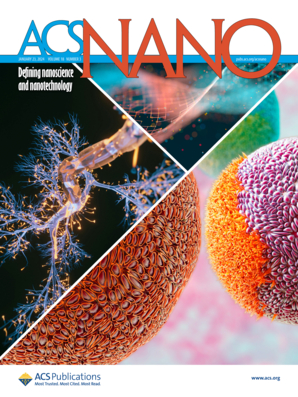
ACS Nano, published monthly, serves as an international forum for comprehensive articles on nanoscience and nanotechnology research at the intersections of chemistry, biology, materials science, physics, and engineering. The journal fosters communication among scientists in these communities, facilitating collaboration, new research opportunities, and advancements through discoveries. ACS Nano covers synthesis, assembly, characterization, theory, and simulation of nanostructures, nanobiotechnology, nanofabrication, methods and tools for nanoscience and nanotechnology, and self- and directed-assembly. Alongside original research articles, it offers thorough reviews, perspectives on cutting-edge research, and discussions envisioning the future of nanoscience and nanotechnology.




 京公网安备 11010802042870号
京ICP备2023020795号-1
京公网安备 11010802042870号
京ICP备2023020795号-1

 分享
分享
 求助内容:
求助内容: 应助结果提醒方式:
 扫码关注我们
