Highly efficient grafting of silazanes to the inner surface of the vials under mild conditions by surface engineering to improve the chemical durability
{"title":"Highly efficient grafting of silazanes to the inner surface of the vials under mild conditions by surface engineering to improve the chemical durability","authors":"Ruolin Zhou, Shengyao Tan, Fangrui Xie, Jing Dong, Jianping Zhu, Linxuan Fang, Lianbin Wu","doi":"10.1016/j.apsusc.2025.163059","DOIUrl":null,"url":null,"abstract":"<div><div>As the composition of drugs has become more complex, the chemical durability of glass has been challenged. In this study, two silazanes, n-n-butyl-azido-2,2-dimethoxysilazane (BADMACP) and hexamethyldisilazane (HMDS) were used separately to efficiently modify the inner surfaces of vials under mild conditions. These two silazanes were reacted with the –OH groups on the inner surface of the vials through Si-N bonds, and grafted by O-Si bonds to form a functional hydrolysis-resistant surface with excellent stability. The success of the chemical modification was confirmed by colorimetric staining experiments, Fourier transform infrared spectra, water contact angle and the morphology of the inner surface of the vials before and after modification. The water contact angle was increased from unmodified 65° to more than 100°, and improved the hydrolytic resistance of the glass by modifying the hydrophobicity of the inner surface of the glass vial. Hydrothermal aging tests were performed before and after modification defined by the pharmacopeias, and the volume of 0.01 M HCl consumed during titration decreased by 88 % and 86 %, indicating that metal ion precipitation is greatly reduced, effectively reducing the risk of glass delamination. It is worth mentioning that the surface modification engineering of the inner surface of the vials with HMDS and BADMSCP can significantly improve the barrier properties of the inner surface of the vials without affecting the appearance and the transmittance of the vials.</div></div>","PeriodicalId":247,"journal":{"name":"Applied Surface Science","volume":"697 ","pages":"Article 163059"},"PeriodicalIF":6.9000,"publicationDate":"2025-03-24","publicationTypes":"Journal Article","fieldsOfStudy":null,"isOpenAccess":false,"openAccessPdf":"","citationCount":"0","resultStr":null,"platform":"Semanticscholar","paperid":null,"PeriodicalName":"Applied Surface Science","FirstCategoryId":"88","ListUrlMain":"https://www.sciencedirect.com/science/article/pii/S0169433225007731","RegionNum":2,"RegionCategory":"材料科学","ArticlePicture":[],"TitleCN":null,"AbstractTextCN":null,"PMCID":null,"EPubDate":"","PubModel":"","JCR":"Q2","JCRName":"CHEMISTRY, PHYSICAL","Score":null,"Total":0}
引用次数: 0
Abstract
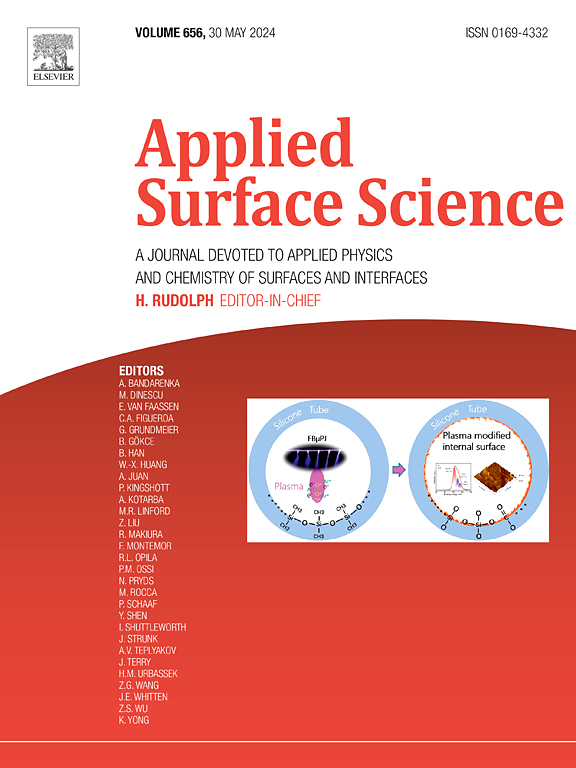
As the composition of drugs has become more complex, the chemical durability of glass has been challenged. In this study, two silazanes, n-n-butyl-azido-2,2-dimethoxysilazane (BADMACP) and hexamethyldisilazane (HMDS) were used separately to efficiently modify the inner surfaces of vials under mild conditions. These two silazanes were reacted with the –OH groups on the inner surface of the vials through Si-N bonds, and grafted by O-Si bonds to form a functional hydrolysis-resistant surface with excellent stability. The success of the chemical modification was confirmed by colorimetric staining experiments, Fourier transform infrared spectra, water contact angle and the morphology of the inner surface of the vials before and after modification. The water contact angle was increased from unmodified 65° to more than 100°, and improved the hydrolytic resistance of the glass by modifying the hydrophobicity of the inner surface of the glass vial. Hydrothermal aging tests were performed before and after modification defined by the pharmacopeias, and the volume of 0.01 M HCl consumed during titration decreased by 88 % and 86 %, indicating that metal ion precipitation is greatly reduced, effectively reducing the risk of glass delamination. It is worth mentioning that the surface modification engineering of the inner surface of the vials with HMDS and BADMSCP can significantly improve the barrier properties of the inner surface of the vials without affecting the appearance and the transmittance of the vials.
由于药物的成分越来越复杂,玻璃的化学耐久性受到了挑战。本研究分别利用n-正丁基叠氮-2,2-二甲氧基硅氮烷(BADMACP)和六甲基二硅氮烷(HMDS)两种硅氮烷,在温和条件下对小瓶的内表面进行了高效修饰。这两种硅氮烷通过Si-N键与瓶内表面的-OH基团反应,并通过O-Si键接枝,形成具有优异稳定性的抗水解功能表面。通过比色染色实验、傅里叶变换红外光谱、水接触角和改性前后小瓶的内表面形貌,证实了化学改性的成功。水接触角由未改性的65°增加到100°以上,并通过改性玻璃小瓶内表面的疏水性提高了玻璃的抗水解能力。在药典规定的改性前后进行水热老化试验,滴定过程中消耗的0.01 M HCl体积分别减少了88 %和86 %,表明金属离子析出大大减少,有效降低了玻璃分层的风险。值得一提的是,对HMDS和BADMSCP小瓶的内表面进行表面改性工程,可以在不影响小瓶外观和透光率的情况下,显著提高小瓶内表面的阻隔性能。
期刊介绍:
Applied Surface Science covers topics contributing to a better understanding of surfaces, interfaces, nanostructures and their applications. The journal is concerned with scientific research on the atomic and molecular level of material properties determined with specific surface analytical techniques and/or computational methods, as well as the processing of such structures.





 京公网安备 11010802042870号
京ICP备2023020795号-1
京公网安备 11010802042870号
京ICP备2023020795号-1

 分享
分享
 求助内容:
求助内容: 应助结果提醒方式:
 扫码关注我们
