Xiayun Dai , Fan Wang , Yonggang Liao , Na Tu , Xiaolei Fu, Wenjuan Fu, Yizhe Sun, Junpin Liu, Siyu Wan, Wenjun Yin, Wei Pi, Jiaojun Liang, Siqi Chen, Jinfeng Jiang, Guilin Yi, Yongbin Luo, Zhiwei Pan, Zhenlong Chen
{"title":"Associations of welding-related metals and hypertension in male welders: Roles of cytokinesis-block micronucleus cytome assay parameters","authors":"Xiayun Dai , Fan Wang , Yonggang Liao , Na Tu , Xiaolei Fu, Wenjuan Fu, Yizhe Sun, Junpin Liu, Siyu Wan, Wenjun Yin, Wei Pi, Jiaojun Liang, Siqi Chen, Jinfeng Jiang, Guilin Yi, Yongbin Luo, Zhiwei Pan, Zhenlong Chen","doi":"10.1016/j.envpol.2025.126119","DOIUrl":null,"url":null,"abstract":"<div><div>The effects of welding-related metals on hypertension remain unclear. In this study, we aimed to assess the associations between welding-related metals and hypertension risk <em>in occupational settings</em>, and to evaluate the mediating roles of micronucleus parameters in these associations. We conducted a study on 434 male welders from a vehicle manufacturing plant in Wuhan, China, in 2023. We measured 17 metals in welding workshops and office air, specifically copper (Cu), manganese (Mn), nickel (Ni), lead (Pb), chromium (Cr), iron (Fe), barium (Ba), aluminium (Al), zinc (Zn), tin (Sn), indium (In), cesium (Cs), arsenic (As), tellurium (Te), cadmium (Cd), cobalt (Co), and selenium (Se). We also examined blood levels of welding-related metals and micronucleus parameters, including micronuclei (MN), nucleoplasmic bridges, and nuclear buds. Generalized linear models were used to assess metal-hypertension associations, with mediation analyses exploring the roles of micronucleus parameters in these associations. The median concentrations of Cu, Mn, Ni, Pb, Cr, and Fe in welding workshop air were five times higher than in offices and correlated significantly with welding fume, hence designated as welding-related metals. The mean age of the participants was 42.96 years and 108 (24.88 %) were hypertension patients. Significant positive associations were found between blood Mn (<em>OR</em> = 1.120, 95 %<em>CI</em> = 1.044–1.200, <em>P</em> = 0.002) and Pb (<em>OR</em> = 1.047, 95 %<em>CI</em> = 1.018–1.077, <em>P</em> = 0.001) and hypertension. These associations persisted even after adjustment for all other metals. Additionally, positive associations were found of MN with hypertension risk (<em>OR</em> = 2.684, 95 %<em>CI</em> = 1.431–5.037, <em>P</em> = 0.002) and Pb with MN (<em>β</em> = 0.007, 95 %<em>CI</em> = 0.002–0.011, <em>P</em> = 0.002). Furthermore, we observed a significant mediation role of MN in the Pb-hypertension association, with a mediating proportion of 16.10 %. Specifically, the <em>OR</em>s(95 %<em>CIs</em>) for the direct and indirect effects of Pb on hypertension risk were 0.0031(0.0004–0.0042) and 0.0006(0.0001–0.0012), respectively. Our findings indicated that Pb and Mn were associated with higher hypertension risk, with elevated MN frequency potentially mediating the Pb-hypertension association.</div></div>","PeriodicalId":311,"journal":{"name":"Environmental Pollution","volume":"373 ","pages":"Article 126119"},"PeriodicalIF":7.3000,"publicationDate":"2025-03-24","publicationTypes":"Journal Article","fieldsOfStudy":null,"isOpenAccess":false,"openAccessPdf":"","citationCount":"0","resultStr":null,"platform":"Semanticscholar","paperid":null,"PeriodicalName":"Environmental Pollution","FirstCategoryId":"93","ListUrlMain":"https://www.sciencedirect.com/science/article/pii/S0269749125004920","RegionNum":2,"RegionCategory":"环境科学与生态学","ArticlePicture":[],"TitleCN":null,"AbstractTextCN":null,"PMCID":null,"EPubDate":"","PubModel":"","JCR":"Q1","JCRName":"ENVIRONMENTAL SCIENCES","Score":null,"Total":0}
引用次数: 0
Abstract
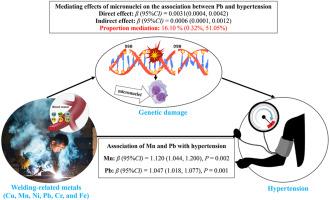
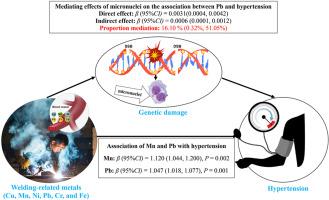
The effects of welding-related metals on hypertension remain unclear. In this study, we aimed to assess the associations between welding-related metals and hypertension risk in occupational settings, and to evaluate the mediating roles of micronucleus parameters in these associations. We conducted a study on 434 male welders from a vehicle manufacturing plant in Wuhan, China, in 2023. We measured 17 metals in welding workshops and office air, specifically copper (Cu), manganese (Mn), nickel (Ni), lead (Pb), chromium (Cr), iron (Fe), barium (Ba), aluminium (Al), zinc (Zn), tin (Sn), indium (In), cesium (Cs), arsenic (As), tellurium (Te), cadmium (Cd), cobalt (Co), and selenium (Se). We also examined blood levels of welding-related metals and micronucleus parameters, including micronuclei (MN), nucleoplasmic bridges, and nuclear buds. Generalized linear models were used to assess metal-hypertension associations, with mediation analyses exploring the roles of micronucleus parameters in these associations. The median concentrations of Cu, Mn, Ni, Pb, Cr, and Fe in welding workshop air were five times higher than in offices and correlated significantly with welding fume, hence designated as welding-related metals. The mean age of the participants was 42.96 years and 108 (24.88 %) were hypertension patients. Significant positive associations were found between blood Mn (OR = 1.120, 95 %CI = 1.044–1.200, P = 0.002) and Pb (OR = 1.047, 95 %CI = 1.018–1.077, P = 0.001) and hypertension. These associations persisted even after adjustment for all other metals. Additionally, positive associations were found of MN with hypertension risk (OR = 2.684, 95 %CI = 1.431–5.037, P = 0.002) and Pb with MN (β = 0.007, 95 %CI = 0.002–0.011, P = 0.002). Furthermore, we observed a significant mediation role of MN in the Pb-hypertension association, with a mediating proportion of 16.10 %. Specifically, the ORs(95 %CIs) for the direct and indirect effects of Pb on hypertension risk were 0.0031(0.0004–0.0042) and 0.0006(0.0001–0.0012), respectively. Our findings indicated that Pb and Mn were associated with higher hypertension risk, with elevated MN frequency potentially mediating the Pb-hypertension association.
期刊介绍:
Environmental Pollution is an international peer-reviewed journal that publishes high-quality research papers and review articles covering all aspects of environmental pollution and its impacts on ecosystems and human health.
Subject areas include, but are not limited to:
• Sources and occurrences of pollutants that are clearly defined and measured in environmental compartments, food and food-related items, and human bodies;
• Interlinks between contaminant exposure and biological, ecological, and human health effects, including those of climate change;
• Contaminants of emerging concerns (including but not limited to antibiotic resistant microorganisms or genes, microplastics/nanoplastics, electronic wastes, light, and noise) and/or their biological, ecological, or human health effects;
• Laboratory and field studies on the remediation/mitigation of environmental pollution via new techniques and with clear links to biological, ecological, or human health effects;
• Modeling of pollution processes, patterns, or trends that is of clear environmental and/or human health interest;
• New techniques that measure and examine environmental occurrences, transport, behavior, and effects of pollutants within the environment or the laboratory, provided that they can be clearly used to address problems within regional or global environmental compartments.



 京公网安备 11010802042870号
京ICP备2023020795号-1
京公网安备 11010802042870号
京ICP备2023020795号-1

 分享
分享
 求助内容:
求助内容: 应助结果提醒方式:
 扫码关注我们
