Chao Guo, Xinquan Wang, Zhenzhen Liu, Huiyu Zhao, Ge Yin, Yuele Lu, Peipei Qi, Zhiwei Wang, Shanshan Di
{"title":"Effects and Potential Risks of Chiral Penflufen on Pickled Cowpea: Combined Microbiome and Metabolomics","authors":"Chao Guo, Xinquan Wang, Zhenzhen Liu, Huiyu Zhao, Ge Yin, Yuele Lu, Peipei Qi, Zhiwei Wang, Shanshan Di","doi":"10.1021/acs.jafc.4c13144","DOIUrl":null,"url":null,"abstract":"Pesticide residues on vegetables may affect microbes and metabolites during the fermentation process, leading to effects and potential risks. Here, the enantioselective effects and potential risks of chiral penflufen on pickled cowpea were investigated by using microbiome and metabolomics analyses. Correlation analysis was conducted to construct bacterial–metabolite interaction networks. Penflufen enantiomers were degraded little during the fermentation process. <i>Rac</i>-penflufen treatment significantly decreased the relative abundance of <i>Lactiplantibacillus</i> while increasing <i>Weissella</i>, but the opposite effects were found in <i>R</i>- and <i>S</i>-penflufen treatments. These shifts were linked to content and functional changes of metabolites. <i>R</i>-/<i>S</i>-/<i>Rac-</i>penflufen upregulated rose aroma metabolites (e.g., β-damascenone), while <i>R</i>- and <i>S-</i>penflufen downregulated floral aroma metabolites (e.g., β-ionone, 2-nonenal) and green leaf aroma metabolites (e.g., (E)-2-hexenal). <i>S</i>-Penflufen reduced alcohols and increased esters more significantly, and altered a higher number of volatile organic compounds (VOCs) and chiral amino acids than <i>R</i>-penflufen, showing a greater risk to food flavor and nutritional quality.","PeriodicalId":41,"journal":{"name":"Journal of Agricultural and Food Chemistry","volume":"183 1","pages":""},"PeriodicalIF":6.2000,"publicationDate":"2025-03-24","publicationTypes":"Journal Article","fieldsOfStudy":null,"isOpenAccess":false,"openAccessPdf":"","citationCount":"0","resultStr":null,"platform":"Semanticscholar","paperid":null,"PeriodicalName":"Journal of Agricultural and Food Chemistry","FirstCategoryId":"97","ListUrlMain":"https://doi.org/10.1021/acs.jafc.4c13144","RegionNum":1,"RegionCategory":"农林科学","ArticlePicture":[],"TitleCN":null,"AbstractTextCN":null,"PMCID":null,"EPubDate":"","PubModel":"","JCR":"Q1","JCRName":"AGRICULTURE, MULTIDISCIPLINARY","Score":null,"Total":0}
引用次数: 0
Abstract
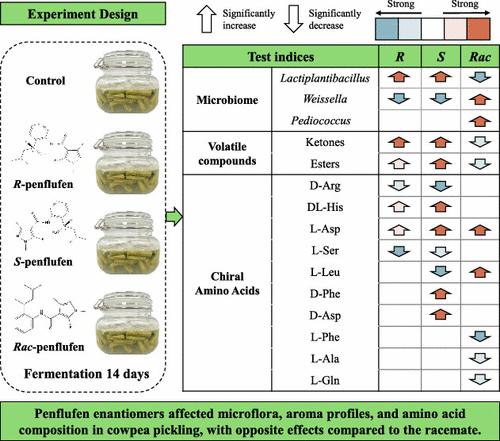
Pesticide residues on vegetables may affect microbes and metabolites during the fermentation process, leading to effects and potential risks. Here, the enantioselective effects and potential risks of chiral penflufen on pickled cowpea were investigated by using microbiome and metabolomics analyses. Correlation analysis was conducted to construct bacterial–metabolite interaction networks. Penflufen enantiomers were degraded little during the fermentation process. Rac-penflufen treatment significantly decreased the relative abundance of Lactiplantibacillus while increasing Weissella, but the opposite effects were found in R- and S-penflufen treatments. These shifts were linked to content and functional changes of metabolites. R-/S-/Rac-penflufen upregulated rose aroma metabolites (e.g., β-damascenone), while R- and S-penflufen downregulated floral aroma metabolites (e.g., β-ionone, 2-nonenal) and green leaf aroma metabolites (e.g., (E)-2-hexenal). S-Penflufen reduced alcohols and increased esters more significantly, and altered a higher number of volatile organic compounds (VOCs) and chiral amino acids than R-penflufen, showing a greater risk to food flavor and nutritional quality.
期刊介绍:
The Journal of Agricultural and Food Chemistry publishes high-quality, cutting edge original research representing complete studies and research advances dealing with the chemistry and biochemistry of agriculture and food. The Journal also encourages papers with chemistry and/or biochemistry as a major component combined with biological/sensory/nutritional/toxicological evaluation related to agriculture and/or food.



 京公网安备 11010802042870号
京ICP备2023020795号-1
京公网安备 11010802042870号
京ICP备2023020795号-1

 分享
分享
 求助内容:
求助内容: 应助结果提醒方式:
 扫码关注我们
