{"title":"Flow pattern and pressure drop of foam flow generated from Non-Newtonian fluids: An experimental and modelling study","authors":"Huan Li, Xiaoyang Yu, Zhihao Fu, Shouxiang Lu","doi":"10.1016/j.cej.2025.161870","DOIUrl":null,"url":null,"abstract":"Foam and bubble flow can greatly enhance the mass transfer of gas–liquid-solid systems in reactors and have been successfully applied in water treatment, pharmaceuticals, mineral flotation and other industries. A persistent challenge is the precise prediction of pressure drop of foam flow generated from non-Newtonian fluids across various flow patterns, which is essential for industrial process operational optimal control. A key aspect of achieving this objective involves integrating the nonlinear characteristics of foaming liquid, along with nonlinear and metastable characteristics of foam into the fluid dynamics model. This has not been thoroughly investigated, yet it is vital for the accurate forecasting of pressure drop. This work investigated the effects of non-Newtonian solutions on the flow behavior and pressure loss of foam flow in pipelines. We considered two distinct types of foam flow: full foaming flow (FFO), which encompasses four subflow types, and foam flow containing liquid (FCL), which includes two subflow types. The variations in flow patterns and pressure losses were intricately linked to the characteristics of the foam, such as the viscosity and gas volume fraction, all of which were influenced by factors such as the solution viscosity and gas/liquid flow rate. Building on these insights, a comprehensive foam flow pattern map based on gas and liquid Reynolds numbers was proposed. Furthermore, hydrodynamic models for annular foam flow, along with the governing equations, were formulated. A predictive model for pressure loss in foam flow was finally developed, accounting for non-Newtonian properties of solution and foam, metastable characteristics of foam, and the entrained efficiency of both foam and gas. The developed model in this work had higher prediction accuracy compared with the previous models.","PeriodicalId":270,"journal":{"name":"Chemical Engineering Journal","volume":"57 1","pages":""},"PeriodicalIF":13.2000,"publicationDate":"2025-03-23","publicationTypes":"Journal Article","fieldsOfStudy":null,"isOpenAccess":false,"openAccessPdf":"","citationCount":"0","resultStr":null,"platform":"Semanticscholar","paperid":null,"PeriodicalName":"Chemical Engineering Journal","FirstCategoryId":"5","ListUrlMain":"https://doi.org/10.1016/j.cej.2025.161870","RegionNum":1,"RegionCategory":"工程技术","ArticlePicture":[],"TitleCN":null,"AbstractTextCN":null,"PMCID":null,"EPubDate":"","PubModel":"","JCR":"Q1","JCRName":"ENGINEERING, CHEMICAL","Score":null,"Total":0}
引用次数: 0
Abstract
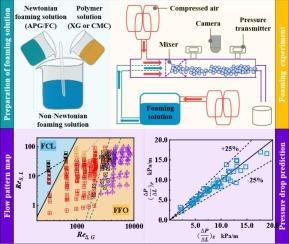
Foam and bubble flow can greatly enhance the mass transfer of gas–liquid-solid systems in reactors and have been successfully applied in water treatment, pharmaceuticals, mineral flotation and other industries. A persistent challenge is the precise prediction of pressure drop of foam flow generated from non-Newtonian fluids across various flow patterns, which is essential for industrial process operational optimal control. A key aspect of achieving this objective involves integrating the nonlinear characteristics of foaming liquid, along with nonlinear and metastable characteristics of foam into the fluid dynamics model. This has not been thoroughly investigated, yet it is vital for the accurate forecasting of pressure drop. This work investigated the effects of non-Newtonian solutions on the flow behavior and pressure loss of foam flow in pipelines. We considered two distinct types of foam flow: full foaming flow (FFO), which encompasses four subflow types, and foam flow containing liquid (FCL), which includes two subflow types. The variations in flow patterns and pressure losses were intricately linked to the characteristics of the foam, such as the viscosity and gas volume fraction, all of which were influenced by factors such as the solution viscosity and gas/liquid flow rate. Building on these insights, a comprehensive foam flow pattern map based on gas and liquid Reynolds numbers was proposed. Furthermore, hydrodynamic models for annular foam flow, along with the governing equations, were formulated. A predictive model for pressure loss in foam flow was finally developed, accounting for non-Newtonian properties of solution and foam, metastable characteristics of foam, and the entrained efficiency of both foam and gas. The developed model in this work had higher prediction accuracy compared with the previous models.
期刊介绍:
The Chemical Engineering Journal is an international research journal that invites contributions of original and novel fundamental research. It aims to provide an international platform for presenting original fundamental research, interpretative reviews, and discussions on new developments in chemical engineering. The journal welcomes papers that describe novel theory and its practical application, as well as those that demonstrate the transfer of techniques from other disciplines. It also welcomes reports on carefully conducted experimental work that is soundly interpreted. The main focus of the journal is on original and rigorous research results that have broad significance. The Catalysis section within the Chemical Engineering Journal focuses specifically on Experimental and Theoretical studies in the fields of heterogeneous catalysis, molecular catalysis, and biocatalysis. These studies have industrial impact on various sectors such as chemicals, energy, materials, foods, healthcare, and environmental protection.




 京公网安备 11010802042870号
京ICP备2023020795号-1
京公网安备 11010802042870号
京ICP备2023020795号-1

 分享
分享
 求助内容:
求助内容: 应助结果提醒方式:
 扫码关注我们
