Reversible Switching and Recycling of Thermoresponsive 1,2,4-Triazolium-Based Poly(ionic liquid) Catalysts for Porous Organic Cage Synthesis in Organic Media
Jiefeng Zhu, Feng Chen, Jie Zhang, Ruijie Hou, Jian-ke Sun, Xianjing Zhou, Jiayin Yuan, Xinping Wang
{"title":"Reversible Switching and Recycling of Thermoresponsive 1,2,4-Triazolium-Based Poly(ionic liquid) Catalysts for Porous Organic Cage Synthesis in Organic Media","authors":"Jiefeng Zhu, Feng Chen, Jie Zhang, Ruijie Hou, Jian-ke Sun, Xianjing Zhou, Jiayin Yuan, Xinping Wang","doi":"10.1021/acsmacrolett.5c00072","DOIUrl":null,"url":null,"abstract":"Homogeneous catalysts of high activity and selectivity often face challenges in the separation from feedstocks and products after reactions. In contrast, heterogeneous catalysts are easier to separate, usually at the cost of compromised catalytic performance. By designing catalysts capable of switching between homogeneous and heterogeneous states for catalysis and separation, the merits of both could be synergistically combined. In this study, a thermoresponsive 1,2,4-triazolium-based poly(ionic liquid) (PIL) was applied as a temperature-switchable organocatalyst for the controlled synthesis of porous organic cages in methanol. Variation of the reaction temperature induced a phase transition of the PIL, causing the polymer chains to dissolve or collapse in methanol, thereby exposing or shielding the catalytically active sites to proceed or retard the reaction, respectively. To note, at a sufficiently low temperature, the PIL as a catalyst precipitated out of its methanol solution and could be separated by centrifugation or filtration for reuse, similar to common heterogeneous catalysts. Such switchable and recyclable properties of polymeric catalysts will inspire the design of efficient and adaptable organic or hybrid nanoreactors in liquid media.","PeriodicalId":18,"journal":{"name":"ACS Macro Letters","volume":"71 1","pages":""},"PeriodicalIF":5.2000,"publicationDate":"2025-03-23","publicationTypes":"Journal Article","fieldsOfStudy":null,"isOpenAccess":false,"openAccessPdf":"","citationCount":"0","resultStr":null,"platform":"Semanticscholar","paperid":null,"PeriodicalName":"ACS Macro Letters","FirstCategoryId":"92","ListUrlMain":"https://doi.org/10.1021/acsmacrolett.5c00072","RegionNum":0,"RegionCategory":null,"ArticlePicture":[],"TitleCN":null,"AbstractTextCN":null,"PMCID":null,"EPubDate":"","PubModel":"","JCR":"Q1","JCRName":"POLYMER SCIENCE","Score":null,"Total":0}
引用次数: 0
Abstract
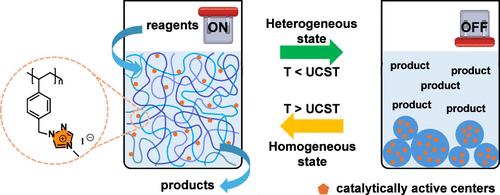
Homogeneous catalysts of high activity and selectivity often face challenges in the separation from feedstocks and products after reactions. In contrast, heterogeneous catalysts are easier to separate, usually at the cost of compromised catalytic performance. By designing catalysts capable of switching between homogeneous and heterogeneous states for catalysis and separation, the merits of both could be synergistically combined. In this study, a thermoresponsive 1,2,4-triazolium-based poly(ionic liquid) (PIL) was applied as a temperature-switchable organocatalyst for the controlled synthesis of porous organic cages in methanol. Variation of the reaction temperature induced a phase transition of the PIL, causing the polymer chains to dissolve or collapse in methanol, thereby exposing or shielding the catalytically active sites to proceed or retard the reaction, respectively. To note, at a sufficiently low temperature, the PIL as a catalyst precipitated out of its methanol solution and could be separated by centrifugation or filtration for reuse, similar to common heterogeneous catalysts. Such switchable and recyclable properties of polymeric catalysts will inspire the design of efficient and adaptable organic or hybrid nanoreactors in liquid media.
期刊介绍:
ACS Macro Letters publishes research in all areas of contemporary soft matter science in which macromolecules play a key role, including nanotechnology, self-assembly, supramolecular chemistry, biomaterials, energy generation and storage, and renewable/sustainable materials. Submissions to ACS Macro Letters should justify clearly the rapid disclosure of the key elements of the study. The scope of the journal includes high-impact research of broad interest in all areas of polymer science and engineering, including cross-disciplinary research that interfaces with polymer science.
With the launch of ACS Macro Letters, all Communications that were formerly published in Macromolecules and Biomacromolecules will be published as Letters in ACS Macro Letters.



 京公网安备 11010802042870号
京ICP备2023020795号-1
京公网安备 11010802042870号
京ICP备2023020795号-1

 分享
分享
 求助内容:
求助内容: 应助结果提醒方式:
 扫码关注我们
