Exploring the effect of metal ratio on electrochemical properties of MOF-derived microporous flower-like NiO/Co3O4 electrodes for high-performance asymmetric supercapacitor application
Balaji Chettiannan , Gowdhaman Arumugam , Stanleydhinakar Mathan , Manickam Selvaraj , Mohammed A. Assiri , Ramesh Rajendran
{"title":"Exploring the effect of metal ratio on electrochemical properties of MOF-derived microporous flower-like NiO/Co3O4 electrodes for high-performance asymmetric supercapacitor application","authors":"Balaji Chettiannan , Gowdhaman Arumugam , Stanleydhinakar Mathan , Manickam Selvaraj , Mohammed A. Assiri , Ramesh Rajendran","doi":"10.1016/j.est.2025.116326","DOIUrl":null,"url":null,"abstract":"<div><div>This research introduces a novel method for creating flower-shaped two-dimensional metal-organic frameworks (MOFs) using sodium dodecyl sulfate (SDS) as an assistant. The study explores various ratios of nickel (Ni) and cobalt (Co) in the synthesis process and evaluates the electrochemical performance capabilities of MOFs and their derived metal oxides. The FESEM investigation revealed minor morphological differences due to space coordination effects, including tightly and loosely packed sheet arrangements. Surface area measurements of the derivatives showed variations like 30.32 m<sup>2</sup>g<sup>−1</sup> for the 1:1 (Ni: Co) ratio, 26.96 m<sup>2</sup>g<sup>−1</sup> for the 2:1 ratio, and 25.12 m<sup>2</sup>g<sup>−1</sup> for the 1:2 ratio. Among the electrodes tested, the metal oxide derived from the MOF with an equal ratio of Ni and Co exhibited better performance. It achieved a notable specific capacity of 985.7C g<sup>−1</sup> (equivalent to 1971.4 F g<sup>−1</sup>) at 1 A g<sup>−1</sup> and maintained 92.85 % of initial capacity at 5000 GCD cycles. When configured in an asymmetric supercapacitor setup combining the developed material (positive electrode) with carbon black (negative electrode), the setup displayed an impressive energy density reaching 77.22 Wh kg<sup>−1</sup> maintaining the power density of 750 W kg<sup>−1</sup>. The research demonstrates that bimetallic MOFs synthesized using varying ratios of metal species with SDS surfactant assistance resulted in a flower-like architectural morphology. Subsequent derivation led to interconnected nanoparticle assemblies while preserving the inherent MOF structure, resulting in high surface area and enhanced electrochemical properties. This study emphasizes the importance of precise control over synthesis conditions to optimize material characteristics for supercapacitor applications.</div></div>","PeriodicalId":15942,"journal":{"name":"Journal of energy storage","volume":"119 ","pages":"Article 116326"},"PeriodicalIF":8.9000,"publicationDate":"2025-03-23","publicationTypes":"Journal Article","fieldsOfStudy":null,"isOpenAccess":false,"openAccessPdf":"","citationCount":"0","resultStr":null,"platform":"Semanticscholar","paperid":null,"PeriodicalName":"Journal of energy storage","FirstCategoryId":"5","ListUrlMain":"https://www.sciencedirect.com/science/article/pii/S2352152X25010394","RegionNum":2,"RegionCategory":"工程技术","ArticlePicture":[],"TitleCN":null,"AbstractTextCN":null,"PMCID":null,"EPubDate":"","PubModel":"","JCR":"Q1","JCRName":"ENERGY & FUELS","Score":null,"Total":0}
引用次数: 0
Abstract
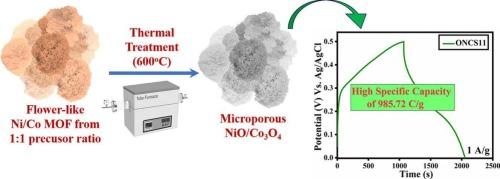
This research introduces a novel method for creating flower-shaped two-dimensional metal-organic frameworks (MOFs) using sodium dodecyl sulfate (SDS) as an assistant. The study explores various ratios of nickel (Ni) and cobalt (Co) in the synthesis process and evaluates the electrochemical performance capabilities of MOFs and their derived metal oxides. The FESEM investigation revealed minor morphological differences due to space coordination effects, including tightly and loosely packed sheet arrangements. Surface area measurements of the derivatives showed variations like 30.32 m2g−1 for the 1:1 (Ni: Co) ratio, 26.96 m2g−1 for the 2:1 ratio, and 25.12 m2g−1 for the 1:2 ratio. Among the electrodes tested, the metal oxide derived from the MOF with an equal ratio of Ni and Co exhibited better performance. It achieved a notable specific capacity of 985.7C g−1 (equivalent to 1971.4 F g−1) at 1 A g−1 and maintained 92.85 % of initial capacity at 5000 GCD cycles. When configured in an asymmetric supercapacitor setup combining the developed material (positive electrode) with carbon black (negative electrode), the setup displayed an impressive energy density reaching 77.22 Wh kg−1 maintaining the power density of 750 W kg−1. The research demonstrates that bimetallic MOFs synthesized using varying ratios of metal species with SDS surfactant assistance resulted in a flower-like architectural morphology. Subsequent derivation led to interconnected nanoparticle assemblies while preserving the inherent MOF structure, resulting in high surface area and enhanced electrochemical properties. This study emphasizes the importance of precise control over synthesis conditions to optimize material characteristics for supercapacitor applications.
期刊介绍:
Journal of energy storage focusses on all aspects of energy storage, in particular systems integration, electric grid integration, modelling and analysis, novel energy storage technologies, sizing and management strategies, business models for operation of storage systems and energy storage developments worldwide.




 京公网安备 11010802042870号
京ICP备2023020795号-1
京公网安备 11010802042870号
京ICP备2023020795号-1

 分享
分享
 求助内容:
求助内容: 应助结果提醒方式:
 扫码关注我们
