Sustainable upcycling of polypropylene-based masks into high-performance carbon materials for supercapacitors via molten salt carbonization and air activation
{"title":"Sustainable upcycling of polypropylene-based masks into high-performance carbon materials for supercapacitors via molten salt carbonization and air activation","authors":"Liqing Qiu , Hangzhong Liu , Minhua Jiang , Hua Zhang , Cuiyun Zeng , Qiaohui Guo , Shuiliang Chen","doi":"10.1016/j.est.2025.116249","DOIUrl":null,"url":null,"abstract":"<div><div>Carbonization is a promising method for upcycling polypropylene (PP)-based plastic waste into high-value carbon materials, yet direct pyrolysis typically suffers from low carbon yield due to significant volatile losses. In this study, we propose a sustainable and integrated approach utilizing thiourea-promoted molten salt carbonization to enhance the carbon yield from PP-based waste masks. The incorporation of thiourea stabilizes the carbon structure by reducing excessive fragmentation of the carbon backbone, significantly increasing the carbon yield from 7.3 % to 21.6 %. Simultaneously, thiourea introduces sulfur and nitrogen co-doping, enhancing conductivity and electrochemical performance. Furthermore, air activation is employed to optimize the pore structure, increase surface area, and introduce oxygen-containing functional groups, greatly improving ion diffusion and electrolyte wettability. The resulting air-activated sulfur- and nitrogen-doped carbon materials exhibit exceptional electrochemical performance, with a specific capacitance of 345.6 F g<sup>−1</sup> at 1 A g<sup>−1</sup> and outstanding cycling stability, retaining 93.3 % capacitance after 20,000 cycles. The corresponding symmetric supercapacitor demonstrates an energy density of 40.1 Wh kg<sup>−1</sup> at a power density of 400 W kg<sup>−1</sup>, alongside excellent cycling stability. This integrated strategy provides a sustainable pathway for converting PP-based waste plastics into high-performance carbon materials, with significant potential for applications in energy storage and environmental remediation.</div></div>","PeriodicalId":15942,"journal":{"name":"Journal of energy storage","volume":"119 ","pages":"Article 116249"},"PeriodicalIF":8.9000,"publicationDate":"2025-03-23","publicationTypes":"Journal Article","fieldsOfStudy":null,"isOpenAccess":false,"openAccessPdf":"","citationCount":"0","resultStr":null,"platform":"Semanticscholar","paperid":null,"PeriodicalName":"Journal of energy storage","FirstCategoryId":"5","ListUrlMain":"https://www.sciencedirect.com/science/article/pii/S2352152X25009624","RegionNum":2,"RegionCategory":"工程技术","ArticlePicture":[],"TitleCN":null,"AbstractTextCN":null,"PMCID":null,"EPubDate":"","PubModel":"","JCR":"Q1","JCRName":"ENERGY & FUELS","Score":null,"Total":0}
引用次数: 0
Abstract
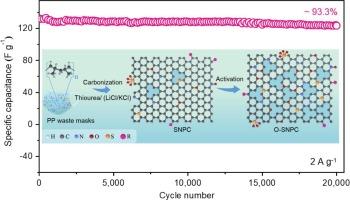
Carbonization is a promising method for upcycling polypropylene (PP)-based plastic waste into high-value carbon materials, yet direct pyrolysis typically suffers from low carbon yield due to significant volatile losses. In this study, we propose a sustainable and integrated approach utilizing thiourea-promoted molten salt carbonization to enhance the carbon yield from PP-based waste masks. The incorporation of thiourea stabilizes the carbon structure by reducing excessive fragmentation of the carbon backbone, significantly increasing the carbon yield from 7.3 % to 21.6 %. Simultaneously, thiourea introduces sulfur and nitrogen co-doping, enhancing conductivity and electrochemical performance. Furthermore, air activation is employed to optimize the pore structure, increase surface area, and introduce oxygen-containing functional groups, greatly improving ion diffusion and electrolyte wettability. The resulting air-activated sulfur- and nitrogen-doped carbon materials exhibit exceptional electrochemical performance, with a specific capacitance of 345.6 F g−1 at 1 A g−1 and outstanding cycling stability, retaining 93.3 % capacitance after 20,000 cycles. The corresponding symmetric supercapacitor demonstrates an energy density of 40.1 Wh kg−1 at a power density of 400 W kg−1, alongside excellent cycling stability. This integrated strategy provides a sustainable pathway for converting PP-based waste plastics into high-performance carbon materials, with significant potential for applications in energy storage and environmental remediation.
炭化是一种很有前途的方法,可以将聚丙烯(PP)基塑料垃圾升级为高价值的碳材料,但直接热解由于挥发损失大,通常存在低碳产量的问题。在这项研究中,我们提出了一种可持续的综合方法,利用硫脲促进熔盐碳化来提高pp基废弃掩膜的碳产量。硫脲的加入稳定了碳结构,减少了碳主链的过度断裂,使碳收率从7.3%显著提高到21.6%。同时,硫脲引入了硫氮共掺杂,提高了电导率和电化学性能。此外,利用空气活化优化孔隙结构,增加比表面积,引入含氧官能团,大大改善离子扩散和电解质润湿性。所制得的空气活性硫掺杂和氮掺杂碳材料表现出优异的电化学性能,在1 a g−1时的比电容为345.6 F g−1,并且具有出色的循环稳定性,在20,000次循环后保持93.3%的电容。相应的对称超级电容器在功率密度为400 W kg - 1时的能量密度为40.1 Wh kg - 1,并具有出色的循环稳定性。这一综合战略为将pp基废塑料转化为高性能碳材料提供了一条可持续的途径,在能源储存和环境修复方面具有巨大的应用潜力。
期刊介绍:
Journal of energy storage focusses on all aspects of energy storage, in particular systems integration, electric grid integration, modelling and analysis, novel energy storage technologies, sizing and management strategies, business models for operation of storage systems and energy storage developments worldwide.



 京公网安备 11010802042870号
京ICP备2023020795号-1
京公网安备 11010802042870号
京ICP备2023020795号-1

 分享
分享
 求助内容:
求助内容: 应助结果提醒方式:
 扫码关注我们
