Luísa Rosenstock Völtz , Linn Berglund , Kristiina Oksman
{"title":"PBAT/PLA copolymer properties improved with end-of-life polyester, viscose, cotton, and silk fibers","authors":"Luísa Rosenstock Völtz , Linn Berglund , Kristiina Oksman","doi":"10.1016/j.clet.2025.100935","DOIUrl":null,"url":null,"abstract":"<div><div>Bioflex is a biodegradable polymer blend combining poly(butylene adipate-co-terephthalate) (PBAT) and bio-based poly(lactic acid) (PLA), offering properties comparable to polyethylene. However, challenges like limited processability and low mechanical properties restrict its use to agricultural films. In this study, fibers from end-of-life textiles (polyester, viscose, cotton, and silk) are used to address these limitations, demonstrating a resource-efficient approach to reducing landfill deposits. Adding fibers to the polymer blend (30 wt%) visibly improves the melt strength. The end-of-life fibers affect the mechanical properties in different ways: polyester fibers almost double the tensile strength, viscose fibers triples flexural strength, and silk fibers lead to the highest compressive strength. The retained colors of the fibers further contribute to vibrant composites, making them ideal for cosmetics packaging, household goods, fashion accessories, and toys. Additionally, the composting test revealed varied disintegration behaviors. Cotton and silk began disintegrating first, viscose followed, while polyester showed no disintegration, extending the composite's durability in use. This study highlights the potential of end-of-life textiles as an excellent reinforcement for Bioflex copolymer blends, promoting efficient resource use, reducing environmental waste, and unlocking new application areas for biodegradable polymers.</div></div>","PeriodicalId":34618,"journal":{"name":"Cleaner Engineering and Technology","volume":"26 ","pages":"Article 100935"},"PeriodicalIF":6.5000,"publicationDate":"2025-03-14","publicationTypes":"Journal Article","fieldsOfStudy":null,"isOpenAccess":false,"openAccessPdf":"","citationCount":"0","resultStr":null,"platform":"Semanticscholar","paperid":null,"PeriodicalName":"Cleaner Engineering and Technology","FirstCategoryId":"1085","ListUrlMain":"https://www.sciencedirect.com/science/article/pii/S2666790825000588","RegionNum":0,"RegionCategory":null,"ArticlePicture":[],"TitleCN":null,"AbstractTextCN":null,"PMCID":null,"EPubDate":"","PubModel":"","JCR":"Q2","JCRName":"ENGINEERING, ENVIRONMENTAL","Score":null,"Total":0}
引用次数: 0
Abstract
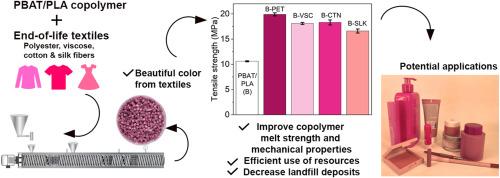
Bioflex is a biodegradable polymer blend combining poly(butylene adipate-co-terephthalate) (PBAT) and bio-based poly(lactic acid) (PLA), offering properties comparable to polyethylene. However, challenges like limited processability and low mechanical properties restrict its use to agricultural films. In this study, fibers from end-of-life textiles (polyester, viscose, cotton, and silk) are used to address these limitations, demonstrating a resource-efficient approach to reducing landfill deposits. Adding fibers to the polymer blend (30 wt%) visibly improves the melt strength. The end-of-life fibers affect the mechanical properties in different ways: polyester fibers almost double the tensile strength, viscose fibers triples flexural strength, and silk fibers lead to the highest compressive strength. The retained colors of the fibers further contribute to vibrant composites, making them ideal for cosmetics packaging, household goods, fashion accessories, and toys. Additionally, the composting test revealed varied disintegration behaviors. Cotton and silk began disintegrating first, viscose followed, while polyester showed no disintegration, extending the composite's durability in use. This study highlights the potential of end-of-life textiles as an excellent reinforcement for Bioflex copolymer blends, promoting efficient resource use, reducing environmental waste, and unlocking new application areas for biodegradable polymers.




 京公网安备 11010802042870号
京ICP备2023020795号-1
京公网安备 11010802042870号
京ICP备2023020795号-1

 分享
分享
 求助内容:
求助内容: 应助结果提醒方式:
 扫码关注我们
