{"title":"First insights on pollination mutualism impact on fig drying and quality","authors":"Ahmed Irchad , Rachida Ouaabou , Charaf Ed-dine Kassimi , Rachid Aboutayeb , Abderrahim Eddahby , Lahcen Hssaini","doi":"10.1016/j.sajb.2025.03.018","DOIUrl":null,"url":null,"abstract":"<div><div>Caprification, or the pollination of figs, represents a unique and complex mutualistic system in nature, prompting the fundamental question: How does caprification influence the drying thermodynamics (drying rate, effective moisture diffusivity, and drying curve modeling) and post-drying quality (ionomic content and spectral fingerprints) of figs? Since there are many types of caprifig, the effect on the quality of the common fig might depend on the specific source. This research aims to address this question by examining the individual and combined effects of pollination and pollen source on the thermodynamic properties and quality of ‘Nabout’ figs under controlled caprification and constant aerothermal conditions. Two male trees, ‘Frond Oeud N°4’ and ‘Ouzidane’, were compared to an unpollinated control group. The results reveal a significant reduction in drying time associated with pollination and specific pollen sources. Pollinated figs with ‘Frond Oeud N°4’ showed a 12 % reduction in drying time, while those with ‘Ouzidane’ showed a 9 % reduction compared to unpollinated figs (<em>p</em> < 0.05). Caprification induced a higher drying rate, leading to an overall decreased drying time. Effective moisture diffusivity (D<sub><em>eff</em></sub>) was higher in pollinated figs, with values ranging from 1.77 × 10⁻⁹ m²/s to 2.23 × 10⁻⁹ m²/s, depending on the pollen source. While both caprification and pollen source influenced fig drying kinetics, the pollen source's impact on drying time was not statistically significant (<em>p</em> > 0.05). Multivariate quality assessment, including mineral content and FTIR-based fingerprinting, unveiled similar trends with caprification and pollen source impacting fig quality, although without a clear linear trend. Pollinated figs exhibited distinct mineral profiles, with total nitrogen (TN) and potassium (K) levels generally lower by approximately 10–20 % compared to unpollinated figs. Conversely, iron (Fe), zinc (Zn), manganese (Mn) and copper (Cu) levels were higher in pollinated figs compared to unpollinated ones. FTIR fingerprinting showed that pollinated figs had higher integrated intensities in key vibrational regions, indicating increased levels of bioactive compounds. These findings elucidate the coevolutionary synergy between figs and their pollinators which modulate fig pre- and post-drying quality while advancing sustainable strategies for optimizing drying efficiency and nutritional quality in fig through selective caprification.</div></div>","PeriodicalId":21919,"journal":{"name":"South African Journal of Botany","volume":"180 ","pages":"Pages 444-460"},"PeriodicalIF":2.7000,"publicationDate":"2025-03-25","publicationTypes":"Journal Article","fieldsOfStudy":null,"isOpenAccess":false,"openAccessPdf":"","citationCount":"0","resultStr":null,"platform":"Semanticscholar","paperid":null,"PeriodicalName":"South African Journal of Botany","FirstCategoryId":"99","ListUrlMain":"https://www.sciencedirect.com/science/article/pii/S0254629925001413","RegionNum":3,"RegionCategory":"生物学","ArticlePicture":[],"TitleCN":null,"AbstractTextCN":null,"PMCID":null,"EPubDate":"","PubModel":"","JCR":"Q2","JCRName":"PLANT SCIENCES","Score":null,"Total":0}
引用次数: 0
Abstract
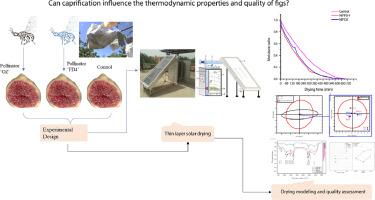
Caprification, or the pollination of figs, represents a unique and complex mutualistic system in nature, prompting the fundamental question: How does caprification influence the drying thermodynamics (drying rate, effective moisture diffusivity, and drying curve modeling) and post-drying quality (ionomic content and spectral fingerprints) of figs? Since there are many types of caprifig, the effect on the quality of the common fig might depend on the specific source. This research aims to address this question by examining the individual and combined effects of pollination and pollen source on the thermodynamic properties and quality of ‘Nabout’ figs under controlled caprification and constant aerothermal conditions. Two male trees, ‘Frond Oeud N°4’ and ‘Ouzidane’, were compared to an unpollinated control group. The results reveal a significant reduction in drying time associated with pollination and specific pollen sources. Pollinated figs with ‘Frond Oeud N°4’ showed a 12 % reduction in drying time, while those with ‘Ouzidane’ showed a 9 % reduction compared to unpollinated figs (p < 0.05). Caprification induced a higher drying rate, leading to an overall decreased drying time. Effective moisture diffusivity (Deff) was higher in pollinated figs, with values ranging from 1.77 × 10⁻⁹ m²/s to 2.23 × 10⁻⁹ m²/s, depending on the pollen source. While both caprification and pollen source influenced fig drying kinetics, the pollen source's impact on drying time was not statistically significant (p > 0.05). Multivariate quality assessment, including mineral content and FTIR-based fingerprinting, unveiled similar trends with caprification and pollen source impacting fig quality, although without a clear linear trend. Pollinated figs exhibited distinct mineral profiles, with total nitrogen (TN) and potassium (K) levels generally lower by approximately 10–20 % compared to unpollinated figs. Conversely, iron (Fe), zinc (Zn), manganese (Mn) and copper (Cu) levels were higher in pollinated figs compared to unpollinated ones. FTIR fingerprinting showed that pollinated figs had higher integrated intensities in key vibrational regions, indicating increased levels of bioactive compounds. These findings elucidate the coevolutionary synergy between figs and their pollinators which modulate fig pre- and post-drying quality while advancing sustainable strategies for optimizing drying efficiency and nutritional quality in fig through selective caprification.
期刊介绍:
The South African Journal of Botany publishes original papers that deal with the classification, biodiversity, morphology, physiology, molecular biology, ecology, biotechnology, ethnobotany and other botanically related aspects of species that are of importance to southern Africa. Manuscripts dealing with significant new findings on other species of the world and general botanical principles will also be considered and are encouraged.



 京公网安备 11010802042870号
京ICP备2023020795号-1
京公网安备 11010802042870号
京ICP备2023020795号-1

 分享
分享
 求助内容:
求助内容: 应助结果提醒方式:
 扫码关注我们
