Bo Zhang , Xiaoxing Yan , Shengli Liu , Enze Wu , Yuanyuan Tian
{"title":"Polydopamine modified Nd-doped TiO2 films for improved electrochromism and energy storage","authors":"Bo Zhang , Xiaoxing Yan , Shengli Liu , Enze Wu , Yuanyuan Tian","doi":"10.1016/j.optmat.2025.116969","DOIUrl":null,"url":null,"abstract":"<div><div>Electrochromic materials can show reversible optical changes under the small applied voltages, which have the great application prospects in smart window, energy storage, thermal control fields. In the practical application of electrochromic materials, fast responsiveness and stable periodicity are urgently needed. In this study, the nanoporous Nd-doped TiO<sub>2</sub> (TNO) films are synthesized by the hydrothermal method, and then polydopamine (PDA) is coated on the surfaces of TNO films to prepare TNO-P<sub>t</sub> films (t = 15, 30, 60 and 120). TNO-P<sub>t</sub> films have the wider transmittance modulations and larger surface capacitances than that of TNO film. Moreover, TNO-P<sub>t</sub> films have shorter response times and higher cycle stability due to PDA films enhance the interface ion transfer properties and electrochemical stability of nanoporous TNO films. In particular, the coloring and bleaching times of the TNO-P<sub>60</sub> film is 12.4 and 18.3 s, and retained 91.7 % of the initial transmittance modulation (70.3 %) after 2000 cycles. In addition, the surface capacitance of TNO film modified by PDA can be risen to 238 %. Therefore, TNO-P<sub>t</sub> films can be used as one candidate material for electrochromic energy saving and storage window.</div></div>","PeriodicalId":19564,"journal":{"name":"Optical Materials","volume":"163 ","pages":"Article 116969"},"PeriodicalIF":4.2000,"publicationDate":"2025-03-22","publicationTypes":"Journal Article","fieldsOfStudy":null,"isOpenAccess":false,"openAccessPdf":"","citationCount":"0","resultStr":null,"platform":"Semanticscholar","paperid":null,"PeriodicalName":"Optical Materials","FirstCategoryId":"88","ListUrlMain":"https://www.sciencedirect.com/science/article/pii/S0925346725003295","RegionNum":3,"RegionCategory":"材料科学","ArticlePicture":[],"TitleCN":null,"AbstractTextCN":null,"PMCID":null,"EPubDate":"","PubModel":"","JCR":"Q2","JCRName":"MATERIALS SCIENCE, MULTIDISCIPLINARY","Score":null,"Total":0}
引用次数: 0
Abstract
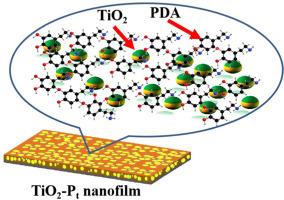
Electrochromic materials can show reversible optical changes under the small applied voltages, which have the great application prospects in smart window, energy storage, thermal control fields. In the practical application of electrochromic materials, fast responsiveness and stable periodicity are urgently needed. In this study, the nanoporous Nd-doped TiO2 (TNO) films are synthesized by the hydrothermal method, and then polydopamine (PDA) is coated on the surfaces of TNO films to prepare TNO-Pt films (t = 15, 30, 60 and 120). TNO-Pt films have the wider transmittance modulations and larger surface capacitances than that of TNO film. Moreover, TNO-Pt films have shorter response times and higher cycle stability due to PDA films enhance the interface ion transfer properties and electrochemical stability of nanoporous TNO films. In particular, the coloring and bleaching times of the TNO-P60 film is 12.4 and 18.3 s, and retained 91.7 % of the initial transmittance modulation (70.3 %) after 2000 cycles. In addition, the surface capacitance of TNO film modified by PDA can be risen to 238 %. Therefore, TNO-Pt films can be used as one candidate material for electrochromic energy saving and storage window.
期刊介绍:
Optical Materials has an open access mirror journal Optical Materials: X, sharing the same aims and scope, editorial team, submission system and rigorous peer review.
The purpose of Optical Materials is to provide a means of communication and technology transfer between researchers who are interested in materials for potential device applications. The journal publishes original papers and review articles on the design, synthesis, characterisation and applications of optical materials.
OPTICAL MATERIALS focuses on:
• Optical Properties of Material Systems;
• The Materials Aspects of Optical Phenomena;
• The Materials Aspects of Devices and Applications.
Authors can submit separate research elements describing their data to Data in Brief and methods to Methods X.



 京公网安备 11010802042870号
京ICP备2023020795号-1
京公网安备 11010802042870号
京ICP备2023020795号-1

 分享
分享
 求助内容:
求助内容: 应助结果提醒方式:
 扫码关注我们
