{"title":"Optimized forgetting factor recursive least square method for equivalent circuit model parameter extraction of battery and ultracapacitor","authors":"Achikkulath Prasanthi , Hussain Shareef , Saifulnizam Abd Khalid , Jeyraj Selvaraj","doi":"10.1016/j.est.2025.116298","DOIUrl":null,"url":null,"abstract":"<div><div>The hybridization of multiple energy sources is crucial for electric vehicle applications to achieve the same level of performance as that of internal combustion engine vehicles. Accurate power flow control depends on knowing the internal resistance of the battery and ultracapacitor (UC) at various charge levels. Therefore, this work focuses on prediction of the internal resistance of these sources at varying charge states and discharge rates. The first objective of this work is to establish a relationship between the source's state of charge (SoC) and open circuit voltage using a machine learning regression-based optimized curve-fitting model. This technique uses an algorithm to learn patterns from experimental data that minimize fitting errors and avoid overfitting, guaranteeing precise and broadly applicable forecasts. Thus, this model increases forecast accuracy and enhances generalization for dynamic operating conditions. The second objective is the application of a hybridized approach of heuristic optimization and forgetting factor recursive least square method, known as optimized forgetting factor recursive least square (OFFRLS) for extracting the source's internal electrical parameter at varying SoC and discharge rate. The forgetting factor in FFRLS can be challenging to adjust and can lead to overfitting since it affects the trade-off between stability and adapting to new input. As a result, the forgetting factor of the FFRLS algorithm is optimized at each time instant using heuristic optimization. This method is used to characterize battery and UC with second order Thevenin equivalent circuit model, which strikes a balance between complexity and accuracy and can capture dynamic behavior. For real time parameter estimation, an artificial neural network (ANN) prediction model trained using Bayesian regularization is developed for accurate and time-efficient source parameter estimation. When compared to OFFRLS, the time consumption can be decreased by using the ANN model for real-time estimate. Calibration tests, open circuit voltage tests, and dynamic discharge tests are performed in the lab with battery and UC for this research. By contrasting the estimated and actual terminal voltages of the sources, OFFRLS's effectiveness is illustrated. The measured terminal voltage of the battery differed from the estimated voltage by less than 0.5 %. The ability of the ANN to predict the internal resistance without overfitting was demonstrated by the strong correlation coefficients between the training and test data. Therefore, the proposed dynamic battery and UC models could be effectively used in applications such as energy management systems in electric vehicles.</div></div>","PeriodicalId":15942,"journal":{"name":"Journal of energy storage","volume":"119 ","pages":"Article 116298"},"PeriodicalIF":8.9000,"publicationDate":"2025-03-23","publicationTypes":"Journal Article","fieldsOfStudy":null,"isOpenAccess":false,"openAccessPdf":"","citationCount":"0","resultStr":null,"platform":"Semanticscholar","paperid":null,"PeriodicalName":"Journal of energy storage","FirstCategoryId":"5","ListUrlMain":"https://www.sciencedirect.com/science/article/pii/S2352152X25010114","RegionNum":2,"RegionCategory":"工程技术","ArticlePicture":[],"TitleCN":null,"AbstractTextCN":null,"PMCID":null,"EPubDate":"","PubModel":"","JCR":"Q1","JCRName":"ENERGY & FUELS","Score":null,"Total":0}
引用次数: 0
Abstract
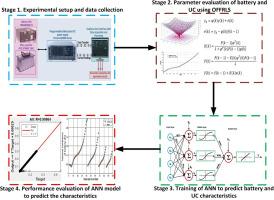
The hybridization of multiple energy sources is crucial for electric vehicle applications to achieve the same level of performance as that of internal combustion engine vehicles. Accurate power flow control depends on knowing the internal resistance of the battery and ultracapacitor (UC) at various charge levels. Therefore, this work focuses on prediction of the internal resistance of these sources at varying charge states and discharge rates. The first objective of this work is to establish a relationship between the source's state of charge (SoC) and open circuit voltage using a machine learning regression-based optimized curve-fitting model. This technique uses an algorithm to learn patterns from experimental data that minimize fitting errors and avoid overfitting, guaranteeing precise and broadly applicable forecasts. Thus, this model increases forecast accuracy and enhances generalization for dynamic operating conditions. The second objective is the application of a hybridized approach of heuristic optimization and forgetting factor recursive least square method, known as optimized forgetting factor recursive least square (OFFRLS) for extracting the source's internal electrical parameter at varying SoC and discharge rate. The forgetting factor in FFRLS can be challenging to adjust and can lead to overfitting since it affects the trade-off between stability and adapting to new input. As a result, the forgetting factor of the FFRLS algorithm is optimized at each time instant using heuristic optimization. This method is used to characterize battery and UC with second order Thevenin equivalent circuit model, which strikes a balance between complexity and accuracy and can capture dynamic behavior. For real time parameter estimation, an artificial neural network (ANN) prediction model trained using Bayesian regularization is developed for accurate and time-efficient source parameter estimation. When compared to OFFRLS, the time consumption can be decreased by using the ANN model for real-time estimate. Calibration tests, open circuit voltage tests, and dynamic discharge tests are performed in the lab with battery and UC for this research. By contrasting the estimated and actual terminal voltages of the sources, OFFRLS's effectiveness is illustrated. The measured terminal voltage of the battery differed from the estimated voltage by less than 0.5 %. The ability of the ANN to predict the internal resistance without overfitting was demonstrated by the strong correlation coefficients between the training and test data. Therefore, the proposed dynamic battery and UC models could be effectively used in applications such as energy management systems in electric vehicles.
期刊介绍:
Journal of energy storage focusses on all aspects of energy storage, in particular systems integration, electric grid integration, modelling and analysis, novel energy storage technologies, sizing and management strategies, business models for operation of storage systems and energy storage developments worldwide.




 京公网安备 11010802042870号
京ICP备2023020795号-1
京公网安备 11010802042870号
京ICP备2023020795号-1

 分享
分享
 求助内容:
求助内容: 应助结果提醒方式:
 扫码关注我们
