Dengwei Yan , Fengyue Sun , Yanwei Ju , Haoping Di , Changle Yue , Yanfei Chen , Chongzheng Xu , Yukun Lu
{"title":"MOF-derived NiMoS hollow sphere for efficient hydrodesulfurization: Effects of composition and morphology of active phase of NiMoS catalysts","authors":"Dengwei Yan , Fengyue Sun , Yanwei Ju , Haoping Di , Changle Yue , Yanfei Chen , Chongzheng Xu , Yukun Lu","doi":"10.1016/j.fuel.2025.135121","DOIUrl":null,"url":null,"abstract":"<div><div>The rational modulation of bimetallic intimately synergistic unsupported catalysts is the essential approach for efficient hydrodesulfurization (HDS). Herein, we have successfully produced NiMoS hollow spheres (H-NiMoS) by the Ni-MOF-engaged strategy using Ni metal–organic framework (Ni-MOF) as a precursor. The Ni-MOF serves as a landing site for vertically oriented MoS<sub>2</sub> nanosheets and also acts as a nickel promoter for inducing the formation of the NiMoS active phase. The H-NiMoS catalyst achieves three-dimensional self-assembly of MoS<sub>2</sub> nanosheets on hollow spheres, displaying a higher specific surface area (105 m<sup>2</sup>·g<sup>−1</sup>) compared to pure MoS<sub>2</sub> (52 m<sup>2</sup>·g<sup>−1</sup>). The H-NiMoS catalyst produces vertical MoS<sub>2</sub> with low stacking number (2–3 layers) and short slab length (2–4 nm), thus providing a large number of “rim” sites for HDS reaction. As expected, the H-NiMoS catalyst exhibits efficient HDS activity with 99.8 % conversion of dibenzothiophene (DBT) and 93.0 % conversion of 4,6-dimethyldibenzothiophene (4,6-DMDBT), as well as HDS selectivity that S<sub>HYD/DDS(DBT)</sub> = 1.3 and S<sub>HYD/DDS(4,6-DMDBT)</sub> = 3.2. Consequently, the Ni-MOF-engaged strategy of fabricating MoS<sub>2</sub> nanosheets with vertically oriented structures by using Ni-MOF precursors provides significant guidance for improving the activity and HYD selectivity of conventional HDS catalysts by exposing more “rim” sites.</div></div>","PeriodicalId":325,"journal":{"name":"Fuel","volume":"394 ","pages":"Article 135121"},"PeriodicalIF":7.5000,"publicationDate":"2025-03-21","publicationTypes":"Journal Article","fieldsOfStudy":null,"isOpenAccess":false,"openAccessPdf":"","citationCount":"0","resultStr":null,"platform":"Semanticscholar","paperid":null,"PeriodicalName":"Fuel","FirstCategoryId":"5","ListUrlMain":"https://www.sciencedirect.com/science/article/pii/S0016236125008464","RegionNum":1,"RegionCategory":"工程技术","ArticlePicture":[],"TitleCN":null,"AbstractTextCN":null,"PMCID":null,"EPubDate":"","PubModel":"","JCR":"Q2","JCRName":"ENERGY & FUELS","Score":null,"Total":0}
引用次数: 0
Abstract
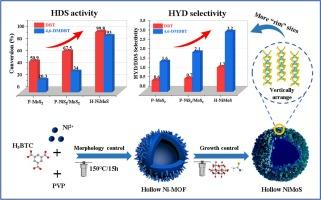
The rational modulation of bimetallic intimately synergistic unsupported catalysts is the essential approach for efficient hydrodesulfurization (HDS). Herein, we have successfully produced NiMoS hollow spheres (H-NiMoS) by the Ni-MOF-engaged strategy using Ni metal–organic framework (Ni-MOF) as a precursor. The Ni-MOF serves as a landing site for vertically oriented MoS2 nanosheets and also acts as a nickel promoter for inducing the formation of the NiMoS active phase. The H-NiMoS catalyst achieves three-dimensional self-assembly of MoS2 nanosheets on hollow spheres, displaying a higher specific surface area (105 m2·g−1) compared to pure MoS2 (52 m2·g−1). The H-NiMoS catalyst produces vertical MoS2 with low stacking number (2–3 layers) and short slab length (2–4 nm), thus providing a large number of “rim” sites for HDS reaction. As expected, the H-NiMoS catalyst exhibits efficient HDS activity with 99.8 % conversion of dibenzothiophene (DBT) and 93.0 % conversion of 4,6-dimethyldibenzothiophene (4,6-DMDBT), as well as HDS selectivity that SHYD/DDS(DBT) = 1.3 and SHYD/DDS(4,6-DMDBT) = 3.2. Consequently, the Ni-MOF-engaged strategy of fabricating MoS2 nanosheets with vertically oriented structures by using Ni-MOF precursors provides significant guidance for improving the activity and HYD selectivity of conventional HDS catalysts by exposing more “rim” sites.
期刊介绍:
The exploration of energy sources remains a critical matter of study. For the past nine decades, fuel has consistently held the forefront in primary research efforts within the field of energy science. This area of investigation encompasses a wide range of subjects, with a particular emphasis on emerging concerns like environmental factors and pollution.



 京公网安备 11010802042870号
京ICP备2023020795号-1
京公网安备 11010802042870号
京ICP备2023020795号-1

 分享
分享
 求助内容:
求助内容: 应助结果提醒方式:
 扫码关注我们
