Improving the antifouling properties of anion exchange membrane by reducing the adhesion force between membrane and foulants via construction of zwitterionic surface nanolayer
Yunchen Mao , Yukun Qian , Hongyu Jin , Manman Wang , Bing Yang , Dan Lu , Ying Li , Zhikan Yao , Lin Zhang
{"title":"Improving the antifouling properties of anion exchange membrane by reducing the adhesion force between membrane and foulants via construction of zwitterionic surface nanolayer","authors":"Yunchen Mao , Yukun Qian , Hongyu Jin , Manman Wang , Bing Yang , Dan Lu , Ying Li , Zhikan Yao , Lin Zhang","doi":"10.1016/j.memsci.2025.124011","DOIUrl":null,"url":null,"abstract":"<div><div>Membrane fouling is a critical challenge that must be addressed for the effective application of electrodialysis in wastewater treatment. In this study, zwitterionic surface nanolayer was constructed on anion exchange membrane (AEM), which significantly reduced the adhesion force between the membrane surface and foulants, thereby improving the antifouling properties of the membrane. Among the modified membranes, the best-performing AEM-PDA-SBMA and AEM-PDA-MPC exhibited low adhesion forces to the model foulant of only 0.465 nN and 0.499 nN as measured by AFM, respectively. This was primarily attributed to the reduction in hydrophobic interactions, with a decrease in electrostatic interactions also contributing to the overall effect. In the electrodialysis desalination fouling experiments, the membrane energy consumption of the zwitterionic modified membranes was only 7.76 % and 9.35 % of that of the unmodified membrane. Additionally, the total energy consumption was reduced to 44.22 % and 45.57 %, respectively, while maintaining high current efficiency (>91 %). The long-term stability of the membrane was verified through cyclic electrodialysis experiments. Fouling analysis demonstrated that most of the fouling on the modified membrane was reversible, but a small amount of irreversible fouling was a potential threat. This study quantified the antifouling properties of membranes by measuring the adhesion force between the membrane surface and foulants, providing valuable insights into the interaction mechanisms involved in membrane fouling and offering guidance for the development of effective antifouling strategies.</div></div>","PeriodicalId":368,"journal":{"name":"Journal of Membrane Science","volume":"724 ","pages":"Article 124011"},"PeriodicalIF":9.0000,"publicationDate":"2025-05-01","publicationTypes":"Journal Article","fieldsOfStudy":null,"isOpenAccess":false,"openAccessPdf":"","citationCount":"0","resultStr":null,"platform":"Semanticscholar","paperid":null,"PeriodicalName":"Journal of Membrane Science","FirstCategoryId":"5","ListUrlMain":"https://www.sciencedirect.com/science/article/pii/S0376738825003242","RegionNum":1,"RegionCategory":"工程技术","ArticlePicture":[],"TitleCN":null,"AbstractTextCN":null,"PMCID":null,"EPubDate":"2025/3/20 0:00:00","PubModel":"Epub","JCR":"Q1","JCRName":"ENGINEERING, CHEMICAL","Score":null,"Total":0}
引用次数: 0
Abstract
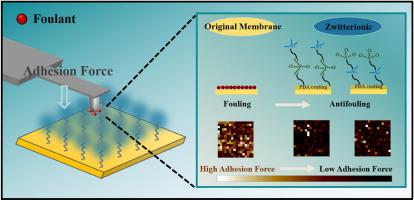
Membrane fouling is a critical challenge that must be addressed for the effective application of electrodialysis in wastewater treatment. In this study, zwitterionic surface nanolayer was constructed on anion exchange membrane (AEM), which significantly reduced the adhesion force between the membrane surface and foulants, thereby improving the antifouling properties of the membrane. Among the modified membranes, the best-performing AEM-PDA-SBMA and AEM-PDA-MPC exhibited low adhesion forces to the model foulant of only 0.465 nN and 0.499 nN as measured by AFM, respectively. This was primarily attributed to the reduction in hydrophobic interactions, with a decrease in electrostatic interactions also contributing to the overall effect. In the electrodialysis desalination fouling experiments, the membrane energy consumption of the zwitterionic modified membranes was only 7.76 % and 9.35 % of that of the unmodified membrane. Additionally, the total energy consumption was reduced to 44.22 % and 45.57 %, respectively, while maintaining high current efficiency (>91 %). The long-term stability of the membrane was verified through cyclic electrodialysis experiments. Fouling analysis demonstrated that most of the fouling on the modified membrane was reversible, but a small amount of irreversible fouling was a potential threat. This study quantified the antifouling properties of membranes by measuring the adhesion force between the membrane surface and foulants, providing valuable insights into the interaction mechanisms involved in membrane fouling and offering guidance for the development of effective antifouling strategies.
期刊介绍:
The Journal of Membrane Science is a publication that focuses on membrane systems and is aimed at academic and industrial chemists, chemical engineers, materials scientists, and membranologists. It publishes original research and reviews on various aspects of membrane transport, membrane formation/structure, fouling, module/process design, and processes/applications. The journal primarily focuses on the structure, function, and performance of non-biological membranes but also includes papers that relate to biological membranes. The Journal of Membrane Science publishes Full Text Papers, State-of-the-Art Reviews, Letters to the Editor, and Perspectives.



 京公网安备 11010802042870号
京ICP备2023020795号-1
京公网安备 11010802042870号
京ICP备2023020795号-1

 分享
分享
 求助内容:
求助内容: 应助结果提醒方式:
 扫码关注我们
