Tao Liu , Suan Huang , Weiwen Xin , Xiaohan He , Shicheng Wan , Chaowen Yang , Juncheng Zhao , Liuyong Shi , Hong Yan , Teng Zhou , Liping Wen
{"title":"High-performance graphene oxide / sodium alginate composite membrane for marine osmotic energy conversion","authors":"Tao Liu , Suan Huang , Weiwen Xin , Xiaohan He , Shicheng Wan , Chaowen Yang , Juncheng Zhao , Liuyong Shi , Hong Yan , Teng Zhou , Liping Wen","doi":"10.1016/j.memsci.2025.123987","DOIUrl":null,"url":null,"abstract":"<div><div>With advancements in Reverse Electrodialysis (RED) technology, an increasing number of high-power-density permeable membranes have been proposed for salinity gradient power generation. Two-dimensional (2D) materials, characterized by their abundant surface charges, can form nanochannels with high surface charge density during the stacking process to achieve exceptional ion selectivity. Additionally, the stacked structure aids in creating a highly porous permeable membrane surface, facilitating substantial ion flux during ion transport. Consequently, permeable membranes composed of 2D materials such as graphene oxide (GO) and MXenes exhibit particularly outstanding performance in the field of salinity gradient power generation. In this context, we designed an ion-selective composite membrane formed by the mixed crosslinking of graphene oxide and sodium alginate. The composite membrane utilizes stacked graphene oxide nanosheets to provide a two-dimensional layered framework, while sodium alginate, rich in negatively charged functional groups, crosslinks between the nanosheets to create abundant spatial charge, significantly enhancing the power density for salinity gradient power generation. This composite membrane exhibits a power density of approximately 14.75 W/m<sup>2</sup> under a 50-fold NaCl solution salinity gradient, and an astonishing 20.94 W/m<sup>2</sup> under a 50-fold KCl solution salinity gradient. In real seawater, it also achieves a high power density of 19.39 W/m<sup>2</sup>, far exceeding the industry benchmark of 5.0 W/m<sup>2</sup> and outperforming most existing materials. These results are expected to promote the practical application of marine salinity gradient energy and provide new design strategies for the development of marine salinity gradient resources.</div></div>","PeriodicalId":368,"journal":{"name":"Journal of Membrane Science","volume":"724 ","pages":"Article 123987"},"PeriodicalIF":9.0000,"publicationDate":"2025-05-01","publicationTypes":"Journal Article","fieldsOfStudy":null,"isOpenAccess":false,"openAccessPdf":"","citationCount":"0","resultStr":null,"platform":"Semanticscholar","paperid":null,"PeriodicalName":"Journal of Membrane Science","FirstCategoryId":"5","ListUrlMain":"https://www.sciencedirect.com/science/article/pii/S037673882500300X","RegionNum":1,"RegionCategory":"工程技术","ArticlePicture":[],"TitleCN":null,"AbstractTextCN":null,"PMCID":null,"EPubDate":"2025/3/20 0:00:00","PubModel":"Epub","JCR":"Q1","JCRName":"ENGINEERING, CHEMICAL","Score":null,"Total":0}
引用次数: 0
Abstract
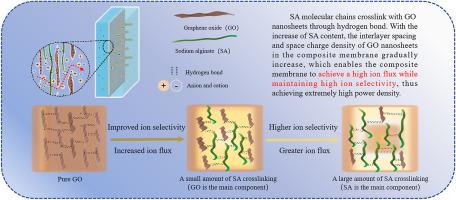
With advancements in Reverse Electrodialysis (RED) technology, an increasing number of high-power-density permeable membranes have been proposed for salinity gradient power generation. Two-dimensional (2D) materials, characterized by their abundant surface charges, can form nanochannels with high surface charge density during the stacking process to achieve exceptional ion selectivity. Additionally, the stacked structure aids in creating a highly porous permeable membrane surface, facilitating substantial ion flux during ion transport. Consequently, permeable membranes composed of 2D materials such as graphene oxide (GO) and MXenes exhibit particularly outstanding performance in the field of salinity gradient power generation. In this context, we designed an ion-selective composite membrane formed by the mixed crosslinking of graphene oxide and sodium alginate. The composite membrane utilizes stacked graphene oxide nanosheets to provide a two-dimensional layered framework, while sodium alginate, rich in negatively charged functional groups, crosslinks between the nanosheets to create abundant spatial charge, significantly enhancing the power density for salinity gradient power generation. This composite membrane exhibits a power density of approximately 14.75 W/m2 under a 50-fold NaCl solution salinity gradient, and an astonishing 20.94 W/m2 under a 50-fold KCl solution salinity gradient. In real seawater, it also achieves a high power density of 19.39 W/m2, far exceeding the industry benchmark of 5.0 W/m2 and outperforming most existing materials. These results are expected to promote the practical application of marine salinity gradient energy and provide new design strategies for the development of marine salinity gradient resources.
期刊介绍:
The Journal of Membrane Science is a publication that focuses on membrane systems and is aimed at academic and industrial chemists, chemical engineers, materials scientists, and membranologists. It publishes original research and reviews on various aspects of membrane transport, membrane formation/structure, fouling, module/process design, and processes/applications. The journal primarily focuses on the structure, function, and performance of non-biological membranes but also includes papers that relate to biological membranes. The Journal of Membrane Science publishes Full Text Papers, State-of-the-Art Reviews, Letters to the Editor, and Perspectives.



 京公网安备 11010802042870号
京ICP备2023020795号-1
京公网安备 11010802042870号
京ICP备2023020795号-1

 分享
分享
 求助内容:
求助内容: 应助结果提醒方式:
 扫码关注我们
