Jiaxin Zhou , Yiqiao Zhao , Yilong Li , Jie Li , Jianan Huang , Lin Liu , Zhonghua Liu , Mingzhi Zhu
{"title":"Jasmine tea extract prevents CUMS-induced depression-like behaviors through the modulation of microbiota-gut-brain axis","authors":"Jiaxin Zhou , Yiqiao Zhao , Yilong Li , Jie Li , Jianan Huang , Lin Liu , Zhonghua Liu , Mingzhi Zhu","doi":"10.1016/j.foodres.2025.116214","DOIUrl":null,"url":null,"abstract":"<div><div>Depression is strongly linked to dysfunctions in the microbiota-gut-brain axis. Jasmine tea, a traditional Chinese beverage made by combining green tea with <em>Jasminum sambac</em>, has potential antidepressant effects. However, its potential to alleviate depression via modulation of the microbiota-gut-brain axis remains largely unstudied. In this study, we used a rat model of depression induced by chronic unpredictable mild stress (CUMS) to investigate the effects of jasmine tea extract (JT) on depression-related symptoms. Behavioral assessments, inflammatory marker analysis, hippocampal histology, and brain-derived neurotrophic factor (BDNF) expression assays demonstrated that JT alleviated depressive behaviors, reduced brain tissue damage, and restored cognitive function in CUMS-exposed rats. JT also significantly reduced intestinal levels of pro-inflammatory cytokines (IL-1β, IL-6, and TNF-α) and modulated oxidative stress markers (MDA, SOD, and CAT), suggesting a role in preserving intestinal integrity. Further, 16S rRNA sequencing revealed that JT shifted the gut microbiota composition in favor of beneficial bacteria such as <em>Romboutsia</em>, <em>Blautia</em>, and <em>Monoglobus</em>, while decreasing the abundance of potentially harmful bacteria, including <em>Bifidobacterium</em>, <em>Clostridium_sensu_stricto_1</em>, and <em>Escherichia-Shigella</em>. Meanwhile, non-targeted and targeted metabolomics analyses showed that JT influenced key metabolic pathways involving tryptophan, short-chain fatty acids, and bile acids, helping to restore metabolic balance across various tissues (feces, colon, serum, and cerebral cortex) in the depressed rats. These findings indicate that JT may alleviate depression by modulating the microbiota-gut-brain axis, highlighting its potential as a dietary intervention for depression management.</div></div>","PeriodicalId":323,"journal":{"name":"Food Research International","volume":"209 ","pages":"Article 116214"},"PeriodicalIF":8.0000,"publicationDate":"2025-03-14","publicationTypes":"Journal Article","fieldsOfStudy":null,"isOpenAccess":false,"openAccessPdf":"","citationCount":"0","resultStr":null,"platform":"Semanticscholar","paperid":null,"PeriodicalName":"Food Research International","FirstCategoryId":"97","ListUrlMain":"https://www.sciencedirect.com/science/article/pii/S0963996925005514","RegionNum":1,"RegionCategory":"农林科学","ArticlePicture":[],"TitleCN":null,"AbstractTextCN":null,"PMCID":null,"EPubDate":"","PubModel":"","JCR":"Q1","JCRName":"FOOD SCIENCE & TECHNOLOGY","Score":null,"Total":0}
引用次数: 0
Abstract
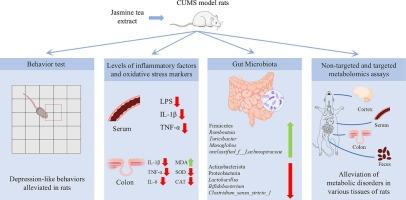
Depression is strongly linked to dysfunctions in the microbiota-gut-brain axis. Jasmine tea, a traditional Chinese beverage made by combining green tea with Jasminum sambac, has potential antidepressant effects. However, its potential to alleviate depression via modulation of the microbiota-gut-brain axis remains largely unstudied. In this study, we used a rat model of depression induced by chronic unpredictable mild stress (CUMS) to investigate the effects of jasmine tea extract (JT) on depression-related symptoms. Behavioral assessments, inflammatory marker analysis, hippocampal histology, and brain-derived neurotrophic factor (BDNF) expression assays demonstrated that JT alleviated depressive behaviors, reduced brain tissue damage, and restored cognitive function in CUMS-exposed rats. JT also significantly reduced intestinal levels of pro-inflammatory cytokines (IL-1β, IL-6, and TNF-α) and modulated oxidative stress markers (MDA, SOD, and CAT), suggesting a role in preserving intestinal integrity. Further, 16S rRNA sequencing revealed that JT shifted the gut microbiota composition in favor of beneficial bacteria such as Romboutsia, Blautia, and Monoglobus, while decreasing the abundance of potentially harmful bacteria, including Bifidobacterium, Clostridium_sensu_stricto_1, and Escherichia-Shigella. Meanwhile, non-targeted and targeted metabolomics analyses showed that JT influenced key metabolic pathways involving tryptophan, short-chain fatty acids, and bile acids, helping to restore metabolic balance across various tissues (feces, colon, serum, and cerebral cortex) in the depressed rats. These findings indicate that JT may alleviate depression by modulating the microbiota-gut-brain axis, highlighting its potential as a dietary intervention for depression management.
期刊介绍:
Food Research International serves as a rapid dissemination platform for significant and impactful research in food science, technology, engineering, and nutrition. The journal focuses on publishing novel, high-quality, and high-impact review papers, original research papers, and letters to the editors across various disciplines in the science and technology of food. Additionally, it follows a policy of publishing special issues on topical and emergent subjects in food research or related areas. Selected, peer-reviewed papers from scientific meetings, workshops, and conferences on the science, technology, and engineering of foods are also featured in special issues.



 京公网安备 11010802042870号
京ICP备2023020795号-1
京公网安备 11010802042870号
京ICP备2023020795号-1

 分享
分享
 求助内容:
求助内容: 应助结果提醒方式:
 扫码关注我们
