{"title":"Leveraging artificial intelligence for bamboo breeding in the context of \"Bamboo as a Substitute for Plastic\" initiative","authors":"Huayu Sun, Xiaolin Di, Zhimin Gao","doi":"10.1016/j.indcrop.2025.120896","DOIUrl":null,"url":null,"abstract":"<div><div>The overuse of plastic products has resulted in severe environmental pollution, driving the need for sustainable alternatives. Bamboo presents a highly promising solution due to its eco-friendly, fast-growing, renewable, and biodegradable properties. However, current bamboo species are not yet meet the large-scale production demands, primarily due to challenges like prolonged vegetative growth, unpredictable flowering time and low genetic transformation efficiency, which hinder targeted genetic improvement. The emergence of Artificial Intelligence (AI) and Internet of Things (IoT) offers a potential breakthrough in developing specialized bamboo varieties for this purpose. This review explores the potential applications of AI in bamboo breeding, including predicting flowering time to accelerate breeding processes, managing large datasets for accurate forecasting, efficiently designing strategies for genetic transformation and gene editing, optimizing species selection for various applications, providing decision-making tools for bamboo introduction sites, and facilitating the rapid propagation of improved varieties. Additionally, it discusses the future challenges and solutions for integrating AI into bamboo breeding, such as establishing regional bamboo germplasm banks and databases, constructing comprehensive genetic datasets from diverse sources, identifying key genetic and environmental factors influencing bamboo traits, developing efficient breeding design methods, and enhancing intelligent cultivation, harvesting, and product processing. Future research should be focused on overcoming these challenges to accelerate the development of bamboo varieties that meet the sustainability goals of the \"Bamboo as a Substitute for Plastic\" initiative.</div></div>","PeriodicalId":13581,"journal":{"name":"Industrial Crops and Products","volume":"228 ","pages":"Article 120896"},"PeriodicalIF":6.2000,"publicationDate":"2025-03-24","publicationTypes":"Journal Article","fieldsOfStudy":null,"isOpenAccess":false,"openAccessPdf":"","citationCount":"0","resultStr":null,"platform":"Semanticscholar","paperid":null,"PeriodicalName":"Industrial Crops and Products","FirstCategoryId":"97","ListUrlMain":"https://www.sciencedirect.com/science/article/pii/S092666902500442X","RegionNum":1,"RegionCategory":"农林科学","ArticlePicture":[],"TitleCN":null,"AbstractTextCN":null,"PMCID":null,"EPubDate":"","PubModel":"","JCR":"Q1","JCRName":"AGRICULTURAL ENGINEERING","Score":null,"Total":0}
引用次数: 0
Abstract
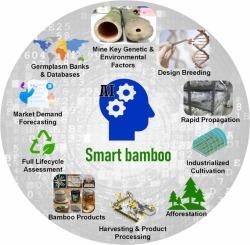
The overuse of plastic products has resulted in severe environmental pollution, driving the need for sustainable alternatives. Bamboo presents a highly promising solution due to its eco-friendly, fast-growing, renewable, and biodegradable properties. However, current bamboo species are not yet meet the large-scale production demands, primarily due to challenges like prolonged vegetative growth, unpredictable flowering time and low genetic transformation efficiency, which hinder targeted genetic improvement. The emergence of Artificial Intelligence (AI) and Internet of Things (IoT) offers a potential breakthrough in developing specialized bamboo varieties for this purpose. This review explores the potential applications of AI in bamboo breeding, including predicting flowering time to accelerate breeding processes, managing large datasets for accurate forecasting, efficiently designing strategies for genetic transformation and gene editing, optimizing species selection for various applications, providing decision-making tools for bamboo introduction sites, and facilitating the rapid propagation of improved varieties. Additionally, it discusses the future challenges and solutions for integrating AI into bamboo breeding, such as establishing regional bamboo germplasm banks and databases, constructing comprehensive genetic datasets from diverse sources, identifying key genetic and environmental factors influencing bamboo traits, developing efficient breeding design methods, and enhancing intelligent cultivation, harvesting, and product processing. Future research should be focused on overcoming these challenges to accelerate the development of bamboo varieties that meet the sustainability goals of the "Bamboo as a Substitute for Plastic" initiative.
期刊介绍:
Industrial Crops and Products is an International Journal publishing academic and industrial research on industrial (defined as non-food/non-feed) crops and products. Papers concern both crop-oriented and bio-based materials from crops-oriented research, and should be of interest to an international audience, hypothesis driven, and where comparisons are made statistics performed.



 京公网安备 11010802042870号
京ICP备2023020795号-1
京公网安备 11010802042870号
京ICP备2023020795号-1

 分享
分享
 求助内容:
求助内容: 应助结果提醒方式:
 扫码关注我们
