{"title":"Preparation of Janus membrane with self-cleaning functionality and membrane distillation performance","authors":"Rui Zhang, Yunhuan Chen, Hailong Wang, Xugang Song, Qiang Ma, Xiaoxiao Duan, Yongsheng Ren","doi":"10.1016/j.desal.2025.118825","DOIUrl":null,"url":null,"abstract":"<div><div>Membrane distillation (MD) technology encounters problems such as membrane scaling, membrane wetting, and fouling during the reprocessing of diverse wastewater types. Janus membranes are anticipated to hold significant potential in addressing these issues. The metal-polyphenol network (MPN) was employed to mediate the catalytic self-cleaning ability of the intermediate mineralization layer as well as the PA-layered Janus membranes generated on the surface through the interfacial polymerization (IP) reaction. It was revealed that the pure water flux of the pristine PVDF membrane was 44.9 LMH, while that of the Janus membrane was 41.8 LMH. The PA layer of the Janus membrane is conducive to the increase of flux because of its hydrophilicity. However, excessive nanoparticles can block the membrane pores, and thus it compensates for part of the decreased flux to a certain extent. During the direct contact membrane distillation (DCMD) experiment, Janus membrane demonstrated superior performance in comparison to the PVDF membrane in the treatment of oily wastewater, saline solutions of sodium dodecyl sulphate (SDS), and gypsum-induced fouling. The mineralization layer based on manganese oxide can ensures higher stability of Janus membranes during cycling through in situ catalytic self-cleaning when dealing with the organic pollutant humic acid (HA). Overall, this study offers a novel and potential MD membrane.</div></div>","PeriodicalId":299,"journal":{"name":"Desalination","volume":"608 ","pages":"Article 118825"},"PeriodicalIF":9.8000,"publicationDate":"2025-08-01","publicationTypes":"Journal Article","fieldsOfStudy":null,"isOpenAccess":false,"openAccessPdf":"","citationCount":"0","resultStr":null,"platform":"Semanticscholar","paperid":null,"PeriodicalName":"Desalination","FirstCategoryId":"5","ListUrlMain":"https://www.sciencedirect.com/science/article/pii/S0011916425003005","RegionNum":1,"RegionCategory":"工程技术","ArticlePicture":[],"TitleCN":null,"AbstractTextCN":null,"PMCID":null,"EPubDate":"2025/3/20 0:00:00","PubModel":"Epub","JCR":"Q1","JCRName":"ENGINEERING, CHEMICAL","Score":null,"Total":0}
引用次数: 0
Abstract
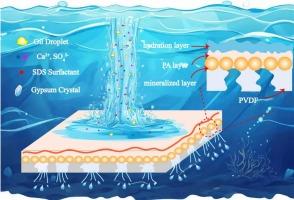
Membrane distillation (MD) technology encounters problems such as membrane scaling, membrane wetting, and fouling during the reprocessing of diverse wastewater types. Janus membranes are anticipated to hold significant potential in addressing these issues. The metal-polyphenol network (MPN) was employed to mediate the catalytic self-cleaning ability of the intermediate mineralization layer as well as the PA-layered Janus membranes generated on the surface through the interfacial polymerization (IP) reaction. It was revealed that the pure water flux of the pristine PVDF membrane was 44.9 LMH, while that of the Janus membrane was 41.8 LMH. The PA layer of the Janus membrane is conducive to the increase of flux because of its hydrophilicity. However, excessive nanoparticles can block the membrane pores, and thus it compensates for part of the decreased flux to a certain extent. During the direct contact membrane distillation (DCMD) experiment, Janus membrane demonstrated superior performance in comparison to the PVDF membrane in the treatment of oily wastewater, saline solutions of sodium dodecyl sulphate (SDS), and gypsum-induced fouling. The mineralization layer based on manganese oxide can ensures higher stability of Janus membranes during cycling through in situ catalytic self-cleaning when dealing with the organic pollutant humic acid (HA). Overall, this study offers a novel and potential MD membrane.
期刊介绍:
Desalination is a scholarly journal that focuses on the field of desalination materials, processes, and associated technologies. It encompasses a wide range of disciplines and aims to publish exceptional papers in this area.
The journal invites submissions that explicitly revolve around water desalting and its applications to various sources such as seawater, groundwater, and wastewater. It particularly encourages research on diverse desalination methods including thermal, membrane, sorption, and hybrid processes.
By providing a platform for innovative studies, Desalination aims to advance the understanding and development of desalination technologies, promoting sustainable solutions for water scarcity challenges.



 京公网安备 11010802042870号
京ICP备2023020795号-1
京公网安备 11010802042870号
京ICP备2023020795号-1

 分享
分享
 求助内容:
求助内容: 应助结果提醒方式:
 扫码关注我们
