Boyu Wang, Yuzhe Niu, Di Wang, Xingsen Mu, Yali Guo, Shengqiang Shen
{"title":"Comprehensive analysis of single tube falling film heat transfer performance considering dynamic growth of fouling","authors":"Boyu Wang, Yuzhe Niu, Di Wang, Xingsen Mu, Yali Guo, Shengqiang Shen","doi":"10.1016/j.desal.2025.118818","DOIUrl":null,"url":null,"abstract":"<div><div>The heat transfer process in horizontal tube falling film flow generally involves gas-liquid phase change and dynamic growth of porous fouling layers. However, most studies neglect fouling effects. This paper uses the finite element method to conduct a coupled numerical simulation of falling film flow, phase change heat transfer, and fouling growth, and studies the variation trend of the heat transfer coefficient (HTC) and the average HTC as the fouling grows. Under constant temperature heating, the HTC of water and seawater during saturated evaporation decreases along the circumference, with a decrease of about 56 % in the top region (0°-20°) of the tube. The HTC of saturated evaporation increases with evaporation temperature and spray density. Especially in the range of <em>θ</em> < 20° and <em>θ</em> > 160°, the rise in spray density has a greater impact on HTC. Under the influence of seawater fouling, both <em>h</em><sub><em>i</em></sub> and <em>h</em><sub><em>w</em></sub> show a decreasing trend as the inlet liquid film temperature increases. Under constant heat flux, the HTC of saturated evaporation is independent of evaporation temperature and increases with spray density. With the accumulation of fouling, the <em>h</em><sub><em>ave-i</em></sub> and <em>h</em><sub><em>ave-w</em></sub> show a downward trend. The non-boiling HTC of water and seawater has a lower decline rate along the circumference. Due to the effect of fouling growth on the flow boundary layer, <em>h</em><sub><em>i</em></sub> and <em>h</em><sub><em>w</em></sub> first increase and subsequently decrease within 20° < <em>θ</em> < 160°. Under constant heat flux, <em>h</em><sub><em>ave-i</em></sub> and <em>h</em><sub><em>ave-w</em></sub> of non-boiling change from an increasing trend with increasing inlet temperature to a decreasing trend as fouling accumulates.</div></div>","PeriodicalId":299,"journal":{"name":"Desalination","volume":"608 ","pages":"Article 118818"},"PeriodicalIF":9.8000,"publicationDate":"2025-08-01","publicationTypes":"Journal Article","fieldsOfStudy":null,"isOpenAccess":false,"openAccessPdf":"","citationCount":"0","resultStr":null,"platform":"Semanticscholar","paperid":null,"PeriodicalName":"Desalination","FirstCategoryId":"5","ListUrlMain":"https://www.sciencedirect.com/science/article/pii/S0011916425002930","RegionNum":1,"RegionCategory":"工程技术","ArticlePicture":[],"TitleCN":null,"AbstractTextCN":null,"PMCID":null,"EPubDate":"2025/3/18 0:00:00","PubModel":"Epub","JCR":"Q1","JCRName":"ENGINEERING, CHEMICAL","Score":null,"Total":0}
引用次数: 0
Abstract
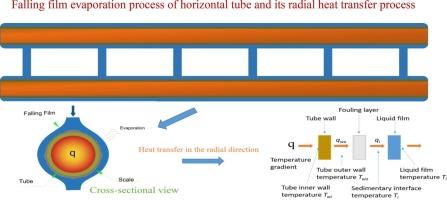
The heat transfer process in horizontal tube falling film flow generally involves gas-liquid phase change and dynamic growth of porous fouling layers. However, most studies neglect fouling effects. This paper uses the finite element method to conduct a coupled numerical simulation of falling film flow, phase change heat transfer, and fouling growth, and studies the variation trend of the heat transfer coefficient (HTC) and the average HTC as the fouling grows. Under constant temperature heating, the HTC of water and seawater during saturated evaporation decreases along the circumference, with a decrease of about 56 % in the top region (0°-20°) of the tube. The HTC of saturated evaporation increases with evaporation temperature and spray density. Especially in the range of θ < 20° and θ > 160°, the rise in spray density has a greater impact on HTC. Under the influence of seawater fouling, both hi and hw show a decreasing trend as the inlet liquid film temperature increases. Under constant heat flux, the HTC of saturated evaporation is independent of evaporation temperature and increases with spray density. With the accumulation of fouling, the have-i and have-w show a downward trend. The non-boiling HTC of water and seawater has a lower decline rate along the circumference. Due to the effect of fouling growth on the flow boundary layer, hi and hw first increase and subsequently decrease within 20° < θ < 160°. Under constant heat flux, have-i and have-w of non-boiling change from an increasing trend with increasing inlet temperature to a decreasing trend as fouling accumulates.
期刊介绍:
Desalination is a scholarly journal that focuses on the field of desalination materials, processes, and associated technologies. It encompasses a wide range of disciplines and aims to publish exceptional papers in this area.
The journal invites submissions that explicitly revolve around water desalting and its applications to various sources such as seawater, groundwater, and wastewater. It particularly encourages research on diverse desalination methods including thermal, membrane, sorption, and hybrid processes.
By providing a platform for innovative studies, Desalination aims to advance the understanding and development of desalination technologies, promoting sustainable solutions for water scarcity challenges.



 京公网安备 11010802042870号
京ICP备2023020795号-1
京公网安备 11010802042870号
京ICP备2023020795号-1

 分享
分享
 求助内容:
求助内容: 应助结果提醒方式:
 扫码关注我们
