Xiaojuan Zhang , Kexin Yang , Jiaqian Guo , Chang Yan , Xiaotong Zou , Changqing Fang
{"title":"Molecular-level side chain engineering on comb-shaped sulfonated poly(ether ether ketone) equilibrium-modified atmosphere packaging membrane","authors":"Xiaojuan Zhang , Kexin Yang , Jiaqian Guo , Chang Yan , Xiaotong Zou , Changqing Fang","doi":"10.1016/j.memsci.2025.123982","DOIUrl":null,"url":null,"abstract":"<div><div>In the fabrication of equilibrium-modified atmosphere packaging (EMAP) membranes, precise control over the membrane properties can be achieved by manipulating their chemical and chain structures. This study synthesized four types of comb-shaped sulfonated poly(ether ether ketone) (SPEEK)-based EMAP membranes, incorporating tertiary amines, imidazole, dodecyl chains, and methoxy polyethylene glycol terminal pendants via a sulfonamide electrophilic substitution reaction. These functionalized pendants acted as “valves” to modulate the membrane properties, with the “valve” size controlled by the grafting degree of each substituent and its microstructures. Among these engineered membranes, the SPEEK-12C-25 membrane, with moderate 12-C side chains, exhibited the best overall performance. It demonstrated robust mechanical strength (tensile stress >218 MPa), controllable hydrophilicity and dimensional stability across temperatures, favorable visible light transmittance (T > 85 %), and UV shielding (S<sub>UVA</sub> > 84 %, S<sub>UVB</sub> > 99 %). Notably, the well-defined hydrophilic/hydrophobic microphase separation structure within its matrix (characteristic separation length (d) value of 2.94 nm) provided a second-phase selective gas transport pathway, optimizing gas permeability and the CO<sub>2</sub>/O<sub>2</sub> separation coefficient (5.51). Furthermore, these features facilitated rapid air balance within the packaging and timely removal of moisture to prevent water vapor condensation, allowing the packaged cherry tomatoes to maintain 88.70 % of their weight, 53.10 % of firmness, 97.30 % of total soluble solids, and controllable levels of titratable acidity, phenolic, and flavonoids content. Evidently, understanding the underlying principles of molecular-level engineering for the SPEEK side chains is critical for designing EMAP materials with optimal overall performance.</div></div>","PeriodicalId":368,"journal":{"name":"Journal of Membrane Science","volume":"724 ","pages":"Article 123982"},"PeriodicalIF":9.0000,"publicationDate":"2025-05-01","publicationTypes":"Journal Article","fieldsOfStudy":null,"isOpenAccess":false,"openAccessPdf":"","citationCount":"0","resultStr":null,"platform":"Semanticscholar","paperid":null,"PeriodicalName":"Journal of Membrane Science","FirstCategoryId":"5","ListUrlMain":"https://www.sciencedirect.com/science/article/pii/S0376738825002959","RegionNum":1,"RegionCategory":"工程技术","ArticlePicture":[],"TitleCN":null,"AbstractTextCN":null,"PMCID":null,"EPubDate":"2025/3/17 0:00:00","PubModel":"Epub","JCR":"Q1","JCRName":"ENGINEERING, CHEMICAL","Score":null,"Total":0}
引用次数: 0
Abstract
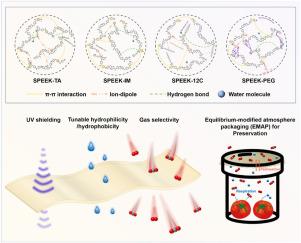
In the fabrication of equilibrium-modified atmosphere packaging (EMAP) membranes, precise control over the membrane properties can be achieved by manipulating their chemical and chain structures. This study synthesized four types of comb-shaped sulfonated poly(ether ether ketone) (SPEEK)-based EMAP membranes, incorporating tertiary amines, imidazole, dodecyl chains, and methoxy polyethylene glycol terminal pendants via a sulfonamide electrophilic substitution reaction. These functionalized pendants acted as “valves” to modulate the membrane properties, with the “valve” size controlled by the grafting degree of each substituent and its microstructures. Among these engineered membranes, the SPEEK-12C-25 membrane, with moderate 12-C side chains, exhibited the best overall performance. It demonstrated robust mechanical strength (tensile stress >218 MPa), controllable hydrophilicity and dimensional stability across temperatures, favorable visible light transmittance (T > 85 %), and UV shielding (SUVA > 84 %, SUVB > 99 %). Notably, the well-defined hydrophilic/hydrophobic microphase separation structure within its matrix (characteristic separation length (d) value of 2.94 nm) provided a second-phase selective gas transport pathway, optimizing gas permeability and the CO2/O2 separation coefficient (5.51). Furthermore, these features facilitated rapid air balance within the packaging and timely removal of moisture to prevent water vapor condensation, allowing the packaged cherry tomatoes to maintain 88.70 % of their weight, 53.10 % of firmness, 97.30 % of total soluble solids, and controllable levels of titratable acidity, phenolic, and flavonoids content. Evidently, understanding the underlying principles of molecular-level engineering for the SPEEK side chains is critical for designing EMAP materials with optimal overall performance.
期刊介绍:
The Journal of Membrane Science is a publication that focuses on membrane systems and is aimed at academic and industrial chemists, chemical engineers, materials scientists, and membranologists. It publishes original research and reviews on various aspects of membrane transport, membrane formation/structure, fouling, module/process design, and processes/applications. The journal primarily focuses on the structure, function, and performance of non-biological membranes but also includes papers that relate to biological membranes. The Journal of Membrane Science publishes Full Text Papers, State-of-the-Art Reviews, Letters to the Editor, and Perspectives.




 京公网安备 11010802042870号
京ICP备2023020795号-1
京公网安备 11010802042870号
京ICP备2023020795号-1

 分享
分享
 求助内容:
求助内容: 应助结果提醒方式:
 扫码关注我们
