{"title":"Investigating rotational characteristics and contact mechanisms of star-like shapes using multiellipse-based DEM","authors":"Yang Li , Haoran Jiang","doi":"10.1016/j.partic.2025.03.001","DOIUrl":null,"url":null,"abstract":"<div><div>This study investigates the effect of non-convexity on the rotational characteristics and contact mechanisms of two-dimensional star-like shapes using multiellipse-based discrete element modeling (DEM). Biaxial shearing tests are conducted on star-shaped geometries with varying arm numbers and aspect ratios of the intersecting ellipses. The results indicate a non-monotonic relationship between overall particle rotation and increasing non-convexity, highlighting a more pronounced role of non-convexity in promoting local interlocking at particle contacts. Moreover, high non-convexity facilitates the formation of multiple contact points between interacting particles, which generally show higher stability than single-point contacts, except in the case of highly non-convex shapes. The geometric complexity introduced by non-convexity induces significant heterogeneity in the contact network and inter-particle force distributions. Finally, a spatial analysis of contact patterns reveals the coexistence of interlocking and excluded volume effects, where the alignment of the arms and valleys results in two distinct peaks in contact frequency and governs the initiation location of particle interactions. Meanwhile, the intermediate surfaces become less involved in particle contacts as non-convexity increases.</div></div>","PeriodicalId":401,"journal":{"name":"Particuology","volume":"99 ","pages":"Pages 210-225"},"PeriodicalIF":4.3000,"publicationDate":"2025-04-01","publicationTypes":"Journal Article","fieldsOfStudy":null,"isOpenAccess":false,"openAccessPdf":"","citationCount":"0","resultStr":null,"platform":"Semanticscholar","paperid":null,"PeriodicalName":"Particuology","FirstCategoryId":"88","ListUrlMain":"https://www.sciencedirect.com/science/article/pii/S167420012500063X","RegionNum":2,"RegionCategory":"材料科学","ArticlePicture":[],"TitleCN":null,"AbstractTextCN":null,"PMCID":null,"EPubDate":"2025/3/13 0:00:00","PubModel":"Epub","JCR":"Q2","JCRName":"ENGINEERING, CHEMICAL","Score":null,"Total":0}
引用次数: 0
Abstract
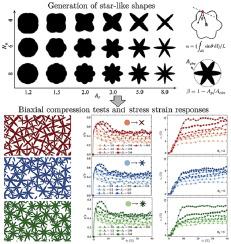
This study investigates the effect of non-convexity on the rotational characteristics and contact mechanisms of two-dimensional star-like shapes using multiellipse-based discrete element modeling (DEM). Biaxial shearing tests are conducted on star-shaped geometries with varying arm numbers and aspect ratios of the intersecting ellipses. The results indicate a non-monotonic relationship between overall particle rotation and increasing non-convexity, highlighting a more pronounced role of non-convexity in promoting local interlocking at particle contacts. Moreover, high non-convexity facilitates the formation of multiple contact points between interacting particles, which generally show higher stability than single-point contacts, except in the case of highly non-convex shapes. The geometric complexity introduced by non-convexity induces significant heterogeneity in the contact network and inter-particle force distributions. Finally, a spatial analysis of contact patterns reveals the coexistence of interlocking and excluded volume effects, where the alignment of the arms and valleys results in two distinct peaks in contact frequency and governs the initiation location of particle interactions. Meanwhile, the intermediate surfaces become less involved in particle contacts as non-convexity increases.
期刊介绍:
The word ‘particuology’ was coined to parallel the discipline for the science and technology of particles.
Particuology is an interdisciplinary journal that publishes frontier research articles and critical reviews on the discovery, formulation and engineering of particulate materials, processes and systems. It especially welcomes contributions utilising advanced theoretical, modelling and measurement methods to enable the discovery and creation of new particulate materials, and the manufacturing of functional particulate-based products, such as sensors.
Papers are handled by Thematic Editors who oversee contributions from specific subject fields. These fields are classified into: Particle Synthesis and Modification; Particle Characterization and Measurement; Granular Systems and Bulk Solids Technology; Fluidization and Particle-Fluid Systems; Aerosols; and Applications of Particle Technology.
Key topics concerning the creation and processing of particulates include:
-Modelling and simulation of particle formation, collective behaviour of particles and systems for particle production over a broad spectrum of length scales
-Mining of experimental data for particle synthesis and surface properties to facilitate the creation of new materials and processes
-Particle design and preparation including controlled response and sensing functionalities in formation, delivery systems and biological systems, etc.
-Experimental and computational methods for visualization and analysis of particulate system.
These topics are broadly relevant to the production of materials, pharmaceuticals and food, and to the conversion of energy resources to fuels and protection of the environment.



 京公网安备 11010802042870号
京ICP备2023020795号-1
京公网安备 11010802042870号
京ICP备2023020795号-1

 分享
分享
 求助内容:
求助内容: 应助结果提醒方式:
 扫码关注我们
