Chenxi Lu , Minmin Zhou , Hang Zhou , Jiwei Yao , Daoyin Liu , Yueming Wang , Lunbo Duan
{"title":"Detailed assessment with sensitivity analysis of solid stress model in MP-PIC simulation for bubbling fluidized beds","authors":"Chenxi Lu , Minmin Zhou , Hang Zhou , Jiwei Yao , Daoyin Liu , Yueming Wang , Lunbo Duan","doi":"10.1016/j.partic.2025.02.022","DOIUrl":null,"url":null,"abstract":"<div><div>Gas-solid granular flows are widely used in multiple industrial applications. The Multiphase Particle-In-Cell (MP-PIC) method is increasingly recognized for its capability to efficiently model these industrial-scale gas-solid granular flows. The solid stress model is crucial in MP-PIC method; however, its influence on the simulation results has not been thoroughly investigated. In this work, the pseudo-2D bubbling fluidized bed is modeled using MP-PIC method in OpenFOAM, in which the experiment operates at twice the minimum fluidization velocity condition using glass bead as the bed material. We primarily investigate the variation of the inter-particle solid stress values in the bed and its influence on the simulation results across a range of solid stress model parameters. The simulation results including bubble size, aspect ratio, and pressure drop and bed height, have been compared with the corresponding experimental data and empirical correlation. Sensitivity analysis narrows down the solid stress model parameter space and identify the most sensitive parameter is the close-packed volume fraction of particles. Results demonstrate that solid stress plays a significant role in dense particle flow, making particles more dispersed. Increasing solid stress reduces bubble size, aspect ratio, and pressure drop fluctuations, with minimal impact on bed height and average pressure drop. By comparing simulations and experiments, the optimal parameters of the model are determined. Moreover, the obtained optimal parameters effectively predict gas-solid flow across varying fluidization velocities and three-dimensional fluidized beds. This study provides a detailed analysis of solid stress effects, offering a more comprehensive understanding of the parameters for future MP-PIC simulations and validations.</div></div>","PeriodicalId":401,"journal":{"name":"Particuology","volume":"99 ","pages":"Pages 226-242"},"PeriodicalIF":4.3000,"publicationDate":"2025-04-01","publicationTypes":"Journal Article","fieldsOfStudy":null,"isOpenAccess":false,"openAccessPdf":"","citationCount":"0","resultStr":null,"platform":"Semanticscholar","paperid":null,"PeriodicalName":"Particuology","FirstCategoryId":"88","ListUrlMain":"https://www.sciencedirect.com/science/article/pii/S1674200125000653","RegionNum":2,"RegionCategory":"材料科学","ArticlePicture":[],"TitleCN":null,"AbstractTextCN":null,"PMCID":null,"EPubDate":"2025/3/8 0:00:00","PubModel":"Epub","JCR":"Q2","JCRName":"ENGINEERING, CHEMICAL","Score":null,"Total":0}
引用次数: 0
Abstract
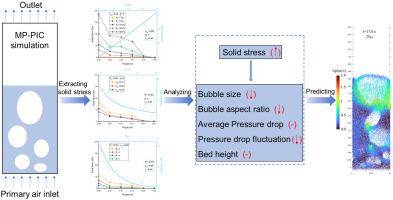
Gas-solid granular flows are widely used in multiple industrial applications. The Multiphase Particle-In-Cell (MP-PIC) method is increasingly recognized for its capability to efficiently model these industrial-scale gas-solid granular flows. The solid stress model is crucial in MP-PIC method; however, its influence on the simulation results has not been thoroughly investigated. In this work, the pseudo-2D bubbling fluidized bed is modeled using MP-PIC method in OpenFOAM, in which the experiment operates at twice the minimum fluidization velocity condition using glass bead as the bed material. We primarily investigate the variation of the inter-particle solid stress values in the bed and its influence on the simulation results across a range of solid stress model parameters. The simulation results including bubble size, aspect ratio, and pressure drop and bed height, have been compared with the corresponding experimental data and empirical correlation. Sensitivity analysis narrows down the solid stress model parameter space and identify the most sensitive parameter is the close-packed volume fraction of particles. Results demonstrate that solid stress plays a significant role in dense particle flow, making particles more dispersed. Increasing solid stress reduces bubble size, aspect ratio, and pressure drop fluctuations, with minimal impact on bed height and average pressure drop. By comparing simulations and experiments, the optimal parameters of the model are determined. Moreover, the obtained optimal parameters effectively predict gas-solid flow across varying fluidization velocities and three-dimensional fluidized beds. This study provides a detailed analysis of solid stress effects, offering a more comprehensive understanding of the parameters for future MP-PIC simulations and validations.
期刊介绍:
The word ‘particuology’ was coined to parallel the discipline for the science and technology of particles.
Particuology is an interdisciplinary journal that publishes frontier research articles and critical reviews on the discovery, formulation and engineering of particulate materials, processes and systems. It especially welcomes contributions utilising advanced theoretical, modelling and measurement methods to enable the discovery and creation of new particulate materials, and the manufacturing of functional particulate-based products, such as sensors.
Papers are handled by Thematic Editors who oversee contributions from specific subject fields. These fields are classified into: Particle Synthesis and Modification; Particle Characterization and Measurement; Granular Systems and Bulk Solids Technology; Fluidization and Particle-Fluid Systems; Aerosols; and Applications of Particle Technology.
Key topics concerning the creation and processing of particulates include:
-Modelling and simulation of particle formation, collective behaviour of particles and systems for particle production over a broad spectrum of length scales
-Mining of experimental data for particle synthesis and surface properties to facilitate the creation of new materials and processes
-Particle design and preparation including controlled response and sensing functionalities in formation, delivery systems and biological systems, etc.
-Experimental and computational methods for visualization and analysis of particulate system.
These topics are broadly relevant to the production of materials, pharmaceuticals and food, and to the conversion of energy resources to fuels and protection of the environment.



 京公网安备 11010802042870号
京ICP备2023020795号-1
京公网安备 11010802042870号
京ICP备2023020795号-1

 分享
分享
 求助内容:
求助内容: 应助结果提醒方式:
 扫码关注我们
