Enhanced hydrophilicity and controlled pore size distribution of polyvinylidene fluoride membranes through segregation and grafting for protein anti-fouling
{"title":"Enhanced hydrophilicity and controlled pore size distribution of polyvinylidene fluoride membranes through segregation and grafting for protein anti-fouling","authors":"Mingfu Gao , Ying Zhang , Shilin Huo , Sanchuan Yu , Doufeng Wu , Congjie Gao","doi":"10.1016/j.desal.2025.118822","DOIUrl":null,"url":null,"abstract":"<div><div>Membrane technology is essential in water treatment due to its efficiency and scalability. Polyvinylidene fluoride (PVDF)-based membranes face significant fouling issues and modification difficulty due to low surface energy and high hydrophobicity. This study introduces an innovative and facile approach combining segregation and grafting techniques to address these challenges. The environmentally friendly material cellulose acetate was incorporated into the PVDF matrix, where it segregated onto the membrane surface during the formation process. Following this, hydrolysis introduced hydroxyl groups, and the membrane was further functionalized by grafting oxidized carboxymethyl cellulose, a cost-effective and biodegradable polymer, onto its surface. This dual-step modification significantly enhances hydrophilicity and surface negative charge density, while also playing a crucial role in modulating pore size and distribution. The modified A-H-SSM-20 membrane exhibits dynamic water contact angle of 0° within 40 s and zeta potential of −75.2 mV at pH 7.0. Additionally, mean pore size decreased from 33.7 to 23.9 nm, while static bovine serum albumin adsorption dropped from 83.8 to 11.6 μg·cm<sup>−2</sup>. The irreversible fouling ratio decreased significantly from 33.0 % to 0.5 %, demonstrating marked improvement in anti-fouling performance. This approach provides promising solution for enhancing fouling resistance in PVDF membranes, facilitating potential for applications in water treatment.</div></div>","PeriodicalId":299,"journal":{"name":"Desalination","volume":"608 ","pages":"Article 118822"},"PeriodicalIF":9.8000,"publicationDate":"2025-08-01","publicationTypes":"Journal Article","fieldsOfStudy":null,"isOpenAccess":false,"openAccessPdf":"","citationCount":"0","resultStr":null,"platform":"Semanticscholar","paperid":null,"PeriodicalName":"Desalination","FirstCategoryId":"5","ListUrlMain":"https://www.sciencedirect.com/science/article/pii/S0011916425002978","RegionNum":1,"RegionCategory":"工程技术","ArticlePicture":[],"TitleCN":null,"AbstractTextCN":null,"PMCID":null,"EPubDate":"2025/3/20 0:00:00","PubModel":"Epub","JCR":"Q1","JCRName":"ENGINEERING, CHEMICAL","Score":null,"Total":0}
引用次数: 0
Abstract
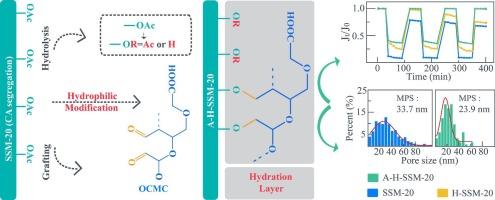
Membrane technology is essential in water treatment due to its efficiency and scalability. Polyvinylidene fluoride (PVDF)-based membranes face significant fouling issues and modification difficulty due to low surface energy and high hydrophobicity. This study introduces an innovative and facile approach combining segregation and grafting techniques to address these challenges. The environmentally friendly material cellulose acetate was incorporated into the PVDF matrix, where it segregated onto the membrane surface during the formation process. Following this, hydrolysis introduced hydroxyl groups, and the membrane was further functionalized by grafting oxidized carboxymethyl cellulose, a cost-effective and biodegradable polymer, onto its surface. This dual-step modification significantly enhances hydrophilicity and surface negative charge density, while also playing a crucial role in modulating pore size and distribution. The modified A-H-SSM-20 membrane exhibits dynamic water contact angle of 0° within 40 s and zeta potential of −75.2 mV at pH 7.0. Additionally, mean pore size decreased from 33.7 to 23.9 nm, while static bovine serum albumin adsorption dropped from 83.8 to 11.6 μg·cm−2. The irreversible fouling ratio decreased significantly from 33.0 % to 0.5 %, demonstrating marked improvement in anti-fouling performance. This approach provides promising solution for enhancing fouling resistance in PVDF membranes, facilitating potential for applications in water treatment.
期刊介绍:
Desalination is a scholarly journal that focuses on the field of desalination materials, processes, and associated technologies. It encompasses a wide range of disciplines and aims to publish exceptional papers in this area.
The journal invites submissions that explicitly revolve around water desalting and its applications to various sources such as seawater, groundwater, and wastewater. It particularly encourages research on diverse desalination methods including thermal, membrane, sorption, and hybrid processes.
By providing a platform for innovative studies, Desalination aims to advance the understanding and development of desalination technologies, promoting sustainable solutions for water scarcity challenges.



 京公网安备 11010802042870号
京ICP备2023020795号-1
京公网安备 11010802042870号
京ICP备2023020795号-1

 分享
分享
 求助内容:
求助内容: 应助结果提醒方式:
 扫码关注我们
