Qingmei Gong , Haihong Jiang , Martin Peterlechner , Sergiy V. Divinski , Gerhard Wilde
{"title":"Tellurium self-diffusion in crystalline Ge2Sb2Te5 phase change material","authors":"Qingmei Gong , Haihong Jiang , Martin Peterlechner , Sergiy V. Divinski , Gerhard Wilde","doi":"10.1016/j.actamat.2025.120929","DOIUrl":null,"url":null,"abstract":"<div><div>Ge<sub>2</sub>Sb<sub>2</sub>Te<sub>5</sub> is the most commonly used material for phase change random access memory. In this work, a chemically homogeneous 200 nm thick layer of amorphous Ge<sub>2</sub>Sb<sub>2</sub>Te<sub>5</sub> was grown on a single crystal Si wafer using DC magnetron sputtering and applying a stoichiometric target at room temperature. A metastable NaCl-type structure having a face-centered-cubic lattice was obtained by subsequent annealing at 473 K for 30 min. The crystal structure and microstructure were analyzed by X-ray diffraction and transmission electron microscopy. Te self-diffusion was measured by secondary ion mass spectroscopy applying a highly enriched natural <sup>122</sup>Te isotope. The Te self-diffusion coefficients follow an Arrhenius law in the temperature range between room temperature and 353 K with an activation enthalpy of (125.0 ± 5) kJ/mol. The diffusion data are discussed in terms of either grain boundary diffusion contributions or, alternatively, in relation to volume diffusion enhanced by structural vacancies. In comparison to the amorphous counterpart, the Te self-diffusion rates in crystalline Ge<sub>2</sub>Sb<sub>2</sub>Te<sub>5</sub> are only marginally lower and exceed the volume diffusivities of Te in crystalline Te by more than four orders of magnitude, indicating that the structural vacancies seem to determine the measured diffusion rates.</div></div>","PeriodicalId":238,"journal":{"name":"Acta Materialia","volume":"289 ","pages":"Article 120929"},"PeriodicalIF":9.3000,"publicationDate":"2025-03-11","publicationTypes":"Journal Article","fieldsOfStudy":null,"isOpenAccess":false,"openAccessPdf":"","citationCount":"0","resultStr":null,"platform":"Semanticscholar","paperid":null,"PeriodicalName":"Acta Materialia","FirstCategoryId":"88","ListUrlMain":"https://www.sciencedirect.com/science/article/pii/S1359645425002216","RegionNum":1,"RegionCategory":"材料科学","ArticlePicture":[],"TitleCN":null,"AbstractTextCN":null,"PMCID":null,"EPubDate":"","PubModel":"","JCR":"Q1","JCRName":"MATERIALS SCIENCE, MULTIDISCIPLINARY","Score":null,"Total":0}
引用次数: 0
Abstract
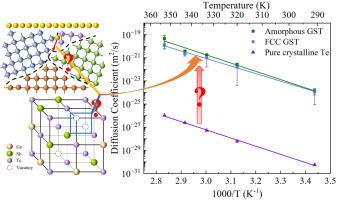
Ge2Sb2Te5 is the most commonly used material for phase change random access memory. In this work, a chemically homogeneous 200 nm thick layer of amorphous Ge2Sb2Te5 was grown on a single crystal Si wafer using DC magnetron sputtering and applying a stoichiometric target at room temperature. A metastable NaCl-type structure having a face-centered-cubic lattice was obtained by subsequent annealing at 473 K for 30 min. The crystal structure and microstructure were analyzed by X-ray diffraction and transmission electron microscopy. Te self-diffusion was measured by secondary ion mass spectroscopy applying a highly enriched natural 122Te isotope. The Te self-diffusion coefficients follow an Arrhenius law in the temperature range between room temperature and 353 K with an activation enthalpy of (125.0 ± 5) kJ/mol. The diffusion data are discussed in terms of either grain boundary diffusion contributions or, alternatively, in relation to volume diffusion enhanced by structural vacancies. In comparison to the amorphous counterpart, the Te self-diffusion rates in crystalline Ge2Sb2Te5 are only marginally lower and exceed the volume diffusivities of Te in crystalline Te by more than four orders of magnitude, indicating that the structural vacancies seem to determine the measured diffusion rates.
期刊介绍:
Acta Materialia serves as a platform for publishing full-length, original papers and commissioned overviews that contribute to a profound understanding of the correlation between the processing, structure, and properties of inorganic materials. The journal seeks papers with high impact potential or those that significantly propel the field forward. The scope includes the atomic and molecular arrangements, chemical and electronic structures, and microstructure of materials, focusing on their mechanical or functional behavior across all length scales, including nanostructures.



 京公网安备 11010802042870号
京ICP备2023020795号-1
京公网安备 11010802042870号
京ICP备2023020795号-1

 分享
分享
 求助内容:
求助内容: 应助结果提醒方式:
 扫码关注我们
