Le Zhao , Minhao Li , Qingjun Zhu, Haili Yang, Yongju Zhao
{"title":"Anti-obesity effect of isoliquiritigenin in the 3T3-L1 cell line and a high-fat diet-induced obesity mice model","authors":"Le Zhao , Minhao Li , Qingjun Zhu, Haili Yang, Yongju Zhao","doi":"10.1016/j.jff.2025.106735","DOIUrl":null,"url":null,"abstract":"<div><div>Excessive fat can lead to obesity and health risks. Increasing thermogenesis and lipolysis are effective obesity treatments. Isoliquiritigenin (ISL), found in licorice, has antioxidant, anti-inflammatory, antiviral, and anticancer properties. However, its anti-obesity effects are poorly understood. Mice treated with 50 mg/kg/d ISL for 8 weeks showed significantly lower adipose tissue weight and smaller adipocytes, indicating reduced lipid accumulation. ISL increased UCP1, HSL, and ATGL expression and electron transport chain protein levels in adipose tissue, suggesting enhanced thermogenesis and lipolysis. ISL also reduced HFD-induced adipose tissue inflammation. Additionally, ISL inhibited preadipocyte differentiation in 3T3-L1 cells by suppressing ERK/P38-MAPK signaling. These findings highlight ISL's potential as a nutraceutical agent against obesity.</div></div>","PeriodicalId":360,"journal":{"name":"Journal of Functional Foods","volume":"127 ","pages":"Article 106735"},"PeriodicalIF":4.0000,"publicationDate":"2025-03-21","publicationTypes":"Journal Article","fieldsOfStudy":null,"isOpenAccess":false,"openAccessPdf":"","citationCount":"0","resultStr":null,"platform":"Semanticscholar","paperid":null,"PeriodicalName":"Journal of Functional Foods","FirstCategoryId":"97","ListUrlMain":"https://www.sciencedirect.com/science/article/pii/S1756464625000775","RegionNum":2,"RegionCategory":"农林科学","ArticlePicture":[],"TitleCN":null,"AbstractTextCN":null,"PMCID":null,"EPubDate":"","PubModel":"","JCR":"Q2","JCRName":"FOOD SCIENCE & TECHNOLOGY","Score":null,"Total":0}
引用次数: 0
Abstract
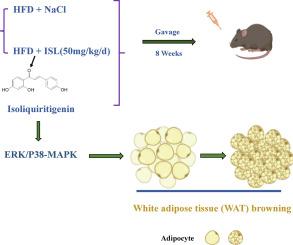
Excessive fat can lead to obesity and health risks. Increasing thermogenesis and lipolysis are effective obesity treatments. Isoliquiritigenin (ISL), found in licorice, has antioxidant, anti-inflammatory, antiviral, and anticancer properties. However, its anti-obesity effects are poorly understood. Mice treated with 50 mg/kg/d ISL for 8 weeks showed significantly lower adipose tissue weight and smaller adipocytes, indicating reduced lipid accumulation. ISL increased UCP1, HSL, and ATGL expression and electron transport chain protein levels in adipose tissue, suggesting enhanced thermogenesis and lipolysis. ISL also reduced HFD-induced adipose tissue inflammation. Additionally, ISL inhibited preadipocyte differentiation in 3T3-L1 cells by suppressing ERK/P38-MAPK signaling. These findings highlight ISL's potential as a nutraceutical agent against obesity.
期刊介绍:
Journal of Functional Foods continues with the same aims and scope, editorial team, submission system and rigorous peer review. We give authors the possibility to publish their top-quality papers in a well-established leading journal in the food and nutrition fields. The Journal will keep its rigorous criteria to screen high impact research addressing relevant scientific topics and performed by sound methodologies.
The Journal of Functional Foods aims to bring together the results of fundamental and applied research into healthy foods and biologically active food ingredients.
The Journal is centered in the specific area at the boundaries among food technology, nutrition and health welcoming papers having a good interdisciplinary approach. The Journal will cover the fields of plant bioactives; dietary fibre, probiotics; functional lipids; bioactive peptides; vitamins, minerals and botanicals and other dietary supplements. Nutritional and technological aspects related to the development of functional foods and beverages are of core interest to the journal. Experimental works dealing with food digestion, bioavailability of food bioactives and on the mechanisms by which foods and their components are able to modulate physiological parameters connected with disease prevention are of particular interest as well as those dealing with personalized nutrition and nutritional needs in pathological subjects.



 京公网安备 11010802042870号
京ICP备2023020795号-1
京公网安备 11010802042870号
京ICP备2023020795号-1

 分享
分享
 求助内容:
求助内容: 应助结果提醒方式:
 扫码关注我们
