Qi-Cong Chen , Chao Wu , Wei-Feng Cai , Qian Ni , Song-Xia Lin , Shao-Wei Zheng , Cui-Ping Jiang , Yan-Kui Yi , Qiang Liu , Chun-Yan Shen
{"title":"Eriocitrin promotes browning of white adipose tissue and activates brown adipose tissue through regulating HSF1/PGC-1α pathways","authors":"Qi-Cong Chen , Chao Wu , Wei-Feng Cai , Qian Ni , Song-Xia Lin , Shao-Wei Zheng , Cui-Ping Jiang , Yan-Kui Yi , Qiang Liu , Chun-Yan Shen","doi":"10.1016/j.jff.2025.106758","DOIUrl":null,"url":null,"abstract":"<div><div>Browning of white adipose tissue (WAT) and activation of brown adipose tissue (BAT) are novel strategies to prevent obesity. Eriocitrin, previously identified in blossom of <em>Citrus aurantium</em> L. var. <em>amara</em> Engl. (CAVA), has various beneficial effects. However, its role in browning of WAT and BAT activation remained unclear. In the current study, oleic acid-induced HepG2 cells and high fat-diet (HFD)-fed mice were developed and treated with eriocitrin. The results showed that eriocitrin significantly inhibited HepG2 cell steatosis, and prevented HFD-induced obesity and insulin resistance in mice. Eriocitrin also induced browning of WAT and activated BAT by increasing expression of thermogenic marker protein UCP1 and other brown/beige adipocyte markers. Further assays demonstrated that the anti-obesity effects of eriocitrin was probably achieved by regulating HSF1/PGC-1α pathway. These results suggested that eriocitrin might promote browning of WAT and activated BAT by activating HSF1/PGC-1α pathway, which was a promising candidate for developing weight-loss supplement.</div></div>","PeriodicalId":360,"journal":{"name":"Journal of Functional Foods","volume":"127 ","pages":"Article 106758"},"PeriodicalIF":4.0000,"publicationDate":"2025-04-01","publicationTypes":"Journal Article","fieldsOfStudy":null,"isOpenAccess":false,"openAccessPdf":"","citationCount":"0","resultStr":null,"platform":"Semanticscholar","paperid":null,"PeriodicalName":"Journal of Functional Foods","FirstCategoryId":"97","ListUrlMain":"https://www.sciencedirect.com/science/article/pii/S1756464625001008","RegionNum":2,"RegionCategory":"农林科学","ArticlePicture":[],"TitleCN":null,"AbstractTextCN":null,"PMCID":null,"EPubDate":"2025/3/25 0:00:00","PubModel":"Epub","JCR":"Q2","JCRName":"FOOD SCIENCE & TECHNOLOGY","Score":null,"Total":0}
引用次数: 0
Abstract
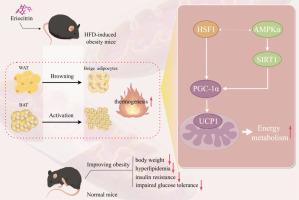
Browning of white adipose tissue (WAT) and activation of brown adipose tissue (BAT) are novel strategies to prevent obesity. Eriocitrin, previously identified in blossom of Citrus aurantium L. var. amara Engl. (CAVA), has various beneficial effects. However, its role in browning of WAT and BAT activation remained unclear. In the current study, oleic acid-induced HepG2 cells and high fat-diet (HFD)-fed mice were developed and treated with eriocitrin. The results showed that eriocitrin significantly inhibited HepG2 cell steatosis, and prevented HFD-induced obesity and insulin resistance in mice. Eriocitrin also induced browning of WAT and activated BAT by increasing expression of thermogenic marker protein UCP1 and other brown/beige adipocyte markers. Further assays demonstrated that the anti-obesity effects of eriocitrin was probably achieved by regulating HSF1/PGC-1α pathway. These results suggested that eriocitrin might promote browning of WAT and activated BAT by activating HSF1/PGC-1α pathway, which was a promising candidate for developing weight-loss supplement.
白色脂肪组织褐化(WAT)和棕色脂肪组织激活(BAT)是预防肥胖的新策略。从柑桔(Citrus aurantium L. var. amara Engl.)花中鉴定出苦皮苷。(CAVA),具有多种有益作用。然而,其在WAT褐变和BAT活化中的作用尚不清楚。在本研究中,我们培育了油酸诱导的HepG2细胞和高脂饮食(HFD)喂养的小鼠,并给它们服用芥子皮苷。结果表明,苦艾曲霉素能显著抑制小鼠HepG2细胞脂肪变性,并能预防hfd诱导的肥胖和胰岛素抵抗。异丙三嗪还通过增加产热标记蛋白UCP1和其他棕色/米色脂肪细胞标记物的表达,诱导WAT褐变并激活BAT。进一步研究表明,卵黄霉素的抗肥胖作用可能是通过调节HSF1/PGC-1α途径实现的。这些结果表明,卵黄素可能通过激活HSF1/PGC-1α通路促进WAT褐变,激活BAT,是一种很有前景的减肥补充剂。
期刊介绍:
Journal of Functional Foods continues with the same aims and scope, editorial team, submission system and rigorous peer review. We give authors the possibility to publish their top-quality papers in a well-established leading journal in the food and nutrition fields. The Journal will keep its rigorous criteria to screen high impact research addressing relevant scientific topics and performed by sound methodologies.
The Journal of Functional Foods aims to bring together the results of fundamental and applied research into healthy foods and biologically active food ingredients.
The Journal is centered in the specific area at the boundaries among food technology, nutrition and health welcoming papers having a good interdisciplinary approach. The Journal will cover the fields of plant bioactives; dietary fibre, probiotics; functional lipids; bioactive peptides; vitamins, minerals and botanicals and other dietary supplements. Nutritional and technological aspects related to the development of functional foods and beverages are of core interest to the journal. Experimental works dealing with food digestion, bioavailability of food bioactives and on the mechanisms by which foods and their components are able to modulate physiological parameters connected with disease prevention are of particular interest as well as those dealing with personalized nutrition and nutritional needs in pathological subjects.



 京公网安备 11010802042870号
京ICP备2023020795号-1
京公网安备 11010802042870号
京ICP备2023020795号-1

 分享
分享
 求助内容:
求助内容: 应助结果提醒方式:
 扫码关注我们
