Exploring the structure–activity relationships and molecular mechanisms of food-derived antioxidative peptides in mitigating oxidative stress: A comprehensive review
Atif Ali , Kiran Kareem Bukhsh , Muhammad Mohsin Raza , Muhammad Talha Afraz , Tazeddinova Diana , Muhammad Waseem , Muhammad Faisal Manzoor , Gholamreza Abdi
{"title":"Exploring the structure–activity relationships and molecular mechanisms of food-derived antioxidative peptides in mitigating oxidative stress: A comprehensive review","authors":"Atif Ali , Kiran Kareem Bukhsh , Muhammad Mohsin Raza , Muhammad Talha Afraz , Tazeddinova Diana , Muhammad Waseem , Muhammad Faisal Manzoor , Gholamreza Abdi","doi":"10.1016/j.jff.2025.106751","DOIUrl":null,"url":null,"abstract":"<div><div>Oxidative stress is mainly attributed to the overproduction of reactive oxygen or nitrogen species during mitochondrial electron transport chain reactions. The presence of these reactive species correlates with metabolic conditions, including inflammation, aging, and neurodegeneration. Food-derived bioactive peptides exhibit antioxidative abilities potentially dependent on processing conditions and structural characteristics, including molecular weight and amino acid sequences. This review summarizes recent advances in generating food protein-derived antioxidant peptides and comprehensively explores comparative structural characterization as the basis for examining the molecular mechanisms underlying anti-oxidative potential in mammalian cells. Enzymatically produced antioxidant peptides with molecular weight ˂3 kDa and short amino acid sequences typically exhibit enhanced intestinal epithelial membrane permeability <em>via</em> enterocytes, tight junctions, and passive diffusion, exerting antioxidative potential. Their antioxidative potential is associated with decreased intracellular reactive oxygen species and malondialdehyde production. Additionally, they enhance the defense capabilities of enzymatic (superoxide dismutase and catalase) and non-enzymatic antioxidants (ascorbic acid and alpha-tocopherol). Mechanistically, they regulate major oxidative protein pathways, including Keap1-Nrf2-ARE, MAPK, NF-κB, and PI3K/AKT/mTOR. Intriguingly, plants and animal-derived peptides exhibit different structural characteristics. Plant-derived peptides tend to be negatively charged, making them more soluble with greater bioavailability. Future researchers should focus on developing new technologies for large-scale commercial production of food protein-derived antioxidant peptides and verifying their health benefits <em>in vivo</em> while addressing limitations and safety considerations.</div></div>","PeriodicalId":360,"journal":{"name":"Journal of Functional Foods","volume":"127 ","pages":"Article 106751"},"PeriodicalIF":4.0000,"publicationDate":"2025-03-21","publicationTypes":"Journal Article","fieldsOfStudy":null,"isOpenAccess":false,"openAccessPdf":"","citationCount":"0","resultStr":null,"platform":"Semanticscholar","paperid":null,"PeriodicalName":"Journal of Functional Foods","FirstCategoryId":"97","ListUrlMain":"https://www.sciencedirect.com/science/article/pii/S1756464625000933","RegionNum":2,"RegionCategory":"农林科学","ArticlePicture":[],"TitleCN":null,"AbstractTextCN":null,"PMCID":null,"EPubDate":"","PubModel":"","JCR":"Q2","JCRName":"FOOD SCIENCE & TECHNOLOGY","Score":null,"Total":0}
引用次数: 0
Abstract
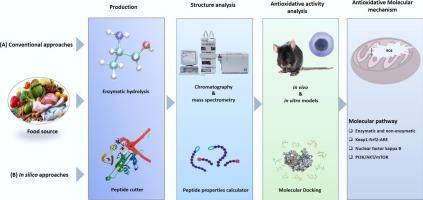
Oxidative stress is mainly attributed to the overproduction of reactive oxygen or nitrogen species during mitochondrial electron transport chain reactions. The presence of these reactive species correlates with metabolic conditions, including inflammation, aging, and neurodegeneration. Food-derived bioactive peptides exhibit antioxidative abilities potentially dependent on processing conditions and structural characteristics, including molecular weight and amino acid sequences. This review summarizes recent advances in generating food protein-derived antioxidant peptides and comprehensively explores comparative structural characterization as the basis for examining the molecular mechanisms underlying anti-oxidative potential in mammalian cells. Enzymatically produced antioxidant peptides with molecular weight ˂3 kDa and short amino acid sequences typically exhibit enhanced intestinal epithelial membrane permeability via enterocytes, tight junctions, and passive diffusion, exerting antioxidative potential. Their antioxidative potential is associated with decreased intracellular reactive oxygen species and malondialdehyde production. Additionally, they enhance the defense capabilities of enzymatic (superoxide dismutase and catalase) and non-enzymatic antioxidants (ascorbic acid and alpha-tocopherol). Mechanistically, they regulate major oxidative protein pathways, including Keap1-Nrf2-ARE, MAPK, NF-κB, and PI3K/AKT/mTOR. Intriguingly, plants and animal-derived peptides exhibit different structural characteristics. Plant-derived peptides tend to be negatively charged, making them more soluble with greater bioavailability. Future researchers should focus on developing new technologies for large-scale commercial production of food protein-derived antioxidant peptides and verifying their health benefits in vivo while addressing limitations and safety considerations.
期刊介绍:
Journal of Functional Foods continues with the same aims and scope, editorial team, submission system and rigorous peer review. We give authors the possibility to publish their top-quality papers in a well-established leading journal in the food and nutrition fields. The Journal will keep its rigorous criteria to screen high impact research addressing relevant scientific topics and performed by sound methodologies.
The Journal of Functional Foods aims to bring together the results of fundamental and applied research into healthy foods and biologically active food ingredients.
The Journal is centered in the specific area at the boundaries among food technology, nutrition and health welcoming papers having a good interdisciplinary approach. The Journal will cover the fields of plant bioactives; dietary fibre, probiotics; functional lipids; bioactive peptides; vitamins, minerals and botanicals and other dietary supplements. Nutritional and technological aspects related to the development of functional foods and beverages are of core interest to the journal. Experimental works dealing with food digestion, bioavailability of food bioactives and on the mechanisms by which foods and their components are able to modulate physiological parameters connected with disease prevention are of particular interest as well as those dealing with personalized nutrition and nutritional needs in pathological subjects.



 京公网安备 11010802042870号
京ICP备2023020795号-1
京公网安备 11010802042870号
京ICP备2023020795号-1

 分享
分享
 求助内容:
求助内容: 应助结果提醒方式:
 扫码关注我们
