{"title":"Leveraging remote sensing for optimised national scale agricultural water management in South Africa","authors":"Kudzai S. Mpakairi , Timothy Dube , Mbulisi Sibanda , Onisimo Mutanga","doi":"10.1016/j.scitotenv.2025.179199","DOIUrl":null,"url":null,"abstract":"<div><div>Agriculture remains a critical water resources consumer in arid regions, globally, including southern Africa. The intensity of consumption, however, varies significantly depending on the adopted watering method (i.e., rainfed or irrigated) and agricultural region. Efficient agricultural water management hinges on effectively monitoring Crop Water Use (CWU) and Crop Water Productivity (CWP). This study, thus, leveraged Moderate Resolution Imaging Spectroradiometer (MODIS) remotely sensed data in estimating the spatio-temporal variations of CWP and CWU across irrigated and rainfed croplands in diverse South African agricultural regions between 2017 and 2022. The results showed that rainfed croplands had higher CWU in agricultural regions dominated by grains (150 mm/yr) and cattle (160 mm/yr), while irrigated croplands exhibited the highest CWU in agricultural regions with sheep rearing (175 mm/yr) and subsistence agricultural activities (160 mm/yr). However, there were no significant differences (<em>p</em> > 0.05) in overall CWU across all the agricultural regions. Irrigated croplands generally had higher annual CWP (>0.002 kg/mm<sup>3</sup>/yr), while rainfed croplands consistently showed low CWP especially in forestry (0.001 kg/mm<sup>3</sup>/yr) and sugar (0.0012 kg/mm<sup>3</sup>/yr) agricultural regions. There were also no significant differences in average CWP between irrigated and rainfed croplands (<em>p</em> > 0.05). This study demonstrates the effectiveness of national-scale remotely sensed data in monitoring the spatiotemporal variations of CWP and CWU in South Africa. The results can be used to tailor strategies to specific agricultural regions and crop types and optimise water use efficiency. This would contribute significantly to sustainable national-scale agricultural water management in South Africa.</div></div>","PeriodicalId":422,"journal":{"name":"Science of the Total Environment","volume":"974 ","pages":"Article 179199"},"PeriodicalIF":8.0000,"publicationDate":"2025-03-25","publicationTypes":"Journal Article","fieldsOfStudy":null,"isOpenAccess":false,"openAccessPdf":"","citationCount":"0","resultStr":null,"platform":"Semanticscholar","paperid":null,"PeriodicalName":"Science of the Total Environment","FirstCategoryId":"93","ListUrlMain":"https://www.sciencedirect.com/science/article/pii/S0048969725008344","RegionNum":1,"RegionCategory":"环境科学与生态学","ArticlePicture":[],"TitleCN":null,"AbstractTextCN":null,"PMCID":null,"EPubDate":"","PubModel":"","JCR":"Q1","JCRName":"ENVIRONMENTAL SCIENCES","Score":null,"Total":0}
引用次数: 0
Abstract
Agriculture remains a critical water resources consumer in arid regions, globally, including southern Africa. The intensity of consumption, however, varies significantly depending on the adopted watering method (i.e., rainfed or irrigated) and agricultural region. Efficient agricultural water management hinges on effectively monitoring Crop Water Use (CWU) and Crop Water Productivity (CWP). This study, thus, leveraged Moderate Resolution Imaging Spectroradiometer (MODIS) remotely sensed data in estimating the spatio-temporal variations of CWP and CWU across irrigated and rainfed croplands in diverse South African agricultural regions between 2017 and 2022. The results showed that rainfed croplands had higher CWU in agricultural regions dominated by grains (150 mm/yr) and cattle (160 mm/yr), while irrigated croplands exhibited the highest CWU in agricultural regions with sheep rearing (175 mm/yr) and subsistence agricultural activities (160 mm/yr). However, there were no significant differences (p > 0.05) in overall CWU across all the agricultural regions. Irrigated croplands generally had higher annual CWP (>0.002 kg/mm3/yr), while rainfed croplands consistently showed low CWP especially in forestry (0.001 kg/mm3/yr) and sugar (0.0012 kg/mm3/yr) agricultural regions. There were also no significant differences in average CWP between irrigated and rainfed croplands (p > 0.05). This study demonstrates the effectiveness of national-scale remotely sensed data in monitoring the spatiotemporal variations of CWP and CWU in South Africa. The results can be used to tailor strategies to specific agricultural regions and crop types and optimise water use efficiency. This would contribute significantly to sustainable national-scale agricultural water management in South Africa.
期刊介绍:
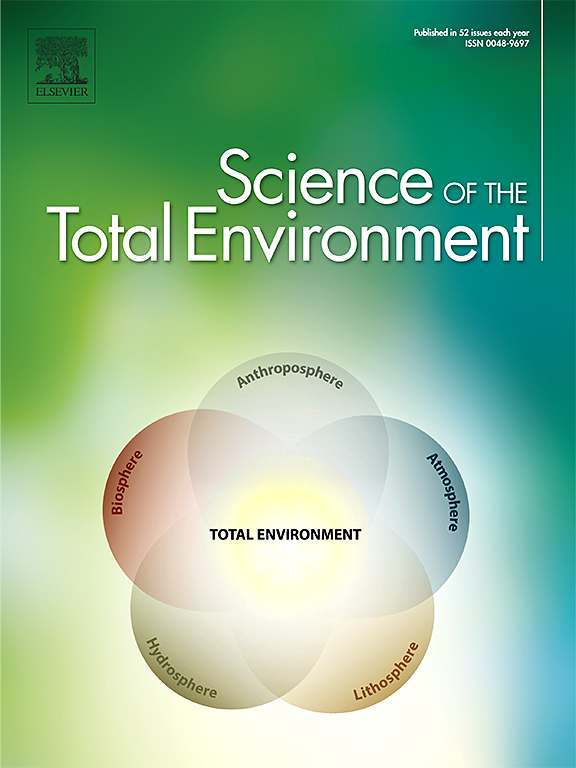
The Science of the Total Environment is an international journal dedicated to scientific research on the environment and its interaction with humanity. It covers a wide range of disciplines and seeks to publish innovative, hypothesis-driven, and impactful research that explores the entire environment, including the atmosphere, lithosphere, hydrosphere, biosphere, and anthroposphere.
The journal's updated Aims & Scope emphasizes the importance of interdisciplinary environmental research with broad impact. Priority is given to studies that advance fundamental understanding and explore the interconnectedness of multiple environmental spheres. Field studies are preferred, while laboratory experiments must demonstrate significant methodological advancements or mechanistic insights with direct relevance to the environment.




 京公网安备 11010802042870号
京ICP备2023020795号-1
京公网安备 11010802042870号
京ICP备2023020795号-1

 分享
分享
 求助内容:
求助内容: 应助结果提醒方式:
 扫码关注我们
