Effect of microbial biofertilizer on proteomic profiling, antioxidant enzyme and andrographolide content in Andrographis paniculata Burm.f Nee. under drought stress
{"title":"Effect of microbial biofertilizer on proteomic profiling, antioxidant enzyme and andrographolide content in Andrographis paniculata Burm.f Nee. under drought stress","authors":"Butsakorn Yodphet , Nuntavun Riddech , Wanwipa Kaewpradit , Sittiruk Roytrakul , Sophon Boonlue , Nisachon Jangpromma","doi":"10.1016/j.stress.2025.100817","DOIUrl":null,"url":null,"abstract":"<div><div><em>Andrographis paniculata</em> is a medicinal plant susceptible to drought stress. This study, employing a completely randomized design, examines the impact of drought stress on the growth and andrographolide content of <em>A. paniculata.</em> Microbial biofertilizers were investigated for their ability to mitigate drought stress and enhance resilience in <em>Andrographis paniculata</em>. Their effectiveness was evidenced by plants supplemented with microbial biofertilizers under drought stress (T4) maintaining significantly higher leaf relative water content (RWC) at 78.75 %, compared to unfertilized drought-stressed plants (T2) with only 22.37 % RWC. Microbial biofertilized <em>A. paniculata</em> also exhibited reduced activity of superoxide dismutase (SOD) and peroxidase (POX), indicating mitigated oxidative stress. Importantly, high-performance liquid chromatography (HPLC) analysis revealed that microbial biofertilizer significantly increased andrographolide content, a key bioactive compound, even under drought stress. Proteomic analysis identified key stress responses and photosynthetic proteins upregulated by microbial biofertilizers, particularly under drought. <em>A. paniculata</em> treated with microbial biofertilizers under well-watered conditions (T3) showed increased levels of proteins involved in photosynthesis and stress response (cytochrome F, ATP synthase), and drought tolerance (Kaurene synthase 1). The key photosynthetic enzyme RuBisCO displayed a 2.48-fold increase in T4, suggesting improved photosynthetic efficiency. Unique protein expressions in T4, including ribosomal proteins and UDP-glycosyltransferase, suggest enhanced drought tolerance. Furthermore, consistent upregulation of NAD(P)H-quinone oxidoreductase subunit 5 indicates improved photosynthesis and resilience under both well-watered and drought conditions. Overall, microbial biofertilizers modulated protein expression, enhancing drought tolerance of <em>A. paniculata</em> by improving stress response, photosynthetic capacity, and potentially other cellular processes.</div></div>","PeriodicalId":34736,"journal":{"name":"Plant Stress","volume":"16 ","pages":"Article 100817"},"PeriodicalIF":6.8000,"publicationDate":"2025-03-20","publicationTypes":"Journal Article","fieldsOfStudy":null,"isOpenAccess":false,"openAccessPdf":"","citationCount":"0","resultStr":null,"platform":"Semanticscholar","paperid":null,"PeriodicalName":"Plant Stress","FirstCategoryId":"1085","ListUrlMain":"https://www.sciencedirect.com/science/article/pii/S2667064X2500082X","RegionNum":0,"RegionCategory":null,"ArticlePicture":[],"TitleCN":null,"AbstractTextCN":null,"PMCID":null,"EPubDate":"","PubModel":"","JCR":"Q1","JCRName":"PLANT SCIENCES","Score":null,"Total":0}
引用次数: 0
Abstract
Andrographis paniculata is a medicinal plant susceptible to drought stress. This study, employing a completely randomized design, examines the impact of drought stress on the growth and andrographolide content of A. paniculata. Microbial biofertilizers were investigated for their ability to mitigate drought stress and enhance resilience in Andrographis paniculata. Their effectiveness was evidenced by plants supplemented with microbial biofertilizers under drought stress (T4) maintaining significantly higher leaf relative water content (RWC) at 78.75 %, compared to unfertilized drought-stressed plants (T2) with only 22.37 % RWC. Microbial biofertilized A. paniculata also exhibited reduced activity of superoxide dismutase (SOD) and peroxidase (POX), indicating mitigated oxidative stress. Importantly, high-performance liquid chromatography (HPLC) analysis revealed that microbial biofertilizer significantly increased andrographolide content, a key bioactive compound, even under drought stress. Proteomic analysis identified key stress responses and photosynthetic proteins upregulated by microbial biofertilizers, particularly under drought. A. paniculata treated with microbial biofertilizers under well-watered conditions (T3) showed increased levels of proteins involved in photosynthesis and stress response (cytochrome F, ATP synthase), and drought tolerance (Kaurene synthase 1). The key photosynthetic enzyme RuBisCO displayed a 2.48-fold increase in T4, suggesting improved photosynthetic efficiency. Unique protein expressions in T4, including ribosomal proteins and UDP-glycosyltransferase, suggest enhanced drought tolerance. Furthermore, consistent upregulation of NAD(P)H-quinone oxidoreductase subunit 5 indicates improved photosynthesis and resilience under both well-watered and drought conditions. Overall, microbial biofertilizers modulated protein expression, enhancing drought tolerance of A. paniculata by improving stress response, photosynthetic capacity, and potentially other cellular processes.
穿心莲是一种易受干旱胁迫的药用植物。本研究采用完全随机设计,研究干旱胁迫对穿心莲生长和穿心莲内酯含量的影响。研究了微生物肥料对穿心莲抗旱胁迫和抗旱能力的影响。干旱胁迫(T4)下添加微生物肥料的植株叶片相对含水量(RWC)显著高于未施肥(T2)的植株叶片相对含水量(RWC),达到78.75%,而干旱胁迫(T2)植株叶片相对含水量仅为22.37%。微生物处理后的金针藤的超氧化物歧化酶(SOD)和过氧化物酶(POX)活性降低,表明其氧化应激得到了缓解。重要的是,高效液相色谱(HPLC)分析显示,即使在干旱胁迫下,微生物肥料也显著增加了穿心莲内酯(一种关键的生物活性化合物)的含量。蛋白质组学分析确定了微生物生物肥料对关键胁迫反应和光合蛋白的上调,特别是在干旱条件下。在水分充足的条件下(T3)施用微生物生物肥后,参与光合作用和胁迫反应的蛋白质(细胞色素F、ATP合成酶)和抗旱性(Kaurene合成酶1)水平均有所提高,关键光合酶RuBisCO在T4处理下增加了2.48倍,表明光合效率有所提高。T4中独特的蛋白表达,包括核糖体蛋白和udp -糖基转移酶,表明耐旱性增强。此外,NAD(P) h -醌氧化还原酶亚基5的持续上调表明,在水分充足和干旱条件下,植物的光合作用和恢复能力都有所提高。总的来说,微生物生物肥料通过改善胁迫反应、光合能力和潜在的其他细胞过程来调节蛋白表达,增强了金针藤的耐旱性。
期刊介绍:
The journal Plant Stress deals with plant (or other photoautotrophs, such as algae, cyanobacteria and lichens) responses to abiotic and biotic stress factors that can result in limited growth and productivity. Such responses can be analyzed and described at a physiological, biochemical and molecular level. Experimental approaches/technologies aiming to improve growth and productivity with a potential for downstream validation under stress conditions will also be considered. Both fundamental and applied research manuscripts are welcome, provided that clear mechanistic hypotheses are made and descriptive approaches are avoided. In addition, high-quality review articles will also be considered, provided they follow a critical approach and stimulate thought for future research avenues.
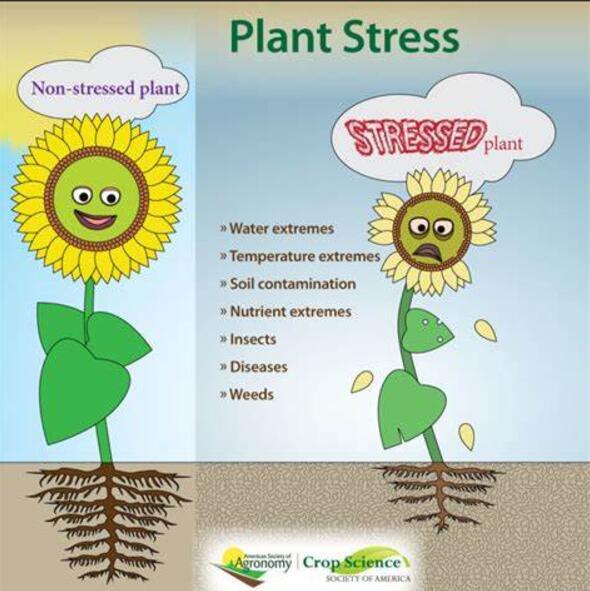
Plant Stress welcomes high-quality manuscripts related (but not limited) to interactions between plants and:
Lack of water (drought) and excess (flooding),
Salinity stress,
Elevated temperature and/or low temperature (chilling and freezing),
Hypoxia and/or anoxia,
Mineral nutrient excess and/or deficiency,
Heavy metals and/or metalloids,
Plant priming (chemical, biological, physiological, nanomaterial, biostimulant) approaches for improved stress protection,
Viral, phytoplasma, bacterial and fungal plant-pathogen interactions.
The journal welcomes basic and applied research articles, as well as review articles and short communications. All submitted manuscripts will be subject to a thorough peer-reviewing process.




 京公网安备 11010802042870号
京ICP备2023020795号-1
京公网安备 11010802042870号
京ICP备2023020795号-1

 分享
分享
 求助内容:
求助内容: 应助结果提醒方式:
 扫码关注我们
