N.Y. Kim , N.H. Kim , M.K. Razali , H.M. Lee , M.S. Joun
{"title":"Analytical and numerical evaluation of the relationship between elongation calibration function and cyber standard tensile tests for ductile materials","authors":"N.Y. Kim , N.H. Kim , M.K. Razali , H.M. Lee , M.S. Joun","doi":"10.1016/j.matdes.2025.113851","DOIUrl":null,"url":null,"abstract":"<div><div>Cylindrical tensile testing is critically reviewed focusing on the gage length per diameter (GLPD) and its effect on the elongation. Flow behaviors and patterns of representative cold forging materials of SCM435, SWCH45F, S25C, SWCH10A, SUS304, A6061, and ESW105 are revealed focusing on accurately predicting their tensile tests with various GLPDs using the combined elastoplastic FEM and tensile test method (EP_CFTM). A GLPD-elongation curve, called numerical elongation calibration curve, is numerically constructed, revealing that the elongation of ESW105 changes around 22.1% when the GLPD changes from 3.98 to 5. A concept of cyber standard tensile test (CSTT) of the numerical specimen with a fixed GLPD of five, based on finite element method (FEM) with accurate flow functions, is proposed to improve the objectivity of tensile testing of circular specimens. The CSTT removes the effect of the gage length of the cylindrical tensile test on the tensile testing results. A novel analytical elongation calibration function is presented and numerically validated. This function simply maps an experimental tensile test to the analytical tensile test of the specimen with arbitrary GLPD.</div></div>","PeriodicalId":383,"journal":{"name":"Materials & Design","volume":"253 ","pages":"Article 113851"},"PeriodicalIF":7.9000,"publicationDate":"2025-05-01","publicationTypes":"Journal Article","fieldsOfStudy":null,"isOpenAccess":false,"openAccessPdf":"","citationCount":"0","resultStr":null,"platform":"Semanticscholar","paperid":null,"PeriodicalName":"Materials & Design","FirstCategoryId":"88","ListUrlMain":"https://www.sciencedirect.com/science/article/pii/S0264127525002710","RegionNum":2,"RegionCategory":"材料科学","ArticlePicture":[],"TitleCN":null,"AbstractTextCN":null,"PMCID":null,"EPubDate":"2025/3/17 0:00:00","PubModel":"Epub","JCR":"Q1","JCRName":"MATERIALS SCIENCE, MULTIDISCIPLINARY","Score":null,"Total":0}
引用次数: 0
Abstract
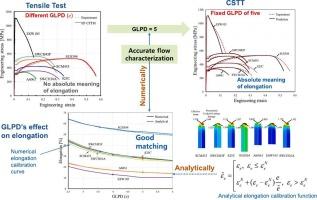
Cylindrical tensile testing is critically reviewed focusing on the gage length per diameter (GLPD) and its effect on the elongation. Flow behaviors and patterns of representative cold forging materials of SCM435, SWCH45F, S25C, SWCH10A, SUS304, A6061, and ESW105 are revealed focusing on accurately predicting their tensile tests with various GLPDs using the combined elastoplastic FEM and tensile test method (EP_CFTM). A GLPD-elongation curve, called numerical elongation calibration curve, is numerically constructed, revealing that the elongation of ESW105 changes around 22.1% when the GLPD changes from 3.98 to 5. A concept of cyber standard tensile test (CSTT) of the numerical specimen with a fixed GLPD of five, based on finite element method (FEM) with accurate flow functions, is proposed to improve the objectivity of tensile testing of circular specimens. The CSTT removes the effect of the gage length of the cylindrical tensile test on the tensile testing results. A novel analytical elongation calibration function is presented and numerically validated. This function simply maps an experimental tensile test to the analytical tensile test of the specimen with arbitrary GLPD.
期刊介绍:
Materials and Design is a multi-disciplinary journal that publishes original research reports, review articles, and express communications. The journal focuses on studying the structure and properties of inorganic and organic materials, advancements in synthesis, processing, characterization, and testing, the design of materials and engineering systems, and their applications in technology. It aims to bring together various aspects of materials science, engineering, physics, and chemistry.
The journal explores themes ranging from materials to design and aims to reveal the connections between natural and artificial materials, as well as experiment and modeling. Manuscripts submitted to Materials and Design should contain elements of discovery and surprise, as they often contribute new insights into the architecture and function of matter.



 京公网安备 11010802042870号
京ICP备2023020795号-1
京公网安备 11010802042870号
京ICP备2023020795号-1

 分享
分享
 求助内容:
求助内容: 应助结果提醒方式:
 扫码关注我们
