Yuan Ye , Yuyong Chen , Yu Zhang , Shuzhi Zhang , Jianfei Sun
{"title":"High-performing TiAl alloy with lamellar-network two-scale structure via semi-solid forging and its non-equilibrium solidification mechanism","authors":"Yuan Ye , Yuyong Chen , Yu Zhang , Shuzhi Zhang , Jianfei Sun","doi":"10.1016/j.matdes.2025.113828","DOIUrl":null,"url":null,"abstract":"<div><div>TiAl alloys are lightweight, high-strength, and have good mechanical properties at elevated temperatures, rendering them appealing for high-temperature applications. However, their difficult processing, and limited ductility at ambient temperatures have hindered their widespread application. Here, we report fabrication of a Ti-43Al-9 V-0.3Y alloy with a novel lamellar-network two-scale structure comprising an inner α<sub>2</sub>/γ lamellar colony + outer β<sub>0</sub>/γ phases via semi-solid forging process. The formation of this lamellar-network two-scale structure is elucidated from the perspective of the solute diffusion and redistribution occurring, and occurs due to liquid segregation and a non-equilibrium transition of L → β(β<sub>0</sub>) + α at late solidification. Compared to the as-cast alloy, the semi-solid forged alloy exhibits significant increases in elongation and tensile strength at room temperature and 800°C. The high density of dislocations and mechanical twins in the β<sub>0</sub>/γ phases and special α<sub>2</sub>/γ lamellae during tensile deformation effectively release the plastic deformation potential of the TiAl alloy at room temperature. Moreover, the abundant nano-twins in the β<sub>0</sub>/γ phase and γ dynamic recrystallization behavior at 800 ℃ significantly enhance the high-temperature plasticity. This approach and microstructure offer a promising solution to the engineering challenges posed by the low room-temperature ductility and limited hot-working ability of TiAl alloys.</div></div>","PeriodicalId":383,"journal":{"name":"Materials & Design","volume":"253 ","pages":"Article 113828"},"PeriodicalIF":7.9000,"publicationDate":"2025-05-01","publicationTypes":"Journal Article","fieldsOfStudy":null,"isOpenAccess":false,"openAccessPdf":"","citationCount":"0","resultStr":null,"platform":"Semanticscholar","paperid":null,"PeriodicalName":"Materials & Design","FirstCategoryId":"88","ListUrlMain":"https://www.sciencedirect.com/science/article/pii/S0264127525002485","RegionNum":2,"RegionCategory":"材料科学","ArticlePicture":[],"TitleCN":null,"AbstractTextCN":null,"PMCID":null,"EPubDate":"2025/3/15 0:00:00","PubModel":"Epub","JCR":"Q1","JCRName":"MATERIALS SCIENCE, MULTIDISCIPLINARY","Score":null,"Total":0}
引用次数: 0
Abstract
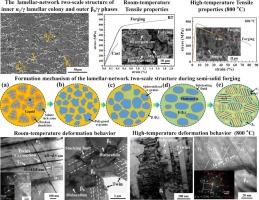
TiAl alloys are lightweight, high-strength, and have good mechanical properties at elevated temperatures, rendering them appealing for high-temperature applications. However, their difficult processing, and limited ductility at ambient temperatures have hindered their widespread application. Here, we report fabrication of a Ti-43Al-9 V-0.3Y alloy with a novel lamellar-network two-scale structure comprising an inner α2/γ lamellar colony + outer β0/γ phases via semi-solid forging process. The formation of this lamellar-network two-scale structure is elucidated from the perspective of the solute diffusion and redistribution occurring, and occurs due to liquid segregation and a non-equilibrium transition of L → β(β0) + α at late solidification. Compared to the as-cast alloy, the semi-solid forged alloy exhibits significant increases in elongation and tensile strength at room temperature and 800°C. The high density of dislocations and mechanical twins in the β0/γ phases and special α2/γ lamellae during tensile deformation effectively release the plastic deformation potential of the TiAl alloy at room temperature. Moreover, the abundant nano-twins in the β0/γ phase and γ dynamic recrystallization behavior at 800 ℃ significantly enhance the high-temperature plasticity. This approach and microstructure offer a promising solution to the engineering challenges posed by the low room-temperature ductility and limited hot-working ability of TiAl alloys.
期刊介绍:
Materials and Design is a multi-disciplinary journal that publishes original research reports, review articles, and express communications. The journal focuses on studying the structure and properties of inorganic and organic materials, advancements in synthesis, processing, characterization, and testing, the design of materials and engineering systems, and their applications in technology. It aims to bring together various aspects of materials science, engineering, physics, and chemistry.
The journal explores themes ranging from materials to design and aims to reveal the connections between natural and artificial materials, as well as experiment and modeling. Manuscripts submitted to Materials and Design should contain elements of discovery and surprise, as they often contribute new insights into the architecture and function of matter.



 京公网安备 11010802042870号
京ICP备2023020795号-1
京公网安备 11010802042870号
京ICP备2023020795号-1

 分享
分享
 求助内容:
求助内容: 应助结果提醒方式:
 扫码关注我们
