{"title":"Laser cladding Ni-based WC/MoS2 composite coatings: Particle competition mechanism and tribological performance","authors":"Kepeng Huang , Changjiang Zheng , Zexi Chen, Dayou Wu, Xuemei Yi","doi":"10.1016/j.matdes.2025.113868","DOIUrl":null,"url":null,"abstract":"<div><div>To develop a highly wear-resistant coating with self-lubricating characteristics, this study reports the use of laser cladding to fabricate WC/MoS<sub>2</sub> composite coatings on the surface of 65Mn steel plates. Here, we investigated the effects of different laser powers and MoS<sub>2</sub> contents on the phase composition, phase distribution, microstructure, and friction/wear properties of the coatings, focusing on heat and element competition mechanisms, as well as the wear mechanism of the Ni-based WC/MoS<sub>2</sub> composite coatings. The results show that compared with MoS<sub>2</sub>, WC remains disadvantaged in terms of heat competition in the molten pool. However, during MoS<sub>2</sub> thermal decomposition, the free Cr atoms in the pool are also captured, not only changing the type and morphology of the M<sub>x</sub>C<sub>y</sub> carbides and inhibiting WC heat damage but also resulting in a decreased content of M<sub>x</sub>C<sub>y</sub> carbides within the coating. When a significant amount of Cr<sub>x</sub>S<sub>y</sub> gathers on the coating surface, a stable and continuous lubricating film is formed, allowing the coating to balance the wear resistance with lubrication.</div></div>","PeriodicalId":383,"journal":{"name":"Materials & Design","volume":"253 ","pages":"Article 113868"},"PeriodicalIF":7.9000,"publicationDate":"2025-05-01","publicationTypes":"Journal Article","fieldsOfStudy":null,"isOpenAccess":false,"openAccessPdf":"","citationCount":"0","resultStr":null,"platform":"Semanticscholar","paperid":null,"PeriodicalName":"Materials & Design","FirstCategoryId":"88","ListUrlMain":"https://www.sciencedirect.com/science/article/pii/S0264127525002886","RegionNum":2,"RegionCategory":"材料科学","ArticlePicture":[],"TitleCN":null,"AbstractTextCN":null,"PMCID":null,"EPubDate":"2025/3/22 0:00:00","PubModel":"Epub","JCR":"Q1","JCRName":"MATERIALS SCIENCE, MULTIDISCIPLINARY","Score":null,"Total":0}
引用次数: 0
Abstract
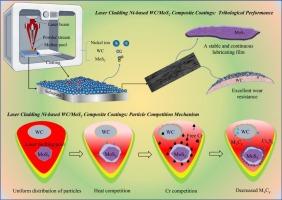
To develop a highly wear-resistant coating with self-lubricating characteristics, this study reports the use of laser cladding to fabricate WC/MoS2 composite coatings on the surface of 65Mn steel plates. Here, we investigated the effects of different laser powers and MoS2 contents on the phase composition, phase distribution, microstructure, and friction/wear properties of the coatings, focusing on heat and element competition mechanisms, as well as the wear mechanism of the Ni-based WC/MoS2 composite coatings. The results show that compared with MoS2, WC remains disadvantaged in terms of heat competition in the molten pool. However, during MoS2 thermal decomposition, the free Cr atoms in the pool are also captured, not only changing the type and morphology of the MxCy carbides and inhibiting WC heat damage but also resulting in a decreased content of MxCy carbides within the coating. When a significant amount of CrxSy gathers on the coating surface, a stable and continuous lubricating film is formed, allowing the coating to balance the wear resistance with lubrication.
期刊介绍:
Materials and Design is a multi-disciplinary journal that publishes original research reports, review articles, and express communications. The journal focuses on studying the structure and properties of inorganic and organic materials, advancements in synthesis, processing, characterization, and testing, the design of materials and engineering systems, and their applications in technology. It aims to bring together various aspects of materials science, engineering, physics, and chemistry.
The journal explores themes ranging from materials to design and aims to reveal the connections between natural and artificial materials, as well as experiment and modeling. Manuscripts submitted to Materials and Design should contain elements of discovery and surprise, as they often contribute new insights into the architecture and function of matter.



 京公网安备 11010802042870号
京ICP备2023020795号-1
京公网安备 11010802042870号
京ICP备2023020795号-1

 分享
分享
 求助内容:
求助内容: 应助结果提醒方式:
 扫码关注我们
